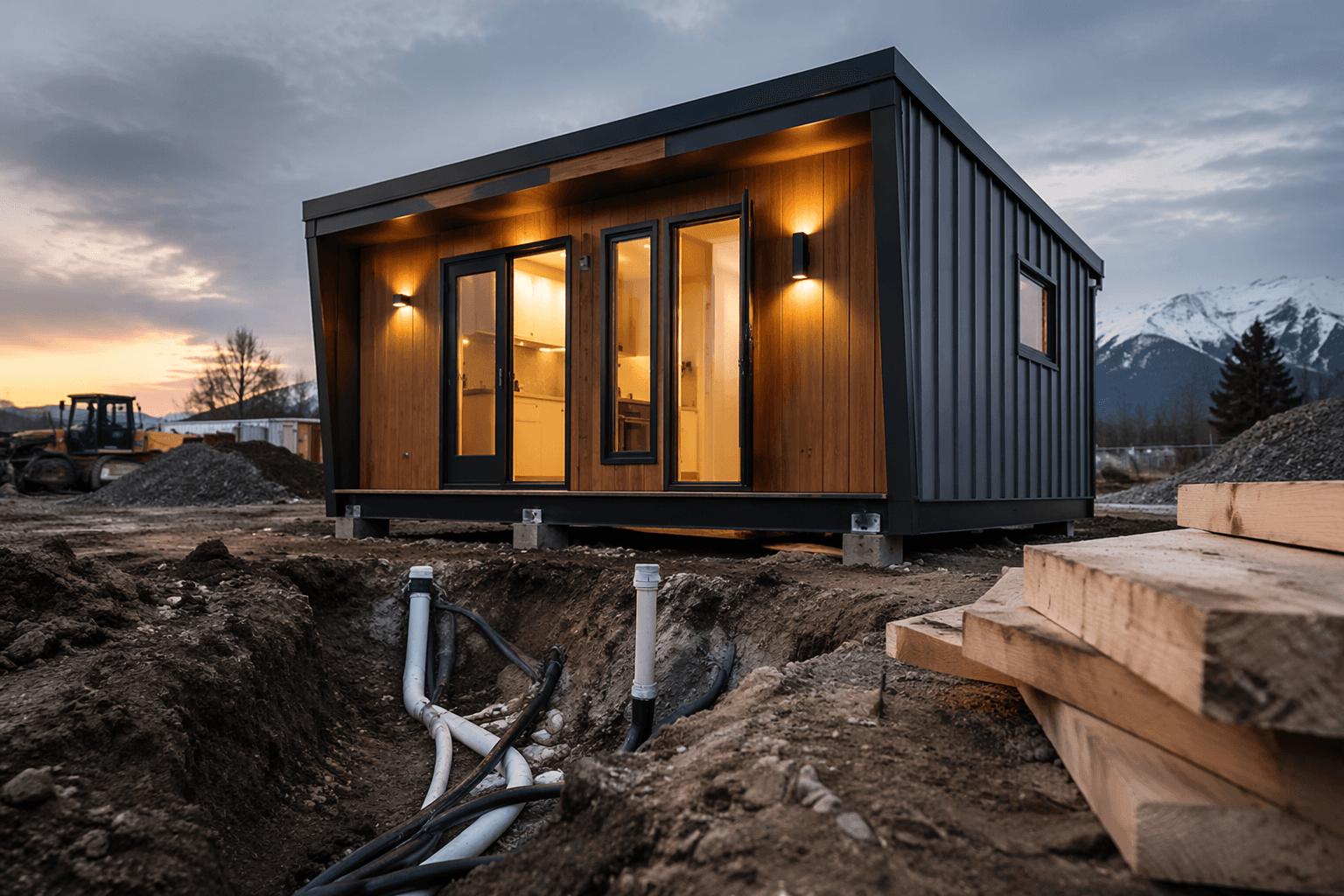
Mobi House's Chocolate tiny house plays with dark and light design
Mobi House’s 169-square-foot Chocolate tiny house turns dark-and-light contrast into a liveability test, not just a style move.

Mobi House’s Chocolate tiny house is a compact case study in whether a bold aesthetic can make an ultra-small home feel better to live in, not just better to photograph. Built on a THM 660 Lift&Go trailer and measuring 6.6 meters by 2.5 meters by 4 meters, with 17.59 square meters of area, it uses a dark exterior and a lighter interior to push visual contrast to the center of the design. The result is a micro-home that asks a practical question: in 169 square feet, does strong styling create depth and comfort, or does it simply dress up tight quarters?
Contrast as a livability tool
The Chocolate model leans into a dark, chocolate-like shell on the outside, then flips the mood inside with warmer, lighter surfaces. That move matters in a tiny house because color is not just decoration at this scale, it is spatial engineering. Light finishes can help a compact room feel brighter and less compressed, while the darker exterior gives the house a more defined identity than the neutral, all-white look common in many tiny homes.
That is where Chocolate becomes more than a visual novelty. In a conventional interior, minimalism often depends on sameness, with pale walls, pale cabinetry, and pale trim doing the work of hiding volume limits. Mobi House takes a sharper route here, using contrast to separate the eye from the physical boundaries of the home. The effect should help the interior feel more intentional, even if the footprint stays firmly in ultra-compact territory.
What fits inside 17.59 square meters
Mobi House says the MOBI MODUL SUNRISE series is built around comfort, simplicity, and modern solutions, with the possibility of future expansion. Inside Chocolate, the layout is divided into four practical zones: a lounge area ready for the owner’s own arrangement, a functional kitchenette, a modern bathroom, and a mezzanine for two people. That division is important because a tiny house succeeds or fails on circulation and clarity, not just on finishes.
The lounge being left open for personal arrangement suggests flexibility, but it also puts pressure on the owner to solve storage and day-to-day use thoughtfully. In a home this small, every piece has to earn its place. A light interior can help keep those functions from feeling visually stacked on top of one another, while the darker exterior keeps the overall package from reading like a temporary shed or a plain utility box.
Why the modular setup matters
Chocolate sits inside a broader modular platform rather than standing alone as a one-off design experiment. Mobi House says the MODUL SUNRISE can be expanded by connecting modules, and it describes the line as its most affordable project. The company also says the model works as a rental house for three people, and for up to seven people when two modules are connected.
That makes the design story bigger than one compact unit. A buyer looking at Chocolate is not just buying a small, attractive shell, but a system that can scale with changing needs. For tiny-house owners, that matters when comparing a fixed single-module micro-home with more conventional interiors that offer permanence but little flexibility. The modular approach gives the Chocolate concept a practical edge, especially for anyone thinking about guest use, rental income, or future expansion.
Everyday comfort versus visual novelty
The strongest argument for Chocolate is that it tries to make a tiny home feel calm instead of crowded. A dark exterior can give the house a more grounded presence on site, while the lighter interior works to soften the small footprint once inside. That combination is especially useful in a home with only 17.59 square meters to work with, because visual heaviness can make a small room feel even smaller.
Maintenance and resale appeal also come into the picture. Dark finishes can be striking, but they can also show dust, scuffs, and wear more readily than softer mid-tone schemes, so the appeal depends on how the materials age and how much upkeep the owner is willing to accept. On the resale side, the contrast-heavy design may stand out in a crowded market of beige or white tiny homes, which could help it look more premium to buyers who want personality rather than a blank interior. At the same time, the more distinctive the look, the more it depends on finding a buyer who shares that taste.
A builder with real production scale
Chocolate is also backed by a company with real volume behind it. Mobi House says it has completed more than 500 homes, and that its production uses Scandinavian spruce. That gives the project more weight than a showroom concept, because it comes from a manufacturer already working at scale and offering customization.
The company says its tiny houses can serve as year-round homes, summer houses, rental accommodation, student studios, bars, mobile shops, or offices. That range helps explain why Chocolate matters beyond design circles. A polished micro-home that looks sophisticated while still being road-ready has appeal not just for private buyers, but for anyone trying to use small-space housing as an asset, a rental, or a mobile business platform.
Road legality and market positioning
Mobi House says it is one of the few companies in Europe with full vehicle approval for a tiny house as a caravan, which allows legal and safe movement on European roads, along with full third-party liability and AC insurance during travel. The company says houses up to 3.5 tonnes can receive full approval as caravans. For buyers, that regulatory detail is as important as the styling, because mobility is part of the promise of a towable tiny house.
The price range also frames where Chocolate sits in the market. Mobi House says its tiny-house prices run from 93,972 PLN to 431,000 PLN, which places the brand across a wide commercial span rather than in a single boutique niche. Chocolate, with its dark-and-light contrast and compact build on the THM 660 Lift&Go frame, fits that strategy neatly: it is designed to look distinctive, but also to function as a legal, movable, year-round product.
In the end, Chocolate succeeds if the contrast does more than look clever. On a 169-square-foot floor plan, the real test is whether the lighter interior keeps the home feeling open, the dark exterior gives it presence, and the modular system makes the design feel useful over time rather than merely stylish at first glance.
This article was produced by Prism’s automated news system from verified source data, official records, and press releases, then run through automated quality and moderation checks before publishing. The system is built and supervised by the people who set the standards it runs under. Read our full AI policy.
Did this article answer your question?