Modern Tiny Home Designs Prove Minimalist Living Never Means Sacrificing Comfort
Five design moves are reshaping tiny homes from novelty campers into credible long-term housing, and the payoff for each one is measurable.
Here is a number worth tattooing on your floor plan before you build: the U.S. Department of Energy estimates that inefficient windows account for 25 to 30 percent of a home's heating and cooling energy load. In a structure under 400 square feet, that penalty hits disproportionately hard. It also points to the central argument driving modern tiny home design in 2026: every square inch you gain or lose carries amplified consequences, so the five design shifts reshaping the industry are not aesthetic preferences. They are decisions with measurable payoffs and real costs you can weigh before you commit.
What follows is a decision guide, not a trend roundup. For each shift, here is what it changes for your daily life, what it costs you in complexity and dollars, and where the regulatory landscape is likely to help or hurt you.
Open Floor Plans: Low Cost, Immediate Spaciousness Payoff
Removing interior partitions costs almost nothing at the design stage and pays off immediately in perceived scale. The logic is straightforward: a 200-square-foot room with no walls reads as a single coherent space; divide it into a "kitchen," a "living area," and a "bedroom nook" with half-walls or built-in dividers, and each zone shrinks to 40 to 66 square feet, which can feel almost impossible to furnish in any meaningful way.
Open plans also improve HVAC distribution. In a sealed box, a single mini-split or propane heater can reach the entire footprint without fighting partitioned air pockets. The tradeoff is acoustic privacy: odors and sound from cooking travel freely, so placement of the kitchen relative to the sleeping zone matters more than in a conventional home.
*Cost/Complexity tag: Low. No structural changes required at design stage; retrofit means removing non-load-bearing walls.*
Large Windows and Glazed Doors: Medium Cost, High Payoff, Real Thermal Risk
This is the trend with the widest gap between reward and risk, which makes it the most important one to get right. More glass means more daylight, better connection to the outdoors, and a strong psychological sense of spaciousness. It is also the design move most likely to destroy your heating bill if you get the specification wrong.
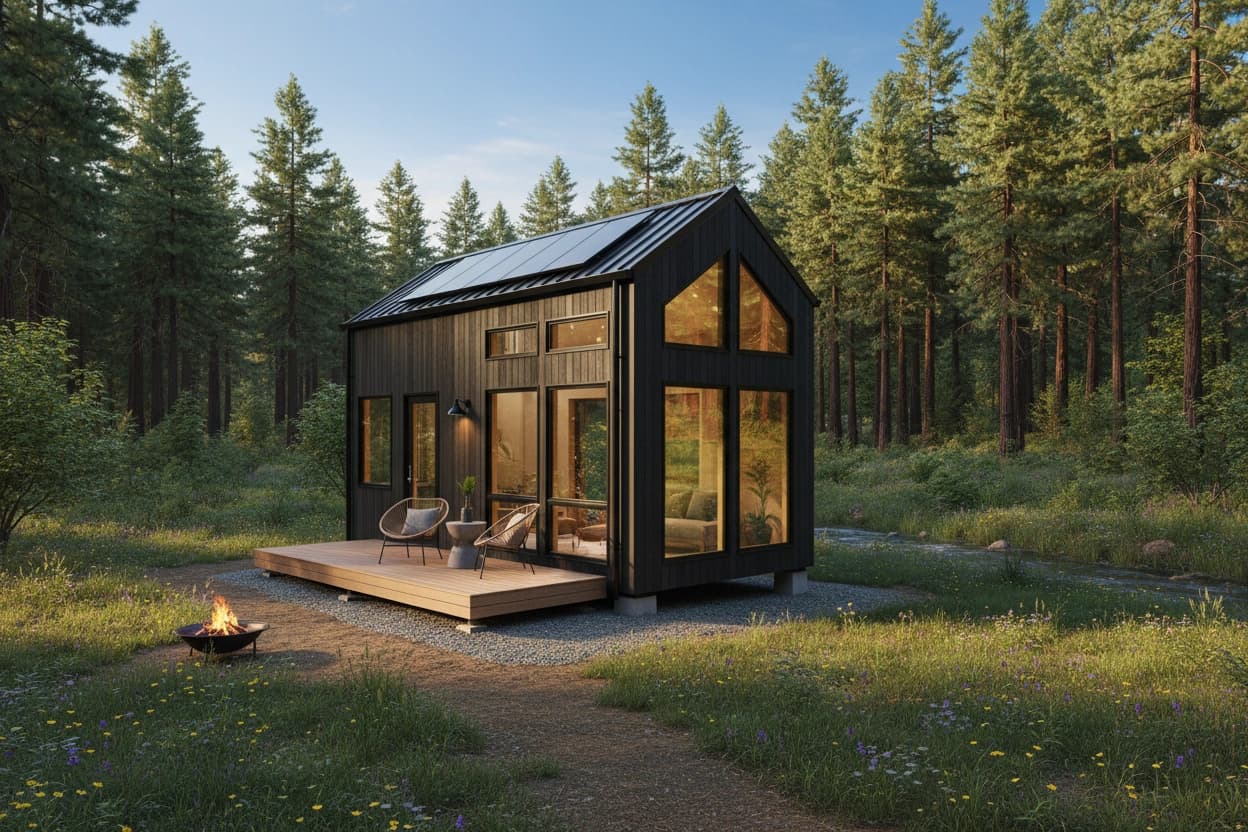
Low-E coatings can filter 40 to 70 percent of solar heat gain while still transmitting the full spectrum of visible daylight, according to the Department of Energy. In a tiny home, where the wall-to-floor ratio is already high, that coating is non-negotiable. Specify double or triple glazing with low-E treatment, orient primary glazing within 30 degrees of south for passive solar gain in cold climates, and budget for exterior shading (deep eaves or retractable panels) on any west-facing glass.
Done right, large windows reduce artificial lighting loads and improve wellbeing considerably when your entire living space is one room.
*Cost/Complexity tag: Medium to High. Budget $800 to $2,500 per window for thermally broken frames with low-E double glazing. Installation in a tiny home shell requires careful structural framing; do not treat this as a DIY shortcut.*
Multi-Functional Furniture: Medium Cost, Storage Volume Multiplier
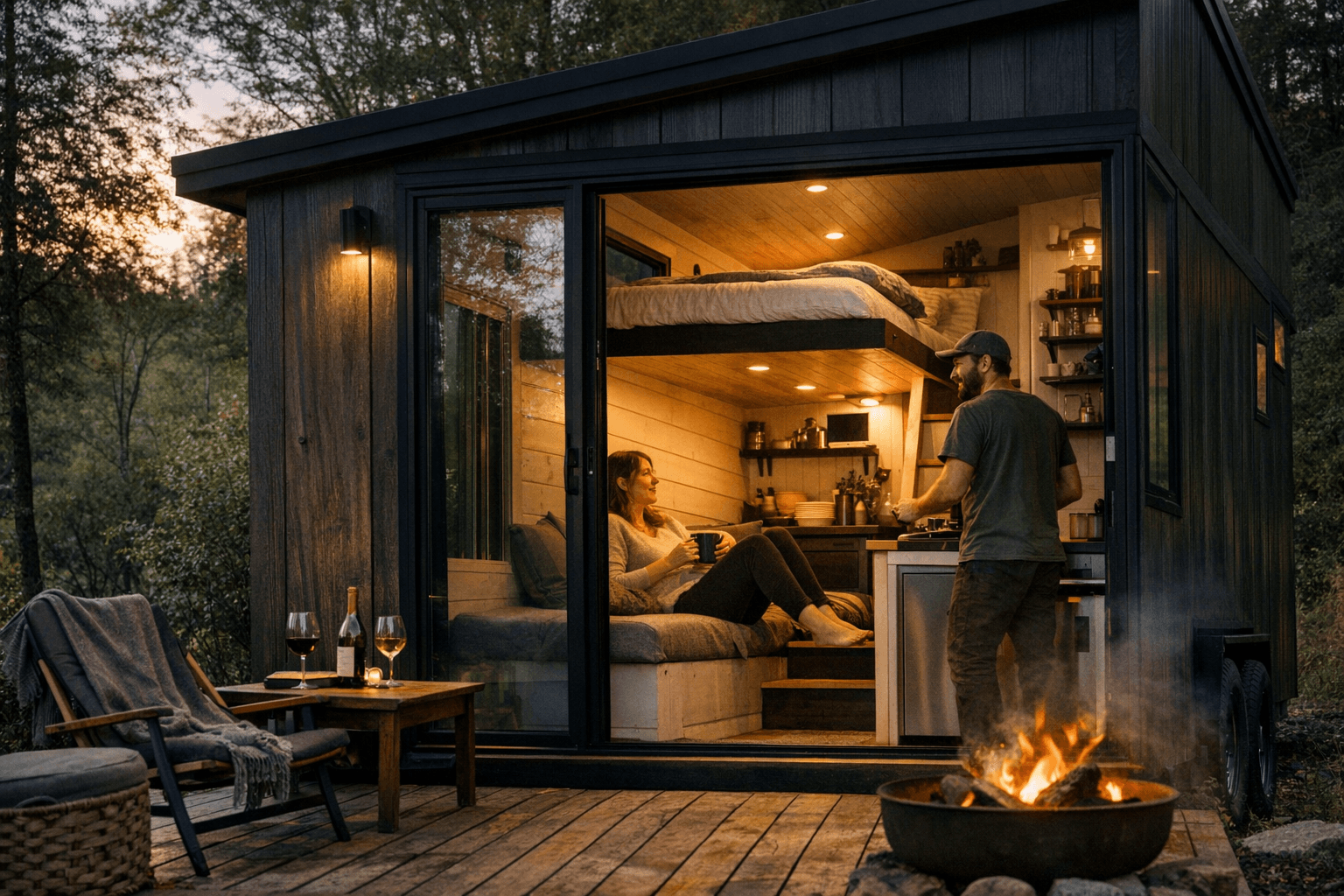
The arithmetic here is compelling. A Murphy bed with integrated shelving reclaims roughly 35 to 50 square feet of floor space during waking hours, space that a fixed queen bed occupies permanently. A fold-away dining table that drops from the wall seats four when open and adds zero footprint when closed. A lift-top coffee table with internal storage replaces a separate ottoman and a side console in one piece.
Wind River Built, one of the more experienced production builders in the sector, puts it plainly: multi-functional furniture is "practically a requirement" in a tiny home, not a novelty option. The design principle follows from that: if a piece serves only one function, it probably cannot justify its square footage.
The practical pitfall is build quality. Cheap Murphy mechanisms jam, fold-away hardware strips out, and integrated storage that is not properly ventilated grows mold. Spend more on mechanisms than on aesthetics; the mechanism is what you interact with every day.
*Cost/Complexity tag: Medium. Expect $1,200 to $4,000 for a quality Murphy bed with integrated storage. Fold-away wall tables run $300 to $900. Budget is better spent on hardware durability than surface finish.*
The "Copy This" Layout: A 240-Square-Foot Single-Level Floor
This configuration reflects what the industry's most livable single-level builds share in common:
[ Entry / Storage Bench ] [ Full Bath - Roll-in Shower ] | | [ Open Kitchen + Island ] [ Murphy Bed + Built-ins ] | | [ Fold-Away Dining Table ] [ South-Facing Glazed Wall ]
Key moves: the entry doubles as a mudroom with built-in bench storage; the kitchen island seats two and provides 8 to 12 linear feet of counter; the glazed south wall uses triple-pane low-E glass; the Murphy bed folds up to reveal a sitting area with a fold-away desk; and the bathroom is designed to wheelchair-turning-radius spec (60-inch diameter clearance) even if the current owner does not need it. That last detail is not optional if you intend to sell or finance through ADU programs.
Single-Level "Master-on-Main" Design: Low Cost, High Resale and Financing Leverage
The loft bedroom is the defining image of tiny house culture. It is also a significant barrier for the fastest-growing buyer demographic: downsizing adults over 55. A ladder to a sleeping loft is a non-starter for anyone with joint issues, and it categorically disqualifies a structure from accessible housing programs and most ADU financing pathways.
Single-level design does not cost more to build. The floor plan simply allocates sleeping space at grade rather than overhead. What it unlocks is substantial: permanently sited tiny homes on foundations with accessible layouts can qualify for ADU incentives that California, Oregon, Washington, and a growing number of municipalities have attached to affordability programs. Access to those programs shifts the financing picture from cash-only or personal loan territory toward something closer to conventional mortgage treatment.
*Cost/Complexity tag: Low. This is a design decision, not a budget line. Single-level plans typically require a wider footprint (minimum 14 to 16 feet wide) to fit sleeping and living at grade, which matters for THOW configurations but rarely for foundation builds.*
Modular and Prefab Manufacturing: Variable Cost, Lower Risk Profile
Factory-built tiny homes have moved well past the park-model aesthetic. Prefab construction means climate-controlled assembly, consistent quality control, and predictable lead times. Full-installation prefab ADUs in Vermont are running $185,000 to $350,000 as of 2026; urban West Coast markets like Seattle, Portland, and California cities run $150 to $400 per square foot depending on finish level.
The less-discussed advantage of prefab is what it does to building science. A tiny home assembled in a factory can be air-sealed and insulated to a standard that is genuinely difficult to achieve on a job site. Energy recovery ventilators, which are essential in an airtight small structure to prevent moisture buildup, are easier to integrate during factory assembly than to retrofit in the field.
*Cost/Complexity tag: Variable. Prefab reduces on-site complexity and risk substantially but does not guarantee lower total cost versus site-built. Always get full installed price quotes, not factory-floor price quotes.*
The Policy Bottleneck Holding All of This Back
None of these design advances matter at scale unless financing and code classification keep up. The core problem is that tiny homes built to residential design standards are still being shoehorned into RV or park-model regulatory categories in many jurisdictions. That classification blocks access to standard mortgage products, ADU incentive programs, and conventional building code treatment, even when the structure sits on a foundation and is built to IRC standards.
The momentum is real: single-level, foundation-sited tiny homes with accessible layouts are the typology that planners and lenders are most willing to engage. Builders who target that configuration are positioning their product for a market where affordability pressure is only intensifying and where municipal ADU reform is steadily unlocking new infill sites in cities across the country.
The design ingenuity is already here. The question is whether the regulatory infrastructure catches up fast enough to let it scale.
This article was produced by Prism’s automated news system from verified source data, official records, and press releases, then run through automated quality and moderation checks before publishing. The system is built and supervised by the people who set the standards it runs under. Read our full AI policy.
Did this article answer your question?