New Zealand tiny home Maple packs two bedrooms into 366 square feet
Maple turns 366 square feet into a credible full-time home, with two bedrooms and a layout that makes tiny-house tradeoffs feel smaller.

A tiny home that tries to live like a real house
Maple does not read like a compromise. Built by Hawke’s Bay-based Tiny Timber Homes, the 8-meter by 2.6-meter house rides on a triple-axle trailer and still manages to hold two bedrooms, a downstairs living plan, and the essentials for full-time living in 366 square feet. That combination is what makes it stand out in the tiny-house world: it is not simply cute, movable, or compact, it is trying to answer the harder question of whether a small home can function as an everyday residence.
That is the benchmark Maple reaches for, and it reaches for it with design discipline rather than gimmicks. Instead of leaning on one dramatic feature, it uses a series of careful moves that make the whole house feel more complete, from a proper kitchen and dining area to storage that does not disappear into the walls.
The layout does the heavy lifting
The strongest thing about Maple is how little of the plan feels wasted. The downstairs arrangement moves from kitchen to lounge to dining to bathroom in a way that feels intentional, which matters more in a tiny home than in almost any other kind of build. In a lot of family-friendly tiny homes, the floor plan has to sacrifice either circulation or daily comfort, and you feel that loss every time two people need to move through the same space at once. Maple avoids that trap by giving each zone a clear job.
The L-shaped kitchen helps the house behave like a place where real meals can happen, not just coffee and reheated leftovers. A standalone dining space is another small but important decision, because it gives the home a social center that is separate from the lounge. Multiple storage solutions add to that sense of livability, especially in a home this size, where a missing cupboard or awkward nook can become the difference between order and clutter.
The two lofts are where the design becomes more flexible. They give couples or families options for sleeping, work, or storage, and they help explain how Maple can fit two bedrooms into such a small footprint without feeling like a puzzle box. That flexibility is the real story here: not that the house has two bedrooms, but that the bedrooms are part of a plan that still leaves room for daily routines.
Warm materials keep the house from feeling spartan
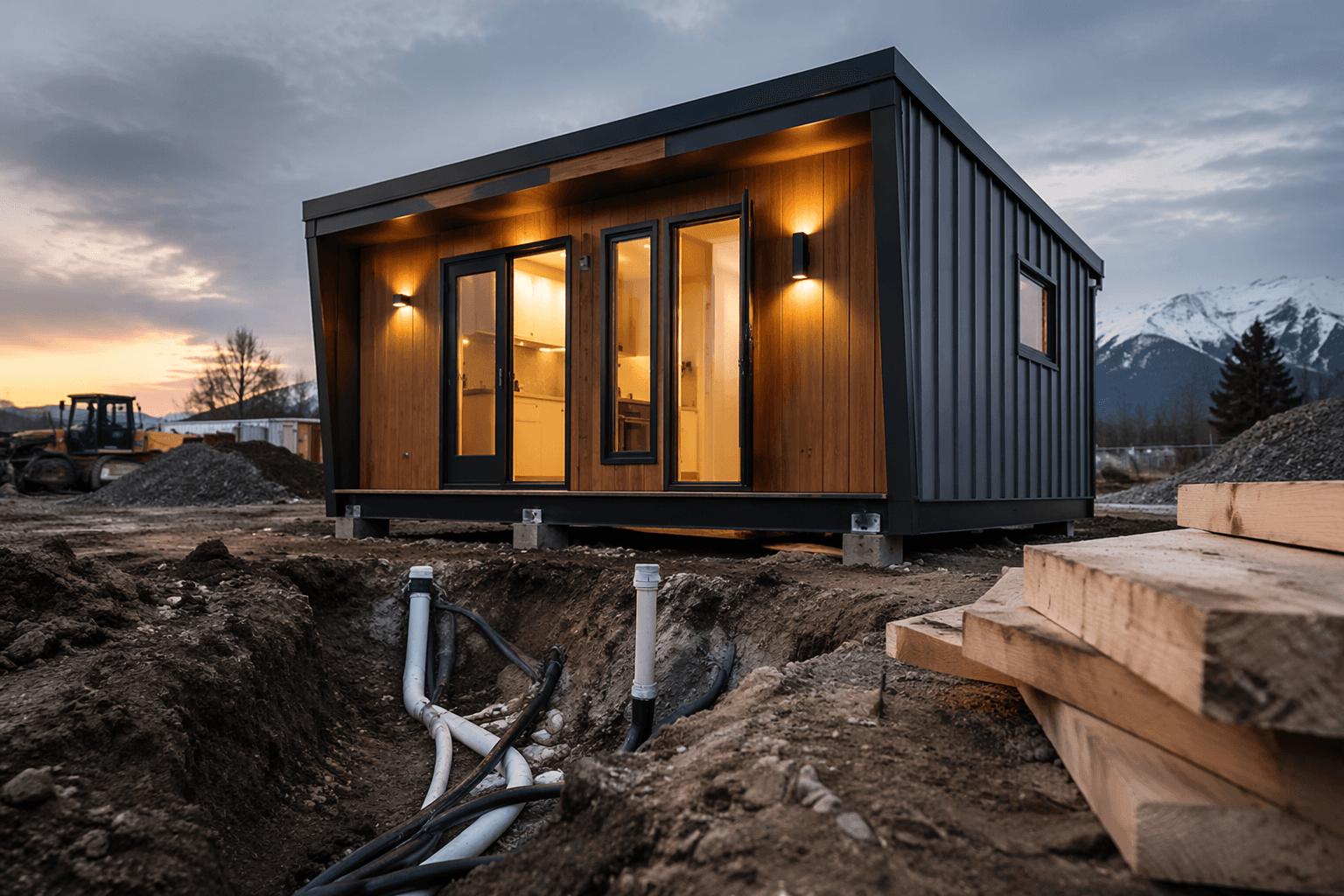
Maple also avoids the cold, stripped-back look that sometimes shadows the tiny-house category. Its black corrugated metal exterior and warm wood siding create a contrast that feels modern and rustic at the same time, while French doors pull in light and reinforce the cabin-like mood. The result is a house that feels lived-in from the outside in, not just engineered for efficiency.
That choice of finish matters because many compact homes lean so hard on minimalism that they start to feel temporary, even when they are meant to be permanent. Maple takes the opposite route. It uses natural materials and a softer visual language to signal permanence, comfort, and warmth, which is exactly what full-time buyers are usually looking for when they step into a tiny house for the first time.
Why this design language fits New Zealand
Maple also makes sense in a country where housing pressure and outdoor living shape the conversation around small homes. New Zealand’s high housing costs have helped create a strong market for tiny-house builders, and the country’s outdoor culture makes compact, mobile living feel less like a fringe experiment and more like a practical way to stay connected to place. Maple sits squarely inside that context.
The broader data backs up that pressure. Stats NZ’s 2025 housing report says affordability remains an issue for many households in Aotearoa New Zealand, and the New Zealand Treasury’s housing-affordability inquiry says home ownership has been declining for many years while low-income households face serious rental affordability pressures. Against that backdrop, a home like Maple is not just a design showcase. It is part of the ongoing search for a housing form that is smaller, more mobile, and more attainable without giving up the feeling of a real home.
The rules now recognize homes like this
The regulatory picture helps explain why a tiny house on wheels can be discussed as a primary residence rather than a novelty build. The Ministry of Business, Innovation & Employment’s tiny-house guidance says a tiny house on wheels may be treated as a building if it is immovable and occupied on a permanent or long-term basis. That distinction matters for anyone trying to live full-time in a compact footprint, because it gives legal and planning language to homes that are designed to stay put.
The guidance has also been refined over time, with versions released in November 2021, September 2023, November 2024, and October 2025. That update history suggests the category is still settling into place, and builds like Maple help show why. Once a tiny house starts offering two bedrooms, a proper kitchen, a defined dining area, and storage that supports daily life, it stops looking like a weekend shelter and starts looking like housing.
The builder behind Maple
Tiny Timber Homes itself is a family-run business based in Hawke’s Bay, with a contact address in Maraekakaho, Hastings. The company records show Tiny Timber Homes Limited was incorporated on 9 June 2014, and the team says Phil Edwards’ tiny-house idea grew out of building garden sheds in 2013 before evolving into tiny homes on wheels. That origin story fits the brand’s practical focus: the work started with making compact structures that solved everyday problems, then grew into a larger response to housing demand and mobility.
That trajectory is part of Maple’s appeal. It feels less like a design stunt and more like the outcome of a builder learning how to squeeze real utility out of limited square footage. The house does not rely on spectacle to prove its point. It proves it by making 366 square feet behave like a home that can actually be lived in.
Maple’s lesson is simple, but it lands hard: in a tiny house, livability is not about how much you fit in, it is about how convincingly the rooms work once you are inside them. Here, the answer is clear enough to settle the question the moment you step through those French doors.
This article was produced by Prism’s automated news system from verified source data, official records, and press releases, then run through automated quality and moderation checks before publishing. The system is built and supervised by the people who set the standards it runs under. Read our full AI policy.
Did this article answer your question?