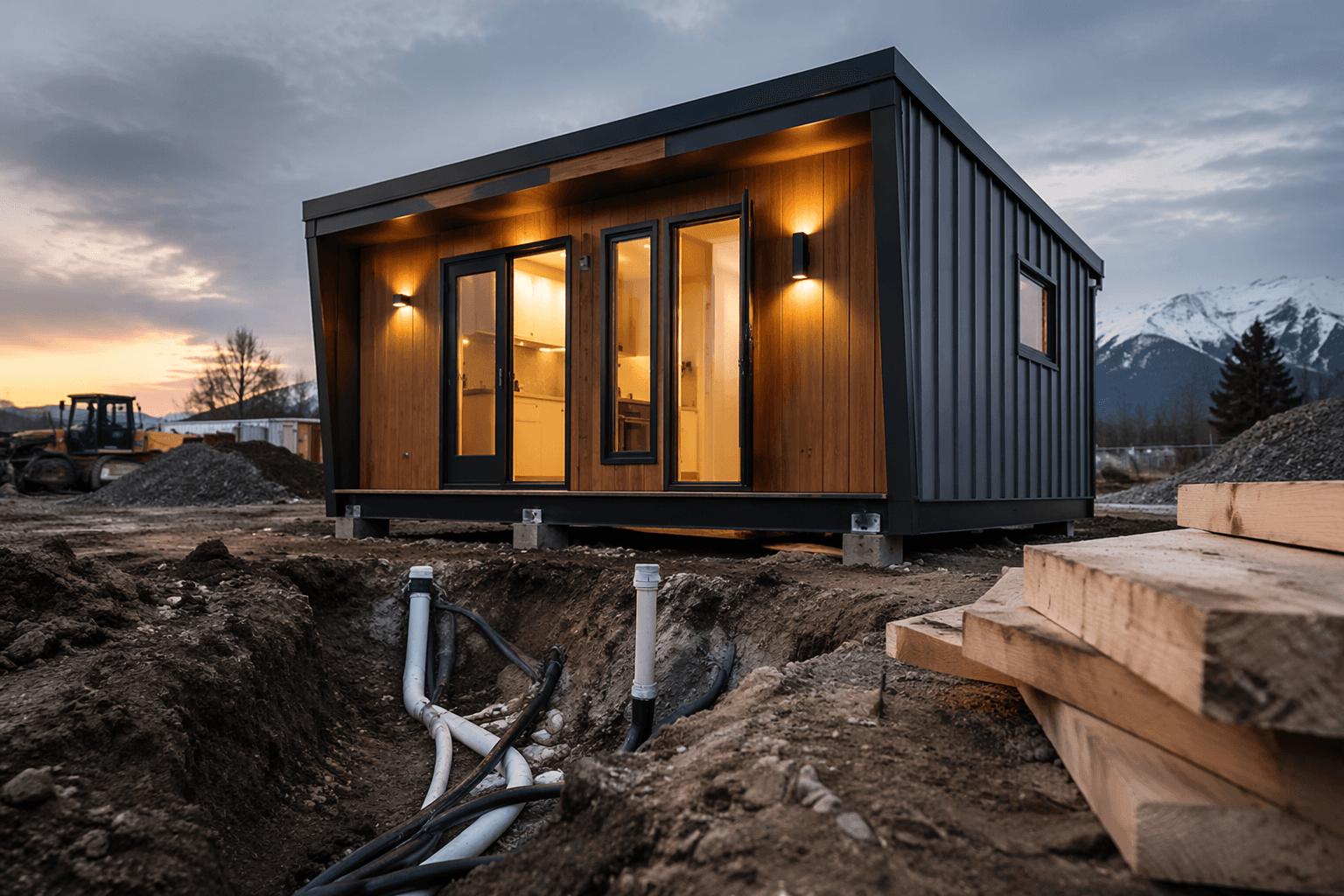
Norway’s Meili tiny house blends warmth, space, and practicality
Meili squeezes a real home into 14 square meters with a loft, sofa bed, and built-ins that keep small-space living calm and workable.

Forward Homes built Meili, a 23-foot-by-8-foot-by-12-foot tiny house in Norway, for couples and small families who want a year-round home with actual routine built into it, not just a pretty shell for weekends. The 14 m² microhome tries to feel larger through restraint: raised ceilings, birch veneer, large windows, and an open plan do most of the heavy lifting.
A small footprint with real domestic range
The first thing Meili gets right is how much life it is designed to hold. The house sleeps up to three people through a ground-floor sofa bed and a loft bedroom, which gives the layout flexibility without crowding the main level. The living room is not treated as leftover space, either. It becomes the central social zone, with a convertible sofa and seating for six, a choice that makes the home feel closer to a compact apartment than a stripped-down cabin.
That same practical thinking carries into the kitchen, which is full-featured. When food prep, dining, and lounging all share one open volume, the plan has to stay calm and legible, and Meili leans hard into that discipline.
The built-ins do the real work
Meili’s smartest move is not one single feature, but the way the pieces connect. A rotatable table doubles as a dining table and desk, and the house includes a custom fitted seating bench, built-in bookshelves, and a wardrobe, all developed by the company’s own architects and cabinetmakers. That kind of integration reduces visual clutter and gives each square foot a clear job, which is exactly what compact homes need if they are going to work day after day.
The utility package follows the same logic. The house can be fitted with composting or incinerating toilet options, a solar off-grid solution, and a water tank, while flooring choices include Forbo linoleum or parquet. The house can be configured for different levels of self-sufficiency and finish, depending on whether you are leaning toward off-grid living, a parked permanent setup, or a more conventional utility connection.
There is also a deliberate warmth in the way the interior is finished. Warm wood tones keep the space from feeling stark, while the birch veneer surfaces help carry light through the room without turning the place cold or clinical.
A compact form built for Norwegian rules
The legal and practical context is just as important as the layout. Forward Homes’ microhouses are architect-designed for Norwegian conditions, built to TEK17, and eligible for a simplified building application. Under the July 2023 rules, microhouse guidance allows up to 30 m² BRA, one main floor with lofts allowed, and a maximum height of 4.5 meters. Meili’s 14 m² footprint sits comfortably inside that framework.
That positioning is reinforced by the company’s broader build model. The homes are designed in Norway and produced by experienced craftsmen in Poland before being delivered by truck or trailer. Delivery takes 14 to 18 weeks, and the company’s main pricing starts from 855,000 kroner, while Meili itself is listed from 990,000 kroner including VAT. Managing director Robin Sime Espeland leads a company that develops, designs, and manufactures microhouses for the Norwegian market and climate.
The mobility question still matters, and Forward Homes does not ignore it. Wheel-mounted houses under 3.5 tons can be towed by a personal car, depending on configuration. That detail shows the split inside the tiny-house world in Norway: some buyers want a movable unit, while others want a home that can be tied into building-permit systems, utilities, and more permanent use.
What this kind of tiny house teaches builders and buyers
For anyone studying small-space design, Meili offers a useful template. It does not try to win attention with quirky shapes or novelty gadgets. Instead, it relies on a handful of smart solutions that make daily life easier:
- A loft plus a ground-floor sofa bed to stretch sleeping capacity without bloating the plan.
- A rotatable table that can switch between dining and desk use.
- Built-ins for books, clothing, and seating so loose furniture does not swallow the room.
- Light-toned birch veneer and large windows to enlarge the feel of a 14 m² interior.
- Off-grid and utility options that let the same shell serve different living setups.
Statistics Norway tracks permits, starts, and completions for dwellings, while Trading Economics put Norway building permits at 1,164 units in May 2026, down from 1,710 in April 2026. In that context, Meili offers a 14 m² home with TEK17 compliance, a simplified application path, and a layout that can carry sleeping, work, dining, and storage.
This article was produced by Prism’s automated news system from verified source data, official records, and press releases, then run through automated quality and moderation checks before publishing. The system is built and supervised by the people who set the standards it runs under. Read our full AI policy.
Did this article answer your question?