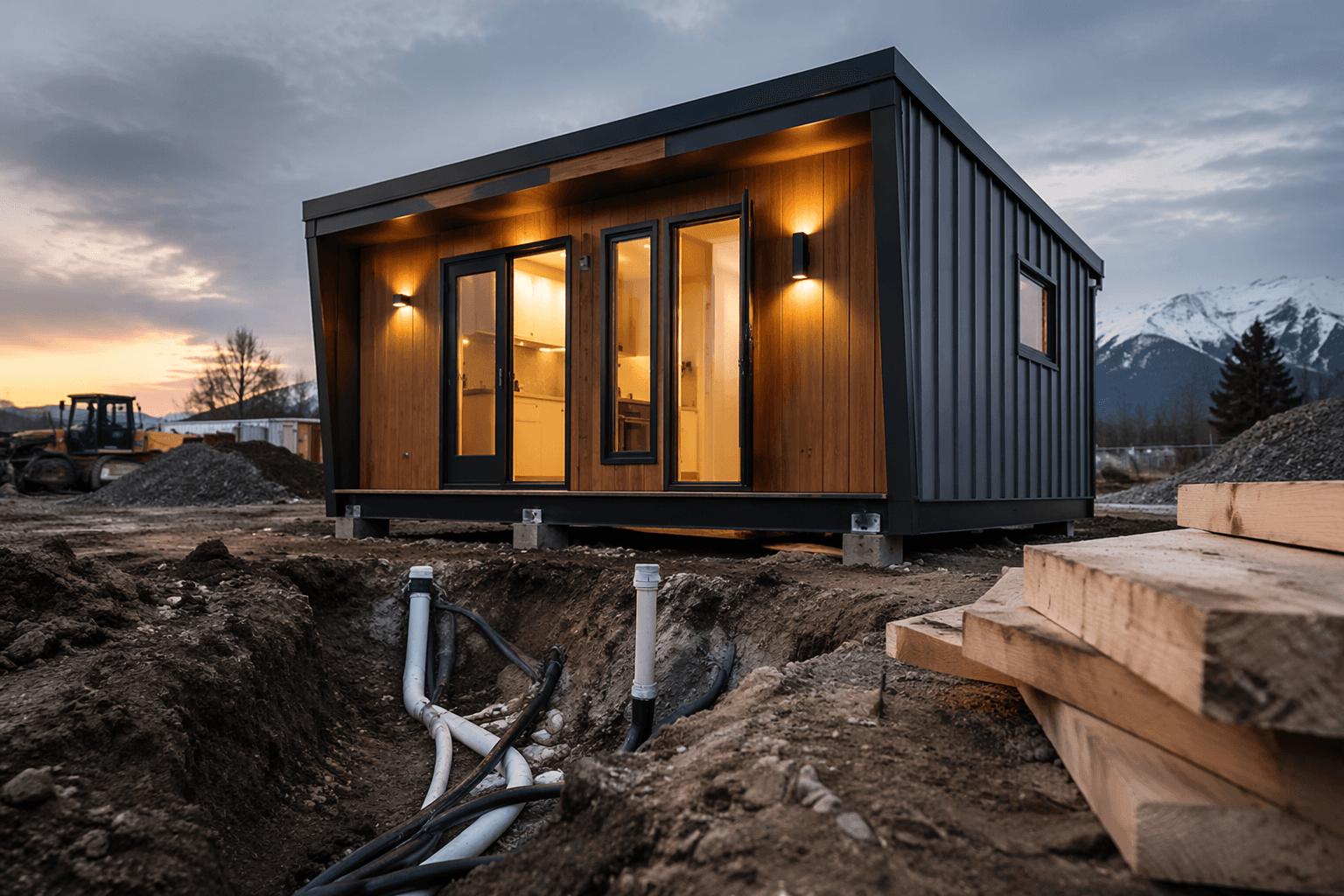
Ortsan Outdoor’s Mini House unfolds from caravan into tiny home
Ortsan’s Mini House shrinks to a 2.10 m by 4.00 m towable shell, then opens into a 20 m² 2+1 home. The real test is whether the accordion move beats a standard slide-out.

Ortsan Outdoor’s Mini House tries to solve one of tiny living’s oldest problems: how to stay towable without giving up real interior space. In travel mode, it is a 2.10 m by 4.00 m single-axle caravan, but once parked it opens into a 20 m² 2+1 living area. That is the promise behind the accordion-style expansion, and it is the detail that makes this release more than a novelty.
A tiny shell that turns into a bigger living room
The Mini House sits in a category between travel trailer and tiny house, and that ambiguity is part of the appeal. Ortsan positions it as a compact unit that can be moved on the road without forcing buyers to settle for the cramped feel that usually comes with small towables. When expanded, the layout is meant to feel closer to a proper small home, with a separate bedroom and a functional living room rather than one all-purpose box.
That interior jump is the whole point. Instead of depending on a fixed floor plan, the design expands like an accordion, increasing usable volume after arrival. For tiny-house readers, that matters because it attacks the movement’s most stubborn tradeoff head-on: mobility versus comfort. A smaller trailer is easier to move and easier to store, but it often gives up the very livability that makes a tiny home feel like a home.
What Ortsan is actually selling
Ortsan’s product page puts a hard number on the package: 890,000 TL before VAT and shipping. It also says the Mini House is made to order and O2 certified for international transport and highway standards, which tells you the company is pitching this as a legitimate road-going product rather than an experimental one-off.
The spec list pushes the home side of the equation hard. Ortsan says the Mini House includes an integrated off-grid solar-energy system, one bedroom, one functional living room, a four-season air-conditioning system, a Webasto diesel heater, a modern bathroom with toilet and sink, 200-liter clean-water and 200-liter wastewater tanks, a built-in kitchen counter, a 90-liter refrigerator, and integrated TV and multimedia equipment. The companion MSN version adds 470 watts of solar power, a 200Ah lithium battery, an inverter, a 200-liter freshwater tank, and a matching gray-water tank, reinforcing the off-grid pitch.
That mix matters because it shows the company is not treating the expansion mechanism as the main product. The mechanism is only useful if the rest of the unit supports real use. A larger footprint means little if the plumbing, climate control, energy storage, and storage capacity are thin. Here, Ortsan is clearly trying to make the open layout feel self-contained rather than improvised.
Accordion expansion versus the usual tiny-home tricks
The key question for anyone who lives in this world is not whether the Mini House is clever. It is whether the accordion-style opening solves space better than the usual slide-out or foldout approach. Slide-outs often buy volume, but they can bring mechanical complexity, sealing concerns, and extra weight. Foldouts can be fast and dramatic, but they sometimes feel temporary, especially when weatherproofing and interior continuity become part of daily life.
The Mini House’s appeal is that it aims for a fuller transformation. Instead of a modest bump in square footage, it turns a travel-sized shell into a 20 m² home-like layout. That makes it especially interesting for buyers who want a towable unit but do not want to live in a space that still feels like a trailer once parked.

The practical tradeoffs are easy to see:
- Setup appears to be the central selling point, because the entire concept depends on fast deployment rather than long campsite assembly.
- Structural complexity is the obvious risk, because any expandable system has to stay durable, weather-tight, and easy to operate over time.
- Interior gain is the clear upside, since the parked layout offers a real 2+1 arrangement instead of a single cramped room.
- Best use cases likely include longer stays, seasonal living, and buyers who want one unit that can travel without becoming a permanent house.
That is why this design is more important as a format test than as a gadget. If the accordion movement holds up in the real world, it offers a cleaner answer to compact-living constraints than many fixed-shell tiny homes.
Part of a real expandable-trailer lineage
Ortsan’s Mini House is not appearing in a vacuum. Expandable caravans have been developing for years, and BeauEr’s French 3X travel trailer is one of the clearest precedents. Dwell reported that the 3X can triple in size in less than 60 seconds, growing from 43 square feet to 129 square feet, with room for a kitchen, bath, living area, and bedroom. Dwell also noted that a prototype built in 2011 is displayed at Germany’s Hymer Museum and that the model has been sold in Europe, China, Korea, and Canada, with plans for Australia and the United States.
That history helps place Ortsan’s Mini House in a small but meaningful design lane. The idea of creating more room on demand has already proved that it can capture attention, and the Mini House pushes that logic into a different mechanism and market context. The accordion-style opening gives Ortsan a distinct identity, but the deeper lineage is what makes the concept feel credible rather than purely speculative.
Why the timing matters in Turkey
The Mini House arrives amid a busy caravan and tiny-house scene in Turkey, where demand for compact, mobile living is clearly visible. KARAVANIST 2026 ran from January 10 to 18, 2026 at Tüyap Fair Convention and Congress Center in Istanbul, and it was billed as Türkiye’s largest thematic exhibition focused on caravan, tiny house, outdoor, and camping life. That kind of event does more than showcase products; it signals that buyers, builders, and suppliers are all moving in the same direction.
For Ortsan, that context matters because it suggests a market ready to judge more than aesthetics. In a scene where towability, off-grid readiness, and usable space all carry weight, the Mini House has to prove it can be lived in, not just photographed. The accordion move is the headline, but the real measure is whether the expanded layout makes the trailer feel like a genuine small home without turning the road-going version into a compromise too far.
This article was produced by Prism’s automated news system from verified source data, official records, and press releases, then run through automated quality and moderation checks before publishing. The system is built and supervised by the people who set the standards it runs under. Read our full AI policy.
Did this article answer your question?