Quadrapol’s La Ruche stacks tiny living into a 10-square-meter tower
La Ruche stacks a kitchen, bath, and loft for two into 10 square meters, but its real advantage is a tiny footprint that favors fixed-site placement.

Quadrapol’s La Ruche takes tiny living up, not out, and that is what makes it interesting. Instead of stretching along a trailer frame like most compact homes, it stacks its rooms vertically into a 10-square-meter tower that is meant to sit lightly on a site. New Atlas says the result is a non-towable tiny house that sleeps two, but behaves more like a tightly engineered garden annex than a road-ready cabin.
A different answer to the tiny-house footprint problem
New Atlas published its look at La Ruche on June 19, 2026, and the story lands because the layout breaks from the usual elongated tiny-house formula. The model measures 2.17 meters long, 2.3 meters wide, and 4.12 meters high, with a total area of 10 square meters, or 107 square feet. Habitat Naturel described an earlier version as having a 4.9-square-meter footprint spread across two levels, which shows exactly where the space efficiency comes from: height, not length.
That vertical approach changes the entire siting conversation. A conventional trailer-style tiny house usually asks for a long, clear run of land and a vehicle-friendly setup, but La Ruche is non-towable and must be transported by truck. That makes it less of a wanderer’s home and more of a fixed-site unit, especially where land footprint matters more than mobility. If the question is whether tiny living can become smaller on the ground without feeling unusable, La Ruche is a serious case study.
What fits inside 10 square meters
The interior is spare, but not bare. Quadrapol fits a kitchen, bathroom, and sleeping space for one to two people into the plan, and the company presents the model as ready to live in. The kitchen includes an induction cooktop, sink, fridge, cabinetry, shelving, and a wall-mounted drop-down table for two, which keeps the eating area folded into the same compact zone as meal prep.
A curtain separates the kitchen from the bathroom, a reminder that this layout is built for efficiency rather than privacy-heavy full-time living. The bathroom holds a shower and toilet, so the core daily functions are all on board, but in very compressed form. Upstairs, a wooden ladder leads to the sleeping level, and that ladder can be stowed against the wall when it is not needed, which helps recover floor space below.

The upper bedroom is sized to fit a double bed, plus a storage unit and a netted shelf. That detail matters because storage is often where tiny houses fail their owners first, and La Ruche tries to squeeze in enough utility to keep the loft from feeling like a bare crawl space. The tradeoff is obvious, though: the more vertical the plan gets, the more the house depends on a ladder, careful movement, and a willingness to live with limited headroom and tightly controlled access.
Who this layout is really for
Quadrapol is not presenting La Ruche as a full-time suburban substitute. New Atlas frames it more as a guest house or vacation home than a main residence, and Quadrapol’s own positioning goes even wider, listing uses such as a permanent dwelling, house extension, second home, vacation rental, and student accommodation. That makes the audience clear: this is for buyers who want the smallest possible footprint without giving up the basics of a self-contained unit.
The design also tells you who may not love it. Two people can live here, but they will need to be comfortable with a ladder, a loft bedroom, and the kind of shared circulation that comes with a very compact one-room-plus-loft plan. If you value easy access, abundant storage, or the ability to move around without climbing, the vertical format will feel restrictive. If your priority is compressing a usable home into a small patch of ground, the plan starts to make real sense.
Materials, finish, and the feel of the build
Quadrapol gives La Ruche a timber frame with pine cladding on the outside, and spruce paneling with vinyl flooring inside. Those choices keep the package in familiar tiny-house territory, but the important point is how the materials support the idea of a clean, simple, low-friction structure. It reads less like a miniature cottage and more like a compact module designed to do its job without adding visual or structural bulk.
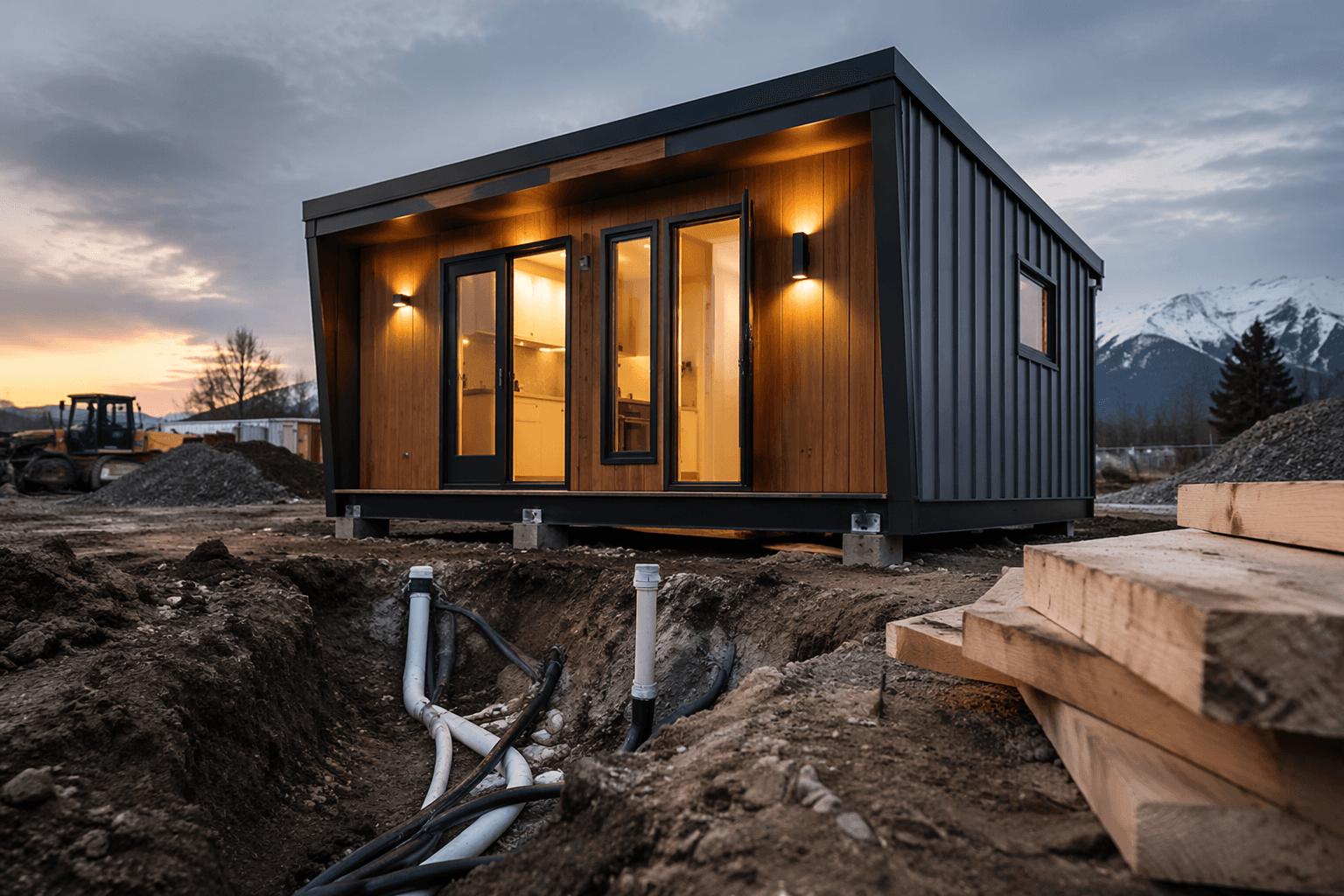
The company’s broader garden-studio range reinforces that approach. Quadrapol says those studios are easy to install on flat ground and can be connected to utilities, which helps explain why a form like La Ruche may work best in back gardens, tourism settings, or community-style projects where fast deployment matters. The company also says it has been building wooden homes since 2008, moved into tiny houses in 2014, and has delivered more than 600 lightweight homes and projects across Europe.
Price, paperwork, and the siting question
Habitat Naturel reported La Ruche at €27,200 TTC as a turnkey package with delivery included in metropolitan France, while also noting an autonomy option for water and energy priced at €9,900 TTC. New Atlas put the model’s starting point at €27,333 before taxes, which keeps it firmly in the premium micro-housing range rather than the ultra-budget end of the tiny-house market. Habitat Naturel also said the structure carried a 10-year warranty.
Quadrapol’s own messaging pushes the pitch toward reduced friction, saying La Ruche is ready to live in and can be offered with no administrative authorization required. Still, French planning guidance from Service-Public says certain projects that create floor area or footprint require a déclaration préalable, and projects in protected sectors follow different rules, files, and timelines. That tension is important for buyers: a compact tower may be easier to place than a longer trailer-format home, but it is not a universal shortcut around local planning.
That is where La Ruche stands out most. It is not trying to make tiny living feel like a shrunken suburban house, and it is not pretending to be a road-trip cabin either. It is a vertical answer to a land-footprint problem, and for the right site, that may be the smartest part of the design.
This article was produced by Prism’s automated news system from verified source data, official records, and press releases, then run through automated quality and moderation checks before publishing. The system is built and supervised by the people who set the standards it runs under. Read our full AI policy.
Did this article answer your question?