Redwood tiny home shows classic layouts still work in small living
Redwood proves a familiar tiny-house plan still works: a single-loft layout, smart storage, and a build that can travel or stay put.
Redwood keeps the tiny-house formula simple on purpose
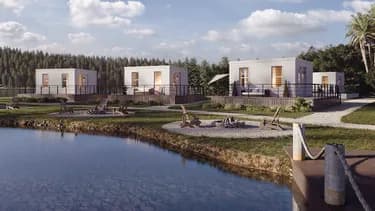
The Redwood does not try to win by being the smallest, flashiest, or most experimental tiny home in the room. It wins by making a familiar layout feel calm, usable, and durable, with a 34-foot-long, 9.5-foot-wide shell that can be built on a trailer or fixed to a foundation. That flexibility matters because it lets the same home serve two very different buyers: the person who wants mobility and the person who wants a compact, long-term residence.
Tiny Timber Homes frames that approach as the result of more than 12 years working in small spaces, and that history shows in the way Redwood is presented. Rather than promising a reinvention of tiny living, the model leans into refinement, which is exactly why it still reads as relevant in 2026. The house feels less like a concept piece and more like a finished answer to a question tiny-house buyers keep asking: how much comfort can a small footprint hold without turning daily life into a puzzle?
A floor plan that reduces daily friction
The biggest practical choice in the current Redwood layout is the single-loft arrangement, sized for one person or a couple. That is a different proposition from the earlier Redwood coverage in 2024, which described a two-bedroom, dual-loft version on a 10-meter triple-axle trailer with 34 square meters of floor space and a folding deck. Put together, those versions show a builder using the Redwood name as a platform for adaptable planning rather than a fixed novelty pod.
For day-to-day living, the single-loft version avoids one of the most common tiny-house tradeoffs: too many sleeping zones competing with the rest of the home. A single loft keeps circulation cleaner below, makes the main floor easier to furnish, and gives the living area a more open feel. In a home this size, that matters more than almost anything else, because every step saved and every corner cleared makes the house feel larger in practice.
The Redwood’s current footprint, listed by Tiny Timber Homes as a 10.4 meter by 2.9 meter base, gives enough length to separate functions without forcing awkward transitions. That is the real value of a proven layout: it lets the home support normal routines, not just weekend novelty.
Living, cooking, and storage are handled like a real home, not a display model
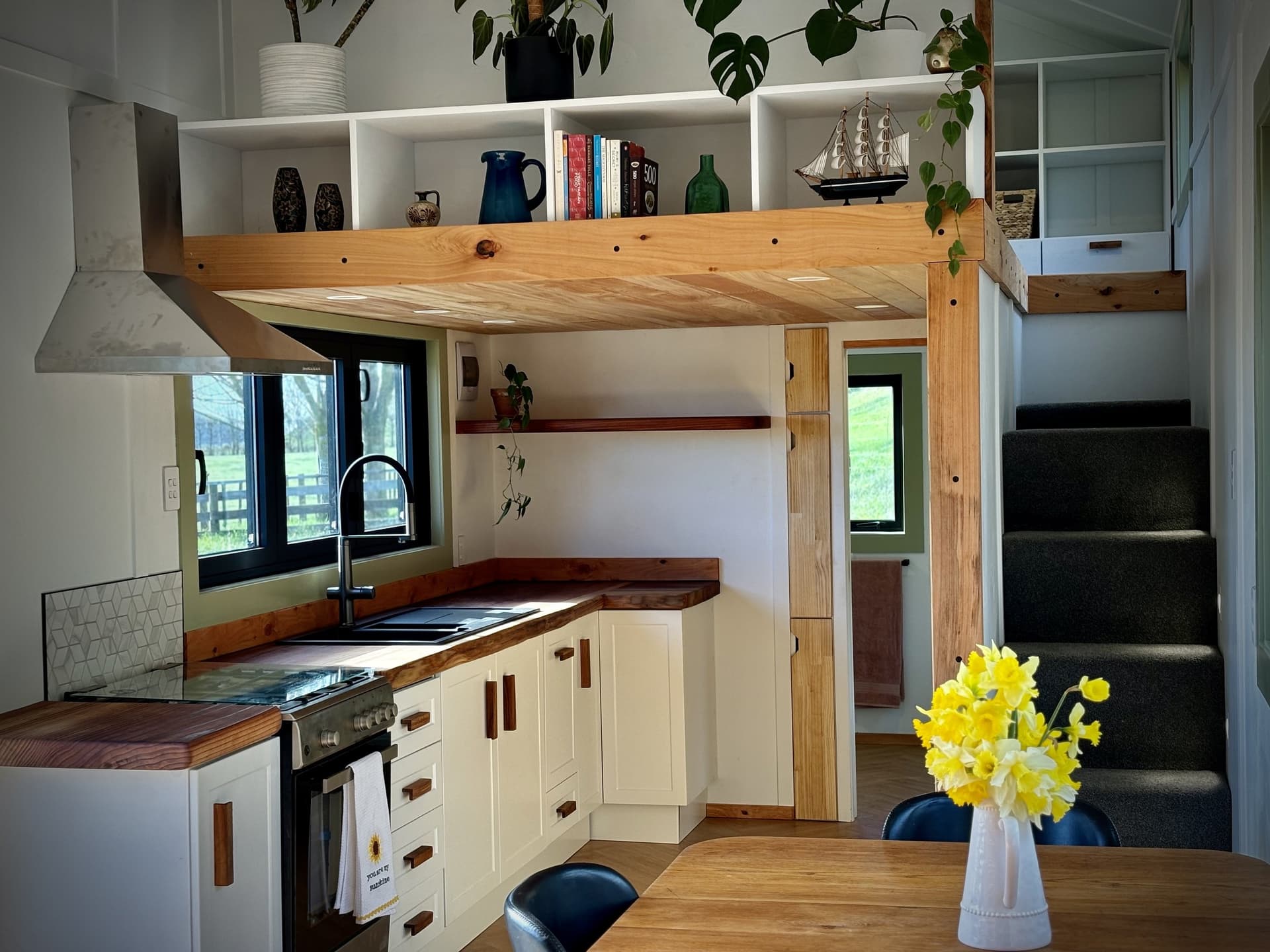
Inside, the Redwood relies heavily on timber, with paneled ceilings, custom cabinetry, warm-toned worktops, and white walls that keep the interior from feeling boxed in. Those choices are not just stylistic. In a small home, light surfaces and built-ins help a room work harder by making storage disappear into the architecture instead of competing with it.
A sofa anchors the living room, while a wood-burning stove gives the space both heat and a clear focal point. That combination is useful because it avoids one of the classic tiny-house frustrations: a room that is technically multifunctional but never quite settles into a comfortable center. The stove gives the main floor a sense of permanence, and the sofa creates a real sitting zone rather than a placeholder.
Natural light plays a major role too. Bifold doors and a ranch slider draw the eye outward and extend the living area visually, which is one of the easiest ways to cut the feeling of confinement in a small footprint. In the Redwood, that is paired with a restrained interior palette, so the house reads as warm rather than cramped.

The exterior signal is practical confidence, not gimmickry
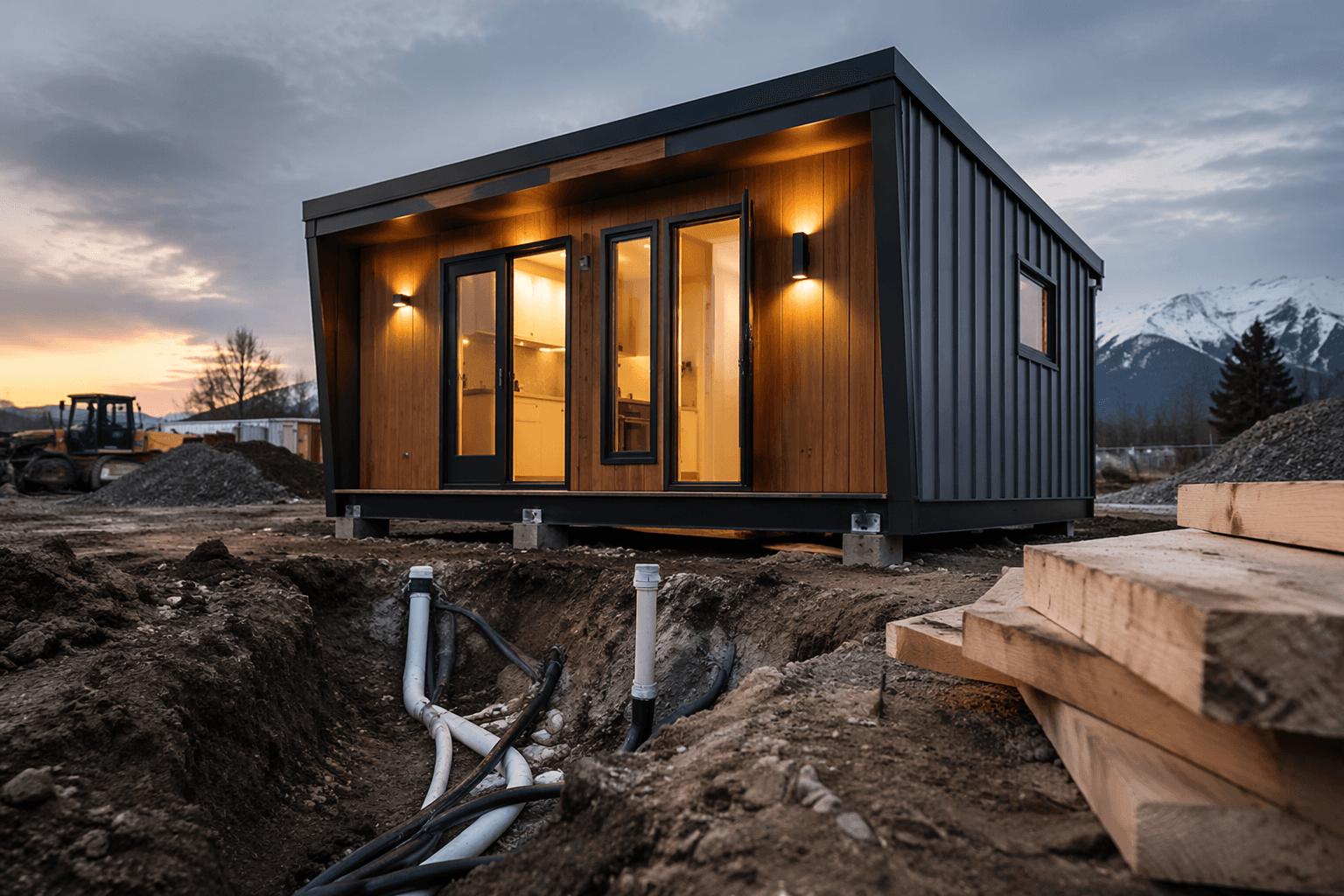
From the outside, the Redwood mixes charcoal-black corrugated metal, vertical natural wood siding, a dark gabled roof, and black-framed windows. The result is modern-rustic without tipping into theme-park styling, which is a harder balance to strike than it sounds. The exterior needs to hold up as transportable or stationary architecture, and this palette does that by feeling grounded and durable.
That matters to buyers because exterior design in tiny homes is not only about curb appeal. It also telegraphs whether a build is trying to look tiny or trying to function like a small house. Redwood lands firmly in the second camp. It looks like a scaled-down residence with architectural discipline, which helps explain why the model reads as mature rather than trendy.
Mobility, consents, and the New Zealand rulebook
Redwood also sits inside a New Zealand tiny-house landscape where classification affects everything. The Ministry of Business, Innovation and Employment released its tiny-house guidance on November 1, 2021 to clarify when a tiny house is treated as a vehicle and when it is treated as a building. Under that guidance, tiny houses on wheels are often vehicles, but they can also become buildings if they are immovable and occupied permanently or long term.
That distinction matters in real life because connections to potable water, storm water, or wastewater systems can trigger building consent requirements, and councils may also determine development contributions. In other words, the shell is only part of the decision. The way you place the home, connect it, and occupy it can change the rule set around it.
Local guidance adds another layer. Queenstown-Lakes District Council says trailer-based tiny homes are generally limited to 2.5 meters wide, 4.25 meters high, 12.5 meters long, and 3.5 tonnes if they are to avoid a special permit, while fixed-to-land tiny homes do not face the same size limits. Selwyn District Council has also developed its guidance with a stakeholder group, aiming for a more consistent approach to building consents across regions. For buyers, that means the appeal of a trailer-ready design like Redwood is matched by the practical reality that the final use case has to fit the rules as carefully as it fits the floor plan.
Why the Redwood still works
The Redwood’s strongest argument is not that it is revolutionary. It is that it refuses to waste space on proving a point. A single loft, a usable main floor, warm finishes, real light, and a shell that can be mobile or fixed are all classic tiny-house moves, but they remain classic because they solve the problems people keep living with. Redwood shows that in small living, the best design choice is often the one that makes cooking, sleeping, storage, and circulation feel effortless.
That is why the Redwood still lands in 2026. It does not chase spectacle. It takes a familiar layout, tightens the details, and reminds the tiny-house world that a well-made small home can feel serene precisely because it knows what not to do.
This article was produced by Prism’s automated news system from verified source data, official records, and press releases, then run through automated quality and moderation checks before publishing. The system is built and supervised by the people who set the standards it runs under. Read our full AI policy.
Did this article answer your question?