When does true crime inform, and when does it exploit victims?
True crime informs when it keeps victims, verification and restraint first. It exploits when speculation, spectacle and monetization outrun the record.
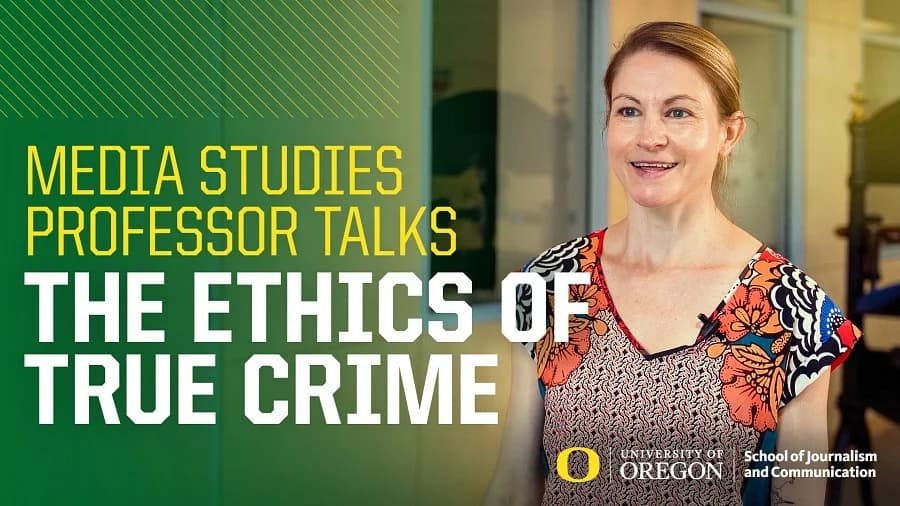
Released in 2014, *Serial* helped turn true-crime podcasting into a mainstream habit for millions of listeners. The true-crime boom now spans podcasts, documentaries, books, television and social-media sleuthing, which means one case can be told as careful reporting or turned into a hook. The University of Oregon School of Journalism and Communication poses the central test in its explainer, “The true crime genre is popular, but is it ethical?”: whether a story stays close to verified facts, or whether it uses a real victim’s worst day as entertainment.
The format shapes the ethics
A long-running television franchise like Dateline, a serialized podcast, a documentary built from archival footage and reenactments, and a TikTok thread all carry different risks. Podcasts can spend hours circling one family’s trauma, documentaries can shape emotion with music and reenactment, and social platforms can reward rumor, amateur theory and crowd-sourced suspicion with very little accountability. The same case can be presented as public-interest reporting in one format and as a mystery box in another.
A story that centers victims, distinguishes verified record from commentary, and explains why a detail matters is doing a different job than one that lingers on gore, amplifies guesses, or converts tragedy into branding.
True crime did not begin with the podcast boom
The current audio era can make true crime feel new, but its roots go back much further. JSTOR Daily traces the genre to 19th-century print culture, including crime pamphlets such as *The beautiful victim of the Elm City* from 1881, and EBSCO’s Research Starters dates the modern true-crime genre’s emergence to the 19th century.
Podcasting changed the scale and intimacy of the conversation. A Georgetown University repository thesis identified *Serial* as a defining moment for the rise of true-crime podcasts.
Checklist: signs a story has crossed into exploitation
The clearest warning signs are easy to spot once you start looking for them. A story has usually crossed the line when the form starts serving the spectacle more than the facts.
- Gratuitous detail: if a podcast dwells on injuries, blood, or the mechanics of violence without advancing the understanding of the case, the detail is doing emotional work rather than reporting work.
- Speculative suspecting: if a YouTube channel or forum treats rumor as evidence, or uses amateur sleuthing to accuse people with no clear record support, the story has moved from analysis into public guessing.
- Victim erasure: if the victim becomes a backdrop for the perpetrator’s psychology, or is mentioned only to set up the host’s narrative voice, the story is no longer centered on the harmed person.
- Marketing built on tragedy: thumbnails, episode titles and teaser copy that lean on shock, blood or sensational language are often the fastest way to see that a case is being sold, not examined.
- Verification blurring: if the creator does not clearly separate court records, police statements, witness accounts and personal theory, the audience is being asked to consume uncertainty as fact.
The boundary gets even sharper when a case is open, unresolved or still active in court, because families are still living with the consequences while the content keeps circulating.
The audience is huge, and the money question is part of the ethics
On June 20, 2023, Pew Research Center found that true-crime podcasts are popular in the United States, especially among women and people with less formal education. Edison Research’s True Crime Consumer Report, conducted from May 10 to May 31, 2024, estimated that 192 million Americans have ever listened to true-crime podcasts.
In 2024, the Reynolds Center asked who pays and who gets the loot in true crime, which is another way of asking who benefits when a victim’s story draws subscriptions, ads and attention. Ethical reporting does not pretend money is irrelevant; it makes the incentives visible and the credit distribution clear.
In a 2025 Sage article, Kelli S. Boling and Danielle C. Slakoff found that co-victims identified five main harms in true-crime media: inaccuracies, sensationalization of tragedy, loss of privacy, disrespect for the victim and glorification of offenders. The Society of Professional Journalists’ ethics committee has published position papers on reporting grief, tragedy and victims that reinforce the same baseline: minimize harm and treat affected people with care. In a June 29, 2025 interview with USA Today / The Excerpt, Kate Winkler Dawson discussed how to avoid retraumatizing victims, while Whitney Phillips has discussed the genre’s ethical complexity and popularity in conversations featured by the University of Oregon. On October 9, 2025, the University of Nebraska-Lincoln highlighted Kelli Boling’s work as examining the “good, bad and ugly” of true crime media.
This article was produced by Prism’s automated news system from verified source data, official records, and press releases, then run through automated quality and moderation checks before publishing. The system is built and supervised by the people who set the standards it runs under. Read our full AI policy.
Did this article answer your question?