Bluefin tuna fire at New Jersey inshore lumps, yellowfin follow offshore
Bluefin are close enough to make the lumps a real Jersey decision, while yellowfin are opening the shelf for canyon crews. The summer tuna menu is already live.
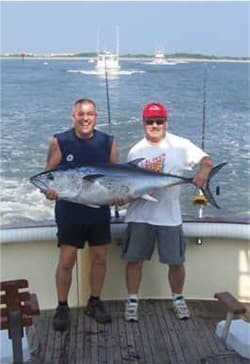
Bluefin are close enough to make New Jersey’s inshore lumps a real decision point again, with fish to 40 pounds on the troll and 60-pound fish on poppers. From Raritan Bay down toward Atlantic City, the bite has tightened enough to give trailer boats a real shot while yellowfin begin to show farther out on the shelf.
Nearshore bluefin: the lumps are the first stop
The most important clue in the current pattern is how compressed the fish have become. Bluefin are pushing into New Jersey waters from the Cigar to the Claw and even closer to shore on local lumps and structure off Atlantic City, while a massive squid invasion has pulled them to within 20 to 30 miles of the Jersey coast. That is not a vague summer note, it is a route decision: if your boat can run the inshore lumps quickly and hold on fish that may be feeding tight to bait, you are in the game.
The other useful detail is how the fish are being caught. Fish to 40 pounds are coming on the troll, while fish to 60 pounds are taking poppers, which tells you the bite is not locked into one style. Trolling spreads still work when the marks are deeper or the fish are moving without much surface noise, but the popper bite says there are windows when the tuna are willing to show and feed up top. That matters for smaller crews because it turns the decision from “Do I have full offshore gear?” into “Can I get there fast enough to fish the right edge at the right time?”
For trailer boats, this is the lane to watch first. The nearshore play does not require a canyon run, but it does reward boats that can cover the lumps, work bait-rich structure, and react when surface activity breaks open. If the weather window is short or the crew wants a day trip rather than a fuel-heavy overnight, the bluefin at the lumps are the clearest go signal in the region.
Offshore yellowfin: the shelf is widening the menu
Farther out, the shelf bite is beginning to turn the fishery from a nearshore shot into a more complete offshore program. Yellowfin are starting to show along the shelf, and eastern canyon grounds are producing excellent yellowfin fishing with many limit catches. That is the difference between a quick Jersey run and a canyon-capable day: one lane is built around the close lumps and the other asks for range, fuel, and a crew ready to stay on the edge.
The offshore reports from the New Jersey run have been consistent on one point, the fish are moving north and stacking where the bait is. Bluefin have already been reported off southern New Jersey, and the better yellowfin fishing has been tied to the eastern canyons and the Mid-Atlantic edge. If you have the boat for it, that opens a second route beyond the nearshore lumps, with yellowfin becoming the species that justifies the longer push after the bluefin window closes or slows.
That longer run still has a backup plan. The canyon tilefish bite remains reliable for crews willing to make the trip, which matters because a canyon day is an investment of fuel and time. When yellowfin are not the headline, tilefish keep the run productive enough that the trip does not hinge on tuna alone.

The rules now matter as much as the marks
NOAA Fisheries has the bluefin and yellowfin regulations in place right now, and they fit directly into this pattern. As of June 1, 2026, private HMS Angling permit vessels may retain 2 bluefin tuna per vessel per day or trip measuring 27 to under 73 inches curved fork length, with only 1 large school or small medium bluefin allowed. HMS Charter or Headboat recreational vessels may retain 3 bluefin under the same size rules, and headboats may retain 6. Bluefin retained or discarded dead must be reported within 24 hours of landing or the end of the trip.
Yellowfin is open in the New England, Mid-Atlantic, and Southeast region. The minimum size is 27 inches curved fork length, and the limit is 3 fish per person per day or trip. Vessels fishing for Atlantic bigeye, albacore, yellowfin, or skipjack tuna must carry a valid HMS Angling or HMS Charter/Headboat permit. That is the difference between a good mark and a legal trip, especially when the bluefin are close enough to tempt quick decisions on small boats.
There is also a bigger regional signal behind the bite. NOAA’s 2026 landings update shows 435 recreational rod-and-reel bluefin in the New England, Mid-Atlantic, Southeast through April 30, with an average weight of 362.6 pounds. NOAA also flags those landings figures as preliminary, so they are not a real-time catch monitor, but they do show that the broader bluefin season has already put real fish in the mix before summer fully settles in.
Why this pattern is worth acting on now
What makes this Jersey setup worth moving on is the combination of compression and range. Bluefin are close on the inshore lumps, the bait has pulled them in tight, and the fish are already taking both trolling baits and poppers. At the same time, yellowfin are opening the shelf for crews that can make the run, and the canyon grounds still give offshore boats a second target if tuna are slow.
That is the real read on New Jersey right now: the fast shot at the lumps is live, the shelf is waking up behind it, and the fishery has already moved beyond a spring placeholder into a summer menu that can be fished two different ways, depending on how far your boat can go.
This article was produced by Prism’s automated news system from verified source data, official records, and press releases, then run through automated quality and moderation checks before publishing. The system is built and supervised by the people who set the standards it runs under. Read our full AI policy.
Did this article answer your question?