Cyclone Narelle Forces Safety Warnings Amid Strong Yellowfin Tuna Action in Western Australia
Category 4 Cyclone Narelle shut down WA's northwest yellowfin tuna grounds; here's the go/no-go framework to survive the next weather window.
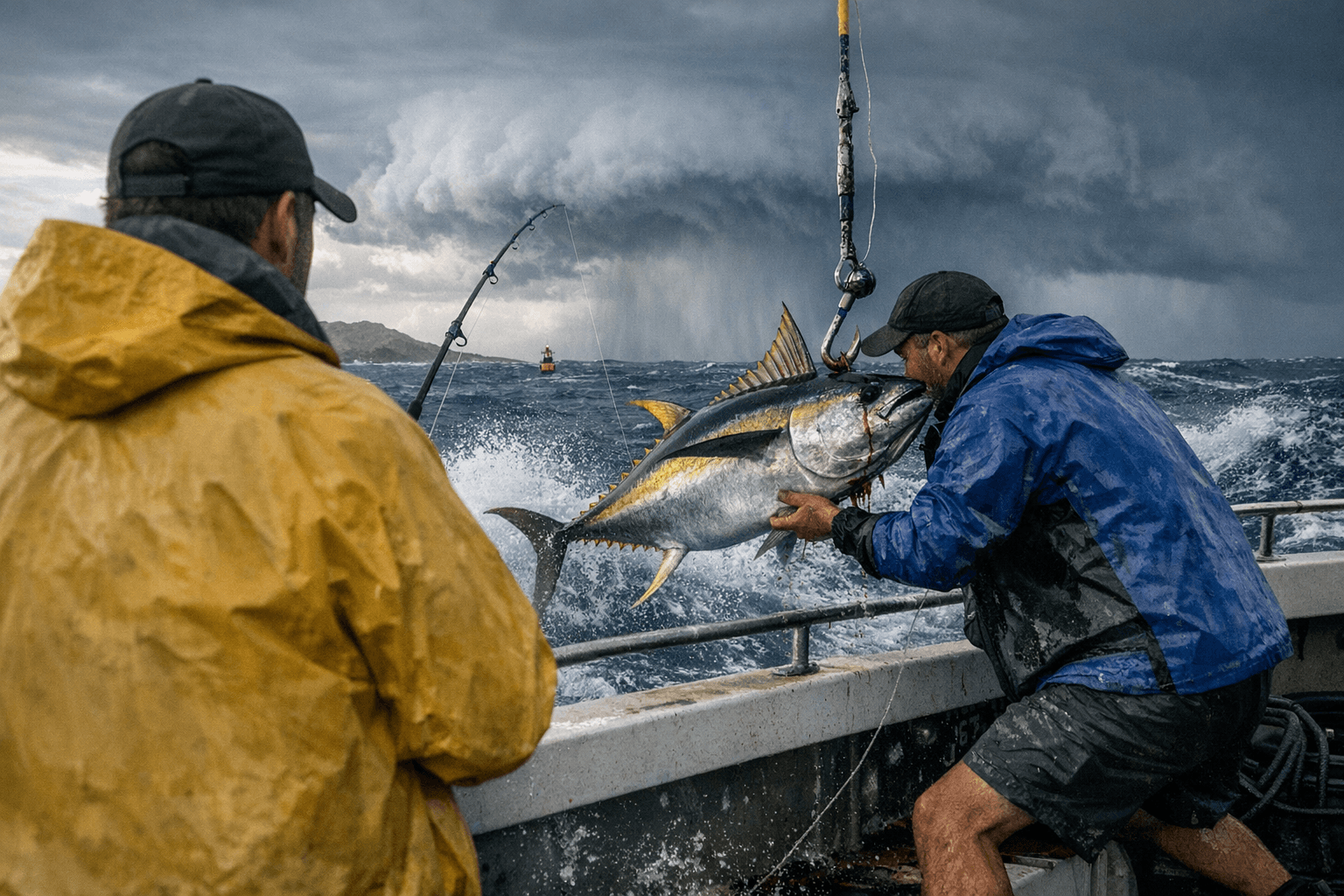
Every tuna angler off Western Australia's northwest coast knows the cruelest timing: the fish are going, the weather looked manageable 48 hours ago, and now a Category 4 cyclone has other ideas.
That was the exact tension Recfishwest navigated in its March 27, 2026 statewide fishing report, which arrived as Tropical Cyclone Narelle, carrying wind gusts up to 275 km/h, tracked from North West Cape southward through the Gascoyne. Boats that found windows before the system arrived had been reporting yellowfin tuna to 30 kg, wahoo to 20 kg, and strong Spanish mackerel action across the northwest. The fish were there. The conditions were not.
Recfishwest's bulletin stated plainly that "hazardous fishing conditions" would extend through the following week, with Narelle generating damaging winds, large swells, and coastal flooding risk between Onslow and Denham. The Bureau of Meteorology had already flagged very destructive gusts, storm surge, and flash-flooding potential across the Pilbara and Gascoyne. The safety advisory carried the blunt message every experienced skipper knows but can forget when a 30-kg yellowfin is the alternative: "no fish is worth risking your life for."
It is not a phrase anyone disputes in hindsight. The difficulty is applying it before departure, when optimism and fishing pressure can cloud the math.
Offshore tuna fishing in WA's northwest involves long transits, pre-dawn bar crossings, and exposure to Indian Ocean swells that can build faster than a six-hourly forecast suggests. Cyclone Narelle underlined why the go/no-go call needs thresholds, not instinct. The Bureau of Meteorology coastal waters forecast is the baseline. For trailer boats under 6 m, swell exceeding 1.5 m or winds above 15 knots should be a hard stop. For the 6- to 8-m centre consoles and walk-arounds that make up the bulk of the northwest tuna fleet, 2 m of swell combined with 20-plus-knot winds is the ceiling. Larger vessels can tolerate more, but not cyclone-generated sea states: the period and power behind those waves is categorically different from trade-wind chop, and they do not feel the same when you are 40 nautical miles offshore in the dark.
The bar crossing is the highest-risk single moment in a typical northwest tuna run. Conditions offshore can be fishable while an outgoing tide and incoming swell make the local bar genuinely dangerous. The call needs to be made at the ramp, not mid-crossing. Transport WA operates a Waves, Seas and Swell guide that maps specific wave height thresholds to vessel size categories. It is a simple document, easy to screenshot and save to a phone, and it is a useful anchor when the bite report is doing the thinking for you.
On communications: an EPIRB registered with the Australian Maritime Safety Authority, a charged VHF radio on Channel 16, and a float plan lodged with a shore contact are not optional items on a 50-nautical-mile tuna run. AMSA data from 2016 to 2020 recorded 26 fatalities across 18 marine incidents nationally, and in every single case, not one of the persons involved was wearing a life jacket. Wearing yours at the bar and in building weather is a separate decision from everything else, and it requires no gear check, no forecast, and no debate.
When Narelle made the northwest coast a no-go zone, the inshore bite still offered viable alternatives. Spanish mackerel were active in accessible coastal zones across the region, along with reef species that do not require a Category 4 weather system to cooperate. A solid day chasing Spanish mackerel on sheltered water also keeps you positioned for the post-cyclone window, which is typically marked by clearing conditions 48 to 72 hours after a system passes. Cyclone-scoured water frequently concentrates bait along depth changes, and the first tuna run after Narelle may well fish better than the one that was cancelled.
The pre-trip go/no-go check before any northwest WA offshore run comes down to six items: the BOM coastal waters forecast reviewed within six hours of departure, the bar crossing conditions confirmed with local intel on the day, the EPIRB test-light active and registration current, the VHF on Channel 16 confirmed, the float plan lodged with a shore contact including your expected return time, and a hard abort threshold agreed before you leave the ramp. That last item is the one most often skipped. Deciding in advance at what point you turn around, before tiredness and the sunk-cost of a long transit do the deciding for you, is what separates a long offshore career from a short one.
The 30-kg yellowfin will still be there when the weather clears. The next window is already on the BOM forecast cycle.
This article was produced by Prism’s automated news system from verified source data, official records, and press releases, then run through automated quality and moderation checks before publishing. The system is built and supervised by the people who set the standards it runs under. Read our full AI policy.
Did this article answer your question?