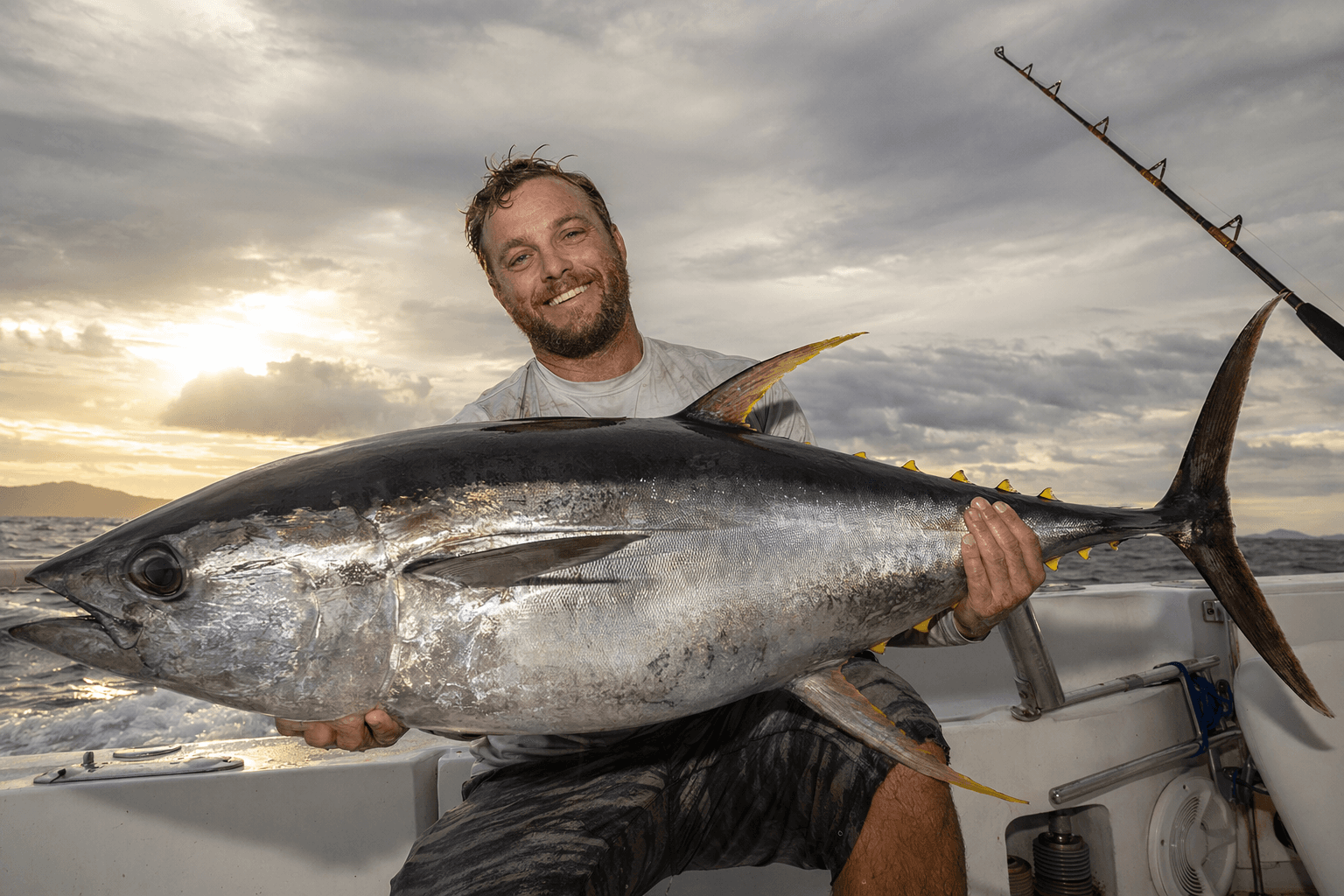
Sean lands 19-kilo longtail tuna as trade winds turn rough
Sean’s 19-kilo longtail came from the bay, not offshore, and it showed pelagics were still around even as trade winds stiffened and sharks pressured the bite.

Sean’s 19-kilo longtail tuna came from the bay, not a bluewater run, and that is the kind of catch that makes every pelagic angler check the wind forecast twice. The fish was a hard-pulling one, landed by a regular bay visitor, and it was big enough to matter without being some once-in-a-decade monster.
For longtail tuna, that size is no throwaway. Queensland Government guidance lists the species, Thunnus tonggol, as common around 70 cm with a maximum length of 130 cm, while NSW Department of Primary Industries says the fish can top out at 32 kilos and that most angler-caught fish weigh less than 15 kilos. At 19 kilos, Sean’s fish sat well above the usual run of bay tuna and close enough to the top end to remind people how serious these fish can get in inshore water.
The timing mattered just as much as the size. Fisho’s Weekly Fishing Report for April 24 opened with the tuna, then quickly shifted to the weather, which had gone from brilliant to breezy as onshore trade winds returned under a stalled high-pressure system in the Tasman Sea. By Monday evening, the Bureau of Meteorology forecast for Urangan had southerly to southeasterly winds of 15 to 25 km/h for Tuesday, building to southeasterly 25 to 35 km/h by Thursday, with rough conditions expected to hang around into the following week.
That kind of breeze changes everything on the water. It cuts down the number of safe options, pushes many boats back into protected water or estuary alternatives, and leaves only the earliest sheltered sessions looking realistic on some days. Even so, the tuna itself suggests the fish were still in the system when the weather turned. Coastwatch’s April 23 report for Hervey Bay and Fraser Island said tuna were in good numbers, although pelagics were being hit hard by sharks before anglers could get them to the boat.
The bait picture fits the story too. Improved water quality had already brought more life back to Urangan Pier, with herring holding in decent numbers and more active bait movement showing up around the structure. Local fishing guidance has long treated the pier as a major land-based pelagic platform because schools of herring, hardihead and pike gather around the pylons and pull larger fish in behind them. Urangan Pier, built between 1913 and 1917 as a cargo-handling facility and later cut back to 868 metres after closure and restoration, still matters for the same reason: when bait stacks up, pelagics follow. Sean’s tuna looked like a strong sign that the bay still has life, and if the bait keeps pushing in, this may be more than a one-fish story.
This article was produced by Prism’s automated news system from verified source data, official records, and press releases, then run through automated quality and moderation checks before publishing. The system is built and supervised by the people who set the standards it runs under. Read our full AI policy.
Did this article answer your question?