Thailand Diesel Shortage Forces Hundreds of Fishing Vessels to Stay in Port
More than 1,000 Thai fishing boats are already docked as "green oil" prices jumped from under 20 baht to 35 baht per litre since the Middle East war began.
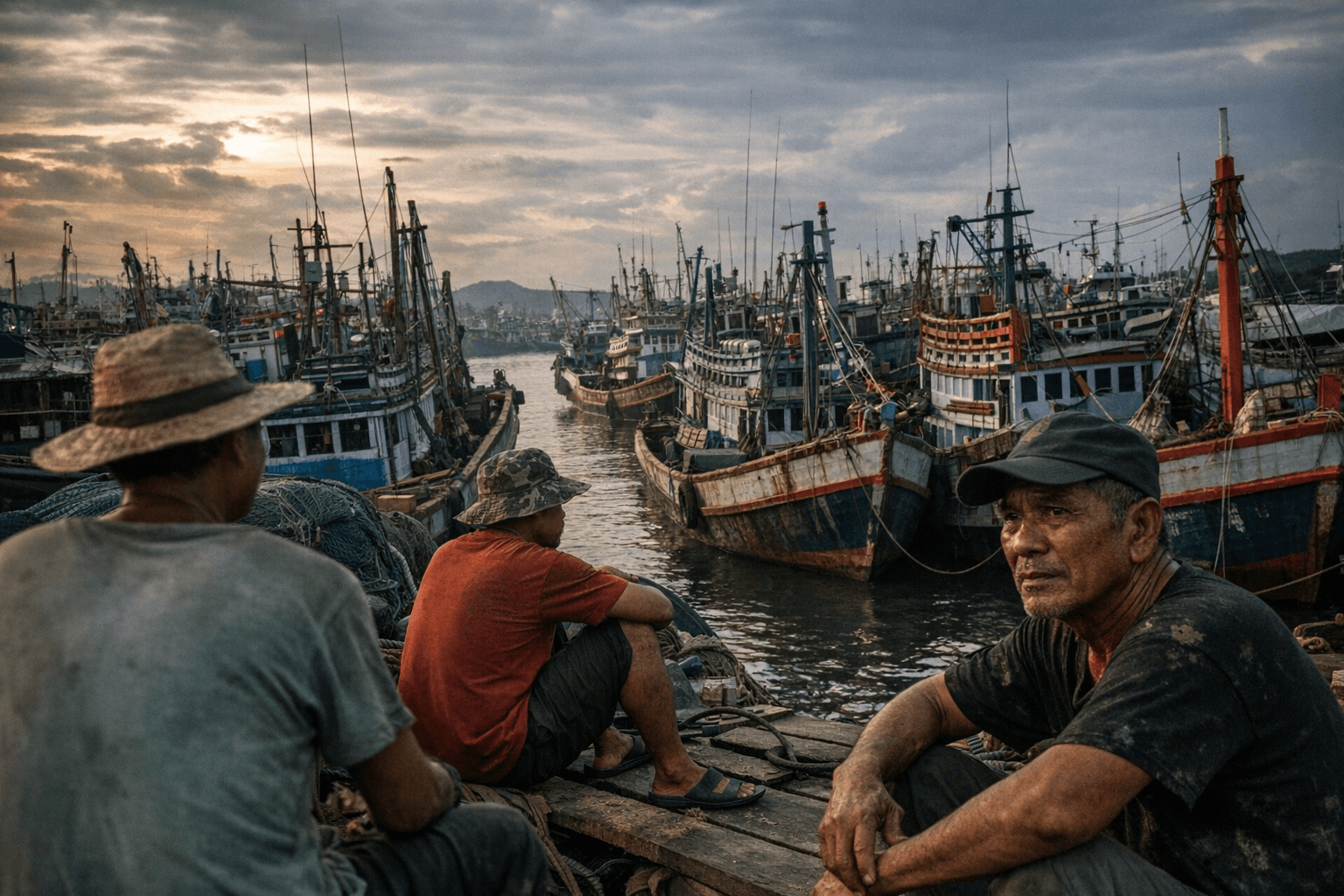
Kwanchai Phatisena has fished for about 50 years and says he has never seen anything like this. His boat has been moored at the Sriracha jetty, north of Pattaya, for at least two weeks. Egrets and stray cats pick through fish scraps that have fallen from plastic tubs on the dock. His crew has been sent home. "There's no profit. It's straight-up losses," he said.
Kwanchai's boat is one of more than 1,000 Thai fishing vessels already forced to stay in port as a diesel shortage and surging prices tied to the war in the Middle East gut the economics of going to sea. The National Fisheries Association of Thailand warned that half the fleet of around 9,000 vessels could soon be idled if the situation continues.
The fuel at the center of the crisis is tax-exempt diesel known as "green oil," a program that normally gives Thailand's fishers some insulation from global price swings. Before the war in the Middle East broke out on February 28, green oil cost less than 20 baht per litre. It now costs 35 baht and is increasingly hard to find. For some operators, the fuel spike has reached 75 percent.
"Those still going out are using the cheaper 'green oil' left over in the tanks," Kwanchai said. "Once this batch is gone, everyone will probably dock because we can't handle the costs."
Among those already onshore is Narongsak Kongsuk, a 27-year-old father who normally earns up to 20,000 baht ($615) a month. He left the dock on Wednesday with his belongings stuffed into a plastic bag, heading home with no clear timeline for returning to sea. "There's the cost of my child's milk, various other expenses and car payments," he said. "I'll have to find part-time jobs."
About 100 miles away, near Laem Chabang, Thailand's largest deep-sea port, truck driver Prayoon Srisawat sat beside a convoy of parked trucks as part of a protest against rising gas prices. He said his income had halved in recent days. In Samut Sakhon and Chonburi, fishermen on docked boats described the same paralysis. Wittaya Lekdee, who has worked at sea for more than 30 years and owns a shrimp boat called "Lucky Blessing," has not been able to take it out all month. "It's the worst that it has ever been," he said.
The National Fisheries Association met with the government in Bangkok on Wednesday to request that the price of diesel reserved for fishers be capped, as it is for pump gasoline sold to the general public. The association estimated that fishing boats consume 40 to 50 million liters of fuel per month under current reduced operations, a figure that could climb to 80 to 90 million liters if the full fleet returned to sea.
The market impact is already visible on shore. Large blue crab prices surged to 850 baht per kilogram in Samet Saman, Sattahip, in Chonburi province, as reduced fishing activity tightened supply. Fuel stations in that area stopped selling diesel in containers, cutting off small-scale fishing boats and speedboats from one of their main refueling options. Vendors urged the government to resolve the shortage before prices climb further.
The crisis extends beyond Thailand's borders. In Cambodia's coastal Preah Sihanouk province, around a third of approximately 1,000 fishing boats stopped going to sea because of higher fuel costs, according to Em Phea, director of the provincial fisheries administration. "They cannot make a profit," Em Phea said, adding that some fishermen were still working by drawing down fuel stockpiles. Fishers in Vietnam faced similar pressure.
The National Fisheries Association noted that most vessels in the Thai fleet run older engines, and while B20 biodiesel has been raised as a potential alternative, the association said careful assessment would be needed before any switch. No government price cap or relief measure had been announced as of March 20, 2026. With green oil stockpiles burning down in the tanks of the boats still at sea, the window before a much larger share of the fleet docks may be short.
Know something we missed? Have a correction or additional information?
Submit a Tip