Guitar Center's 2026 Guide Ranks the Best Analog Synthesizers to Buy
Guitar Center's Riffs guide ranks five analog synths from $1,699 to $4,999, with the Oberheim OB-X8 taking the top spot as the ultimate vintage recreation.
The sweet romance of the analog synthesizer has long been a siren song for enthusiastic synthesists," writes George Van Wagner in Guitar Center's Riffs editorial channel buying guide. That romance now has a price tag, and it ranges from a relatively accessible $1,699.99 all the way to nearly five grand. The guide, published March 11, covers five analog and hybrid instruments spanning compact polyphonics to flagship multi-voice workhorses, giving synthesists a clear map of where the market sits in 2026.
Prices listed are as of March 2026.
1. Oberheim OB-X8 ($4,999.99)
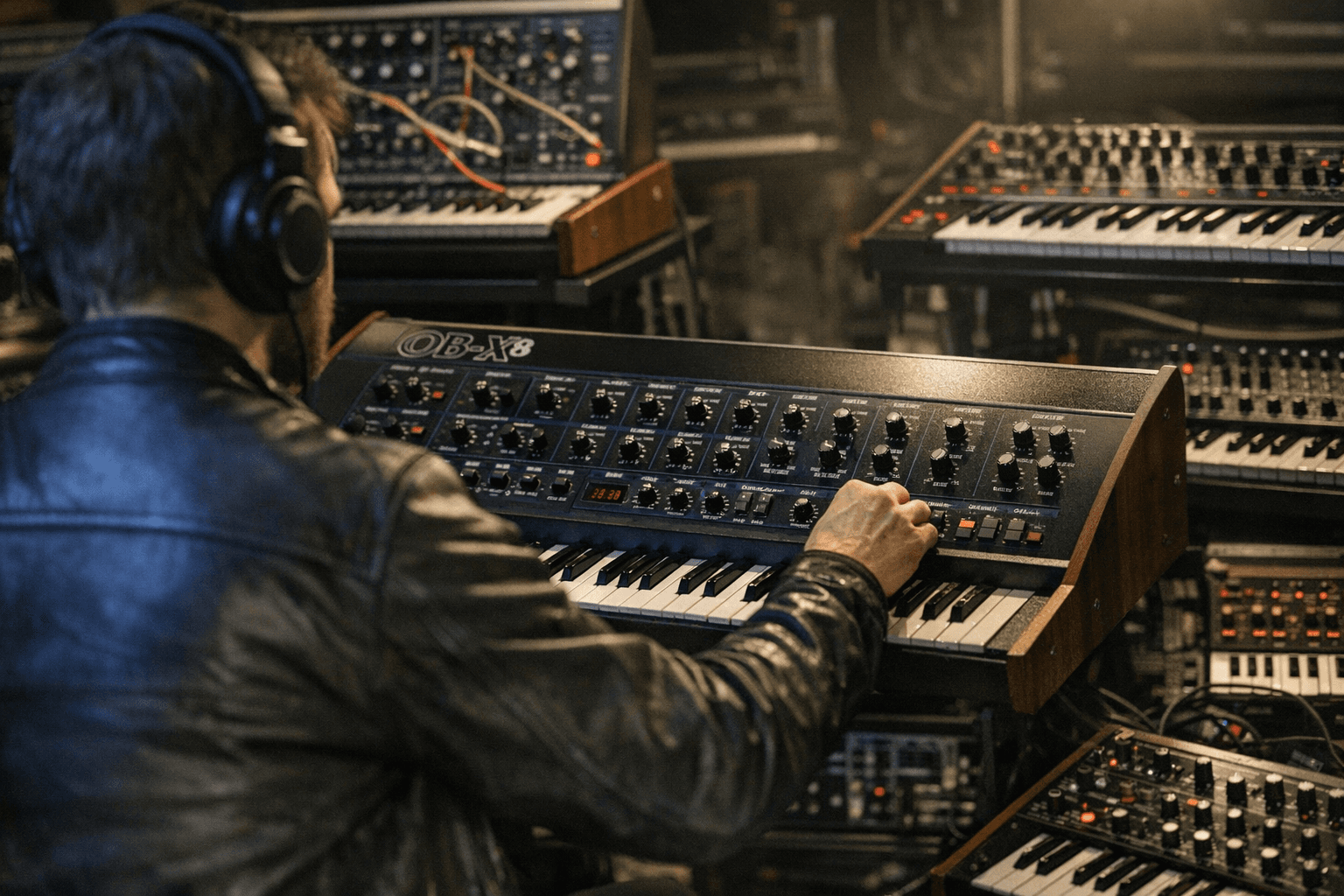
The OB-X8 sits at the top of this list not just because of its price, but because of what it represents sonically and historically. As the guide puts it: "The OB-X8 represents more than just a reissue — it's a faithful recreation of three of the most sought-after vintage synthesizers ever made. Each voice mode captures the specific vibe and circuit behavior of its respective original, from the raw power of the OB-X to the refined elegance of the OB-8." The 8-voice instrument runs two oscillators per voice with saw, triangle, square and pulse waveforms, routed through a 12dB/24dB switchable ladder filter. Two LFOs and two ADSR envelopes per voice give you deep modulation reach, and crucially, the analog circuitry uses discrete components rather than modern integrated circuits, preserving the harmonic complexity and voice-to-voice variation that made vintage Oberheims so fiercely desirable. For anyone who has priced an original OB-X or OB-8 on the vintage market lately, $4,999.99 for something that sounds like all three without the repair bills is a genuinely compelling proposition.
2. Sequential Prophet-10 ($4,399.99)
Sequential's Prophet-10 is the other flagship-tier instrument on this list, and at $4,399.99 it sits just $600 below the OB-X8 while delivering the most polyphonic voice count of any synth here: 10 voices, each with two oscillators. The waveform palette covers saw, triangle, square and pulse, and the filter is a 24dB ladder design, the classic Curtis-descended architecture that defined the Prophet sound. Modulation is handled by one LFO and two ADSR envelopes. Where the OB-X8 leans into the rawer, slightly unpredictable character of vintage Oberheim circuits, the Prophet-10 delivers Sequential's famously smooth and musical voice stacking. Ten-voice polyphony means dense chords, lush pads and rich unison stacks are all on the table without burning through your voice budget.
3. Arturia PolyBrute 12
The PolyBrute 12 earns its place near the top of any serious analog conversation. The guide's "Why It's Cool" section puts it plainly: "The Arturia PolyBrute 12 delivers 12-voice polyphony with a massive modulation matrix that transforms every parameter into a potential destination for creative sonic exploration." Twelve voices puts it ahead of everything else on this list in raw polyphonic headroom, making it the instrument of choice if layered, evolving pads and complex harmonic motion are your primary use case. A pricing note is worth flagging: the supplied guide material includes a "Things to Consider" section for the PolyBrute 12 but the content of that section was not available in the source fragments, so prospective buyers should consult the full Guitar Center Riffs guide page for the complete picture before purchasing.
4. Oberheim TEO-5 ($1,849.99)
The TEO-5 is the more affordable Oberheim on this list, and it brings genuine Oberheim DNA at a fraction of the OB-X8's price. The spec sheet shows a 5-voice instrument with two oscillators per voice, running saw, reverse saw, square and random waveforms. The filter is a SEM-style multimode design, a direct nod to the Oberheim SEM module that started the whole lineage, and modulation comes from two LFOs and two five-stage ADSR envelopes. That five-stage ADSR is a notable detail: the added stage gives envelope shapes that go beyond the standard attack/decay/sustain/release structure, opening up more complex, evolving transients. At $1,849.99 it occupies a genuine mid-tier position, offering a credible polyphonic Oberheim experience without committing to the flagship price. One note: the source material contains a conflicting price of $579.99 in a separate heading fragment, but the detailed spec-table entry prices it at $1,849.99, consistent with the format used for all other instruments in the guide. Buyers should confirm the current price directly with Guitar Center before purchasing.
5. Sequential Take 5 ($1,699.99)
The Take 5 is the most accessible instrument on this list at $1,699.99, and it makes a strong argument that you don't need to spend flagship money to get genuine Sequential character. Like the Prophet-10, it runs two oscillators per voice through a 24dB ladder filter, with the same waveform set of saw, triangle, square and pulse. The voice count drops to five, and modulation is handled by one LFO and two ADSR envelopes, mirroring the Prophet-10's architecture in a more compact package. For synthesists who want the Sequential filter and oscillator sound but aren't ready to commit to $4,399.99, the Take 5 offers a clear and logical on-ramp into that world.
The five instruments in this guide cover a well-considered range of the current analog market. At the high end, the OB-X8 and Prophet-10 represent the state of the art in polyphonic analog recreation, both built to recapture specific vintage characters that the used market prices out of reach for most players. In the middle, the TEO-5 and Take 5 deliver genuine brand-authentic analog voices at under $2,000 each. The PolyBrute 12 sits in its own category by voice count, offering the deepest polyphonic canvas of the group with a modulation architecture designed for synthesis that goes well beyond static patches. Whichever tier fits your budget and workflow, the common thread across all five is that commitment to actual analog circuitry, the oscillators, filters and envelope generators that Van Wagner describes as central to music feeling "more like an organic, living conversation than just punching up a preset.
Know something we missed? Have a correction or additional information?
Submit a Tip