Make Noise 0-Coast blends Moog and Buchla synth philosophies
The 0-Coast still nails the Moog-meets-Buchla brief, and the new crop of semi-modular boxes shows hybrid synth design is now a real buying category.
The east coast, west coast split still matters
The Make Noise 0-Coast makes sense the moment you remember why vintage synth people still argue about East Coast and West Coast design. Bob Moog’s side of the family tree is about dense harmonics, filters, and envelopes; Don Buchla’s side leans into simpler waveforms, frequency modulation, wavefolding, and a workflow that does not assume a keyboard is the center of the universe. Once you hear those two philosophies as different answers to the same problem, the 0-Coast stops looking like a novelty and starts looking like a practical bridge.
That bridge is easier to build now than it was in the classic era. Eurorack and semi-modular instruments have made it possible to borrow from both traditions without turning the instrument into a compromise. Gearnews’ roundup is really about that shift: these are no longer museum pieces dressed up as modern gear, but current instruments that let you keep one foot in Moog territory and the other in Buchla mischief.
Why the 0-Coast works
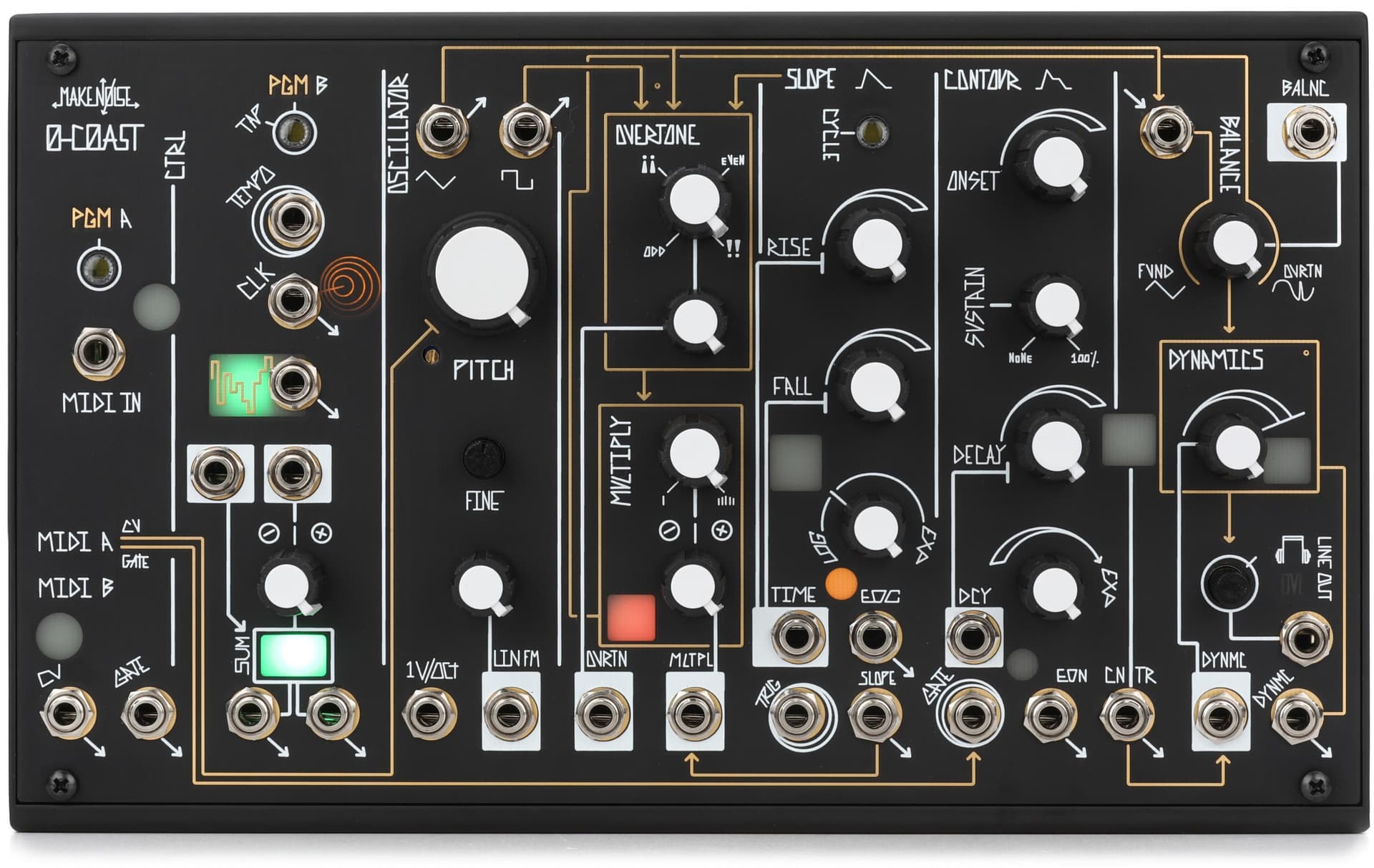
Make Noise says the 0-Coast uses “techniques from both the Moog and Buchla paradigms” while remaining loyal to neither, and that is exactly the right framing. It is a semi-modular tabletop synth that does not pretend to be a Minimoog clone or a Buchla replica. The voice starts with a triangle-core VCO that generates triangle and square waveforms, which gives it a familiar starting point before the patching gets strange.
From there, the 0-Coast goes after the parts of synthesis vintage players usually have to reach for in a rack. The Multiply and Divide sections, the Overtone control, and the wavefolding all push the sound away from plain subtractive territory. The Dynamics block is the real tell, because the transistor-based low-pass gate replaces the usual filter-plus-envelope expectation with something that behaves more like an instrument response than a textbook signal path.
Make Noise also gives the 0-Coast enough practical utility to slot into a real setup instead of living as a desk toy. The product page lists 2 channels of MIDI to CV and MIDI to Gate, 13 sources and 14 destinations, a dual-mode MIDI-controlled arpeggiator, and that unusual low-pass gate in the Dynamics section. In other words, you can bring it into a vintage-heavy rig, clock it from a modern source, and still patch it like a little experimental system when you want it to stop behaving.
What it scratches in a vintage-heavy setup
If your benchmark is Minimoog-style immediacy, the 0-Coast is not that, and that is part of its charm. It gives you enough front-panel logic to understand quickly, but it does not hand you a finished subtractive voice with all the answers baked in. Instead, it scratches the itch for Buchla-style experimentation in a format that is easy to live with, which makes it a smart companion for a studio that already has the classic monosynth thing covered.
That is the practical value here. A lot of modern hybrid boxes are interesting for five minutes and then become a wiring project. The 0-Coast stays appealing because it gives you a clear triangle-core starting point, then invites you to push it into folding, overtones, and dynamic shaping without forcing you into a giant modular commitment. For players who already own vintage gear, that makes it less of a replacement and more of a missing color.

The broader bi-coastal field
Pittsburgh Modular Synthesizers, based in Pittsburgh, Pennsylvania, pushes the same idea from a different angle with Voltage Lab 2. The company introduced it on May 14, 2024, at a suggested retail price of $1,999, and describes it as a “sound design laboratory” with newly developed waveshaping tools, a pair of laboratory oscillators, and a performance-oriented controller. That is a very specific promise, and it reads like a synth built for people who want hands-on exploration rather than a polite recap of a vintage circuit.
Moog Music’s Labyrinth takes the bi-coastal idea and tilts it toward generative play. Moog describes it as a semi-modular instrument and idea machine with two generative sequencers and parallel analog signal paths, while retail descriptions emphasize dual oscillators and a voltage-controlled wavefolder. The result is a box that wants to wander, but still keeps enough analog muscle that it does not lose its Moog identity in the process.
Buchla’s Ziggy is the cleanest reminder that West Coast thinking is still alive in new hardware. It is currently listed as a preorder-only analog desktop synthesizer built around Buchla’s famous complex oscillator, priced at $999, with shipments expected to begin in August/September 2026. Buchla also offers a Ziggy plus LEM218 bundle at $1,999, which tells you this is still a company that thinks in terms of performance systems, not just a single box on a stand.
Gearnews also folds Frap Tools Magnolia into the same conversation, and that matters because it shows the trend is wider than one or two marquee names. The point is no longer that east-west hybrids are an interesting talking point. The point is that they have become a real product category, with each instrument emphasizing a different balance of immediacy, modulation, and hands-on weirdness.
How to choose the right hybrid lane
The 0-Coast is the one to buy if you want the cleanest compact bridge between vintage analog instincts and modern patch culture. Its triangle-core voice, wavefolding, and low-pass gate give it the Buchla flavor, but its MIDI control and straightforward tabletop format keep it usable in a normal studio. It is the best argument for the idea that a synth can feel experimental without becoming fussy.
Voltage Lab 2 makes sense if you want a more expansive sound-design platform with performance control built in. Labyrinth is the choice for players who want Moog branding, analog routing, and sequenced unpredictability in the same box. Ziggy is for the people who hear Buchla complexity and want a desktop entry point rather than a larger system.
That is the real reason the 0-Coast still lands so well. It takes the old East Coast versus West Coast argument, compresses it into a small semi-modular box, and proves that the two philosophies are even better together when you can patch them by hand.
This article was produced by Prism’s automated news system from verified source data, official records, and press releases, then run through automated quality and moderation checks before publishing. The system is built and supervised by the people who set the standards it runs under. Read our full AI policy.
Know something we missed? Have a correction or additional information?
Submit a Tip