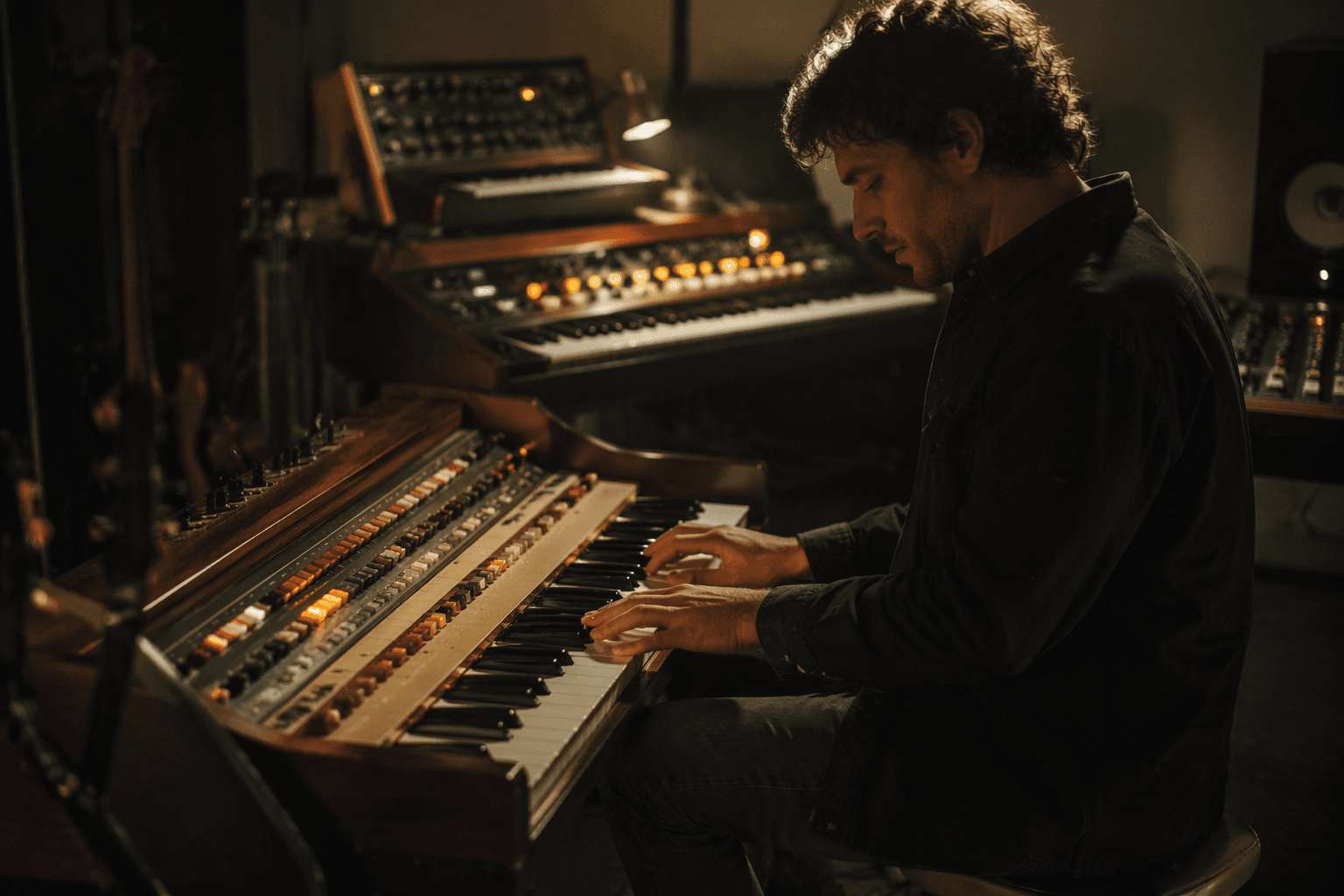
Mitchell Sigman’s Memory Banks celebrates vintage synths, live hardware, and vocoder magic
Mitchell Sigman’s Memory Banks turns classic hardware into a living archive, with a live, no-AI synth stack that reaches from SEM to GX-1.
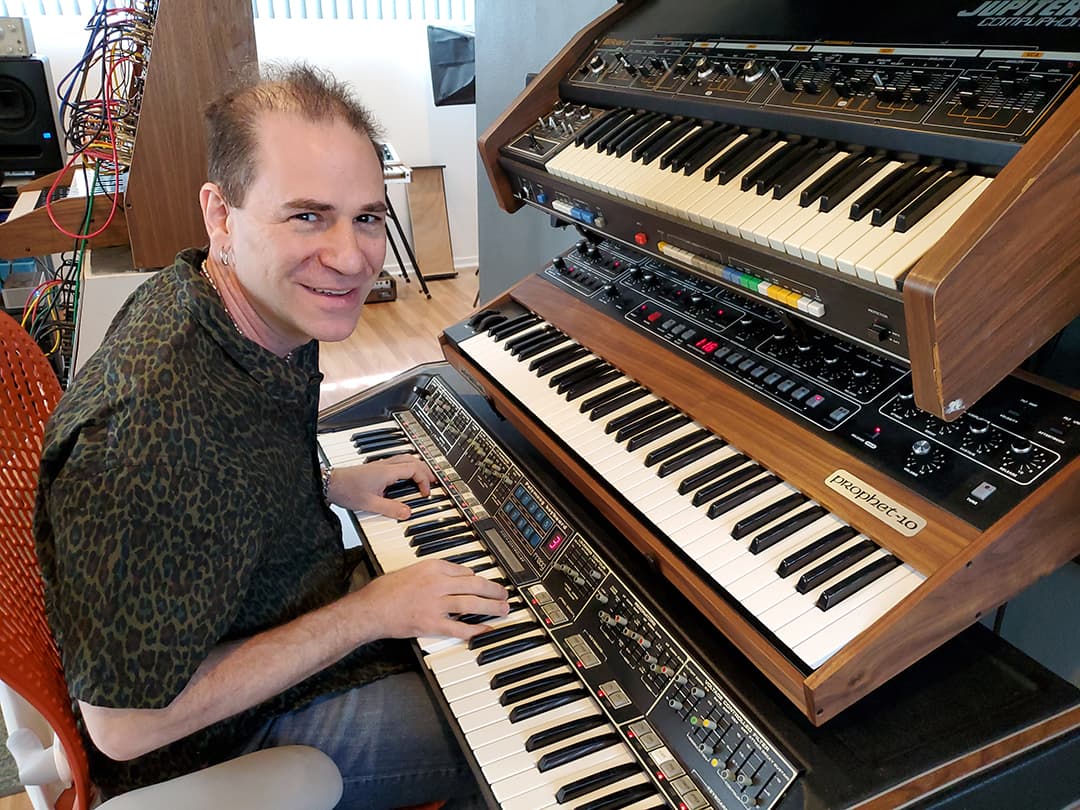
Memory Banks feels like a document of hardware as memory
Mitchell Sigman’s *Memory Banks* lands as more than a synth record. It is a working archive of how vintage instruments still shape musical identity, with live parts played without MIDI and a stated refusal of AI, Suno, or loops. The result carries the pull of ELO, Kraftwerk, and The Alan Parsons Project, but it also reads like a preservation project for the sounds and workflows that defined an earlier era of keyboard culture.
That matters because Sigman does not treat these instruments as props. His own framing calls *Memory Banks* an “all-original love letter” to futuristic pop vision, and the music is built from hardware that long-time players will recognize immediately. In a scene where vintage gear is often discussed as collectible inventory, this release shows the other side of the equation: the instruments still making new music, still being voiced, layered, and committed to tape-era thinking in a modern studio context.
A hardware stack that tells the story
The album’s instrument list is the first clue that this is a serious hardware statement, not a nostalgia exercise. Sigman’s setup includes an Oberheim SEM modular beast, a rev4 Prophet-10, a Roland VP-330 once owned by Greg Hawkes of The Cars, a Polymoog, a Minimoog, a Moog Matriarch, vintage Korg MS-20 and Delta, a Therevox, an Ensoniq SQ-80, and a vintage Chickering grand piano.
A few of those names carry extra weight for collectors and players. The Oberheim SEM was introduced in 1974 as Oberheim’s first official analog synthesizer, which makes it one of the foundational voices in American poly and modular-adjacent synth history. The Minimoog, introduced in 1970, was the first synthesizer sold in retail stores and remains one of the clearest symbols of portable analog synthesis. The Roland VP-330, manufactured from 1979 to 1980, brought vocoder and string-machine functions together in one distinctive package, while the Polymoog represents one of Moog’s early attempts to move beyond monophonic limits.
The Ensoniq SQ-80 adds another layer of period specificity. Released in 1988 as an update to the ESQ-1, it sits right in that late-analog, early-hybrid era that many players still mine for grainy digital edge and expressive, immediate control. Put all of this together and the record starts to look like a map of keyboard evolution, from early analog ambition to the more hybrid sound palettes that followed.
- Oberheim SEM for the classic West Coast-adjacent modular flavor
- Prophet-10 for dense, premium poly pressure
- VP-330 for vocoder and choir-string drama
- Polymoog and Minimoog for Moog-era touchstones
- MS-20 and Delta for Korg character and grit
- SQ-80 for late-80s hybrid texture
- Chickering grand piano for acoustic grounding against the synth layers
Why the no-AI, live-hardware approach resonates
The strongest hook for vintage synth readers is not just the gear list, but how the record was made. Sigman’s own site describes *Memory Banks* as “No AI, no Suno, no loops,” and says the album was released on April 6, 2026. That framing gives the project a clear creative position: this is performance-based synthesis, not software mimicry.
Cherry Audio added another useful detail by noting that Sigman’s keys work is mostly hardware synths, with only a hint of Cherry Audio’s Polymode and Harmonia. That small note helps place *Memory Banks* in the current synth ecosystem. It acknowledges modern tools without letting them displace the central idea, which is that the expressive weight here comes from actual instruments being played as instruments, not assembled as presets.
For owners of vintage gear, that is the practical takeaway. These machines are not only display pieces or resale assets. They are still capable of making a full album with enough character to stand beside the records that originally inspired them, and that should influence how players think about restoration, maintenance, and what it means to keep a synth in playable condition.
Vocoder magic and the ELO-to-Kraftwerk bridge
Sigman’s own description of the album as “ELO-meets-Kraftwerk styled tracks” and “heavy on the synths and vocoder” gives the project its aesthetic center. That is a smart shorthand for readers who know the difference between a polished symphonic rock sheen and the machine-driven precision of German electronic music. The fact that he ties those worlds together says a lot about the intended sound: melodic, cinematic, mechanical, and still human at the keyboard.
Tape Op reinforced that framing by describing the record, in Sigman’s words, as “an all-original love letter” to the futuristic musical visions of ELO, Kraftwerk, and The Alan Parsons Project. That combination is useful because it places the music in a lineage that vintage synth fans instantly understand. It is about texture as much as harmony, and about how vocoder work can make a voice feel both alien and intimate at the same time.
The live-performance context makes the project feel real
The album does not stand alone. Sigman’s related video work extends the same preservation-minded approach into performance, including a version of Led Zeppelin’s “All of My Love” played on a Yamaha GX-1 at the EMEAPP collection in Philadelphia. That is not just a showpiece performance. It is a reminder that one of the rarest and most mythic keyboards in the vintage world still draws musicians into direct contact with its sound.
EMEAPP says it stewards a privately held world-class curated collection of rare vintage electronic instruments and stage-used gear, and describes itself as a private museum, a critical learning center, and a multimedia production studio outside Philadelphia, Pennsylvania. It also schedules visits on Mondays and Fridays, which makes the place feel less like a sealed vault and more like a working space where historical instruments remain part of musical life. The GX-1 is one of the collection’s prize instruments, and calling it a “dream machine” makes perfect sense in the context of a live performance that connects modern interpretation to landmark hardware.
A release that ties community, access, and recognition together
There is also a community signal here that matters. Cherry Audio referred to *Memory Banks* as a release by a “friend and former colleague,” which adds peer recognition from inside the synth software and hardware world. It is the kind of endorsement that carries weight because it comes from people who know the difference between a convincing tribute and a genuinely lived-in hardware record.
The broader practical point is that *Memory Banks* is already accessible. Cherry Audio noted that the album is available on most streaming platforms, while Sigman’s own site also marked the companion “Memory” video as released on April 29, 2026. Taken together, the album and video show a creator using vintage machines as a continuing language, not a museum dialect.
That is why *Memory Banks* stands out. It turns the history of the Oberheim SEM, Minimoog, VP-330, Polymoog, SQ-80, and GX-1 into something active and audible, a record of what these instruments still do when a player trusts the hardware and lets the voices speak for themselves.
This article was produced by Prism’s automated news system from verified source data, official records, and press releases, then run through automated quality and moderation checks before publishing. The system is built and supervised by the people who set the standards it runs under. Read our full AI policy.
Did this article answer your question?