Oskitone Space Dice Kit Blends Retro Synth Sounds With Hands-On Learning
Oskitone's Space Dice generates classic sci-fi laser noise through just three 1970s-era CMOS chips; the $27 kit assembles in 30 minutes.
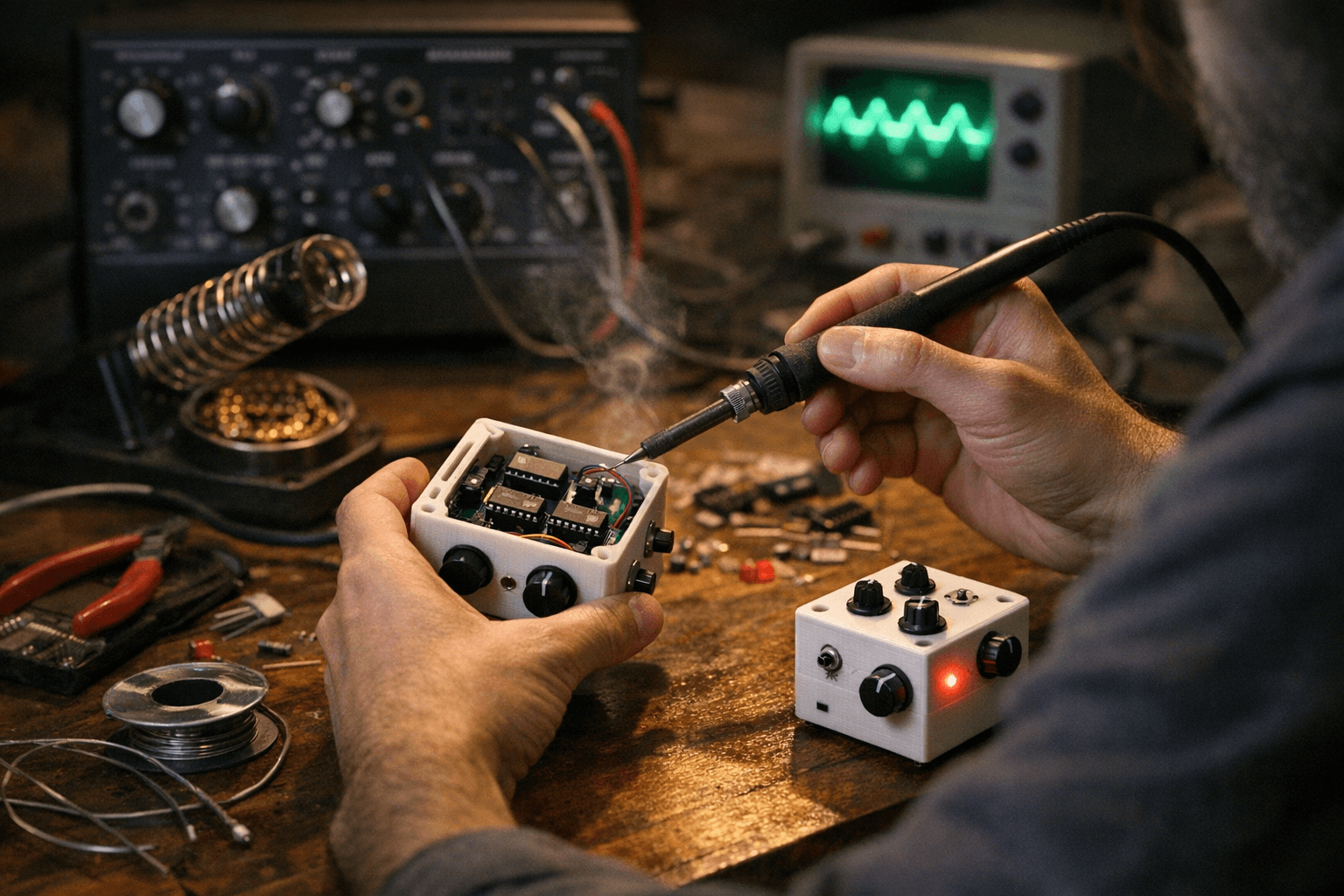
At $27 and thirty minutes of through-hole soldering, Oskitone's Space Dice delivers the descending-pitch blaster sounds of classic sci-fi noise boxes through the same 4000-series CMOS chips that have been producing alien textures since the early 1970s. No microcontroller, no firmware. Just three integrated circuits that any vintage-electronics builder will recognize on sight.
Hackaday spotlighted the project on March 28, calling it "an educational kit that is a combination vintage sci-fi space laser sound generator, and six-sided die roller." That dual function is the kit's central conceit: press the single button and a CD4093 quad NAND gate with Schmitt-trigger inputs fires a relaxation oscillator into a characteristic downward pitch sweep while a CD4017 decade counter simultaneously cycles through six on-board LEDs to land on a random number. A CD4040 binary counter handles prescaling between them. The 3D-printed enclosure, sized to the footprint of an Altoids tin, houses all three chips; the full kit with printed parts runs $40.
Tommy Marshall, the SF Bay Area software engineer and maker behind Oskitone, traced the project directly to his classroom work. "Pew pew pew, one; pew pew pew, five; peewwwww, five again?!; pew two," he wrote, describing the audio-and-dice experience. "Use it to play Candyland, choose dinner, or foley a sci-fi film. It's directly inspired by my time as a DIY Synths workshop instructor."
That workshop origin shows in the assembly guide, which treats the CD4093's Schmitt-trigger behavior, the CD4040's binary counting, and the CD4017's decade-counter sequencing as genuine teaching material rather than implementation details to gloss over. The 4000-series CMOS family, over 50 years old and still in active production, is the same technology that populated DIY noise generators and experimental sound-design circuits throughout the analog era. For anyone who has traced a signal through a vintage noise box or SFX generator, the three-chip architecture is immediately legible.
That legibility is the kit's practical value for restorers and builders. At $27 for the electronics alone, Space Dice is a consequence-free testbed for experimenting with oscillator timing, decay shape, and component-value substitution without risking anything irreplaceable. The full design files sit on GitHub under an open license, making modifications straightforward from the start. Marshall's previous Oskitone releases, including the POLY555 polyphonic synth built around 555 timer chips, consistently attracted modders who pushed well beyond the original spec; the Space Dice circuit's minimal three-chip footprint makes it an even more accessible starting point for that kind of tinkering.
For the vintage-synth community, the deeper implication is generational. Kits that teach CD4093 relaxation oscillators and decade-counter logic on a $27 budget are building the exact circuit intuition needed to eventually understand, repair, and restore the classic hardware that noise-box designers were drawing from in the first place.
Know something we missed? Have a correction or additional information?
Submit a Tip