Pedro Eustache Reveals How Rare 1970s Lyricon Wind Synthesizer Shaped His Track JOY
Pedro Eustache's track JOY spotlights the Lyricon, a 1970s wind synthesizer so rare only ~200 original units were ever hand-built.
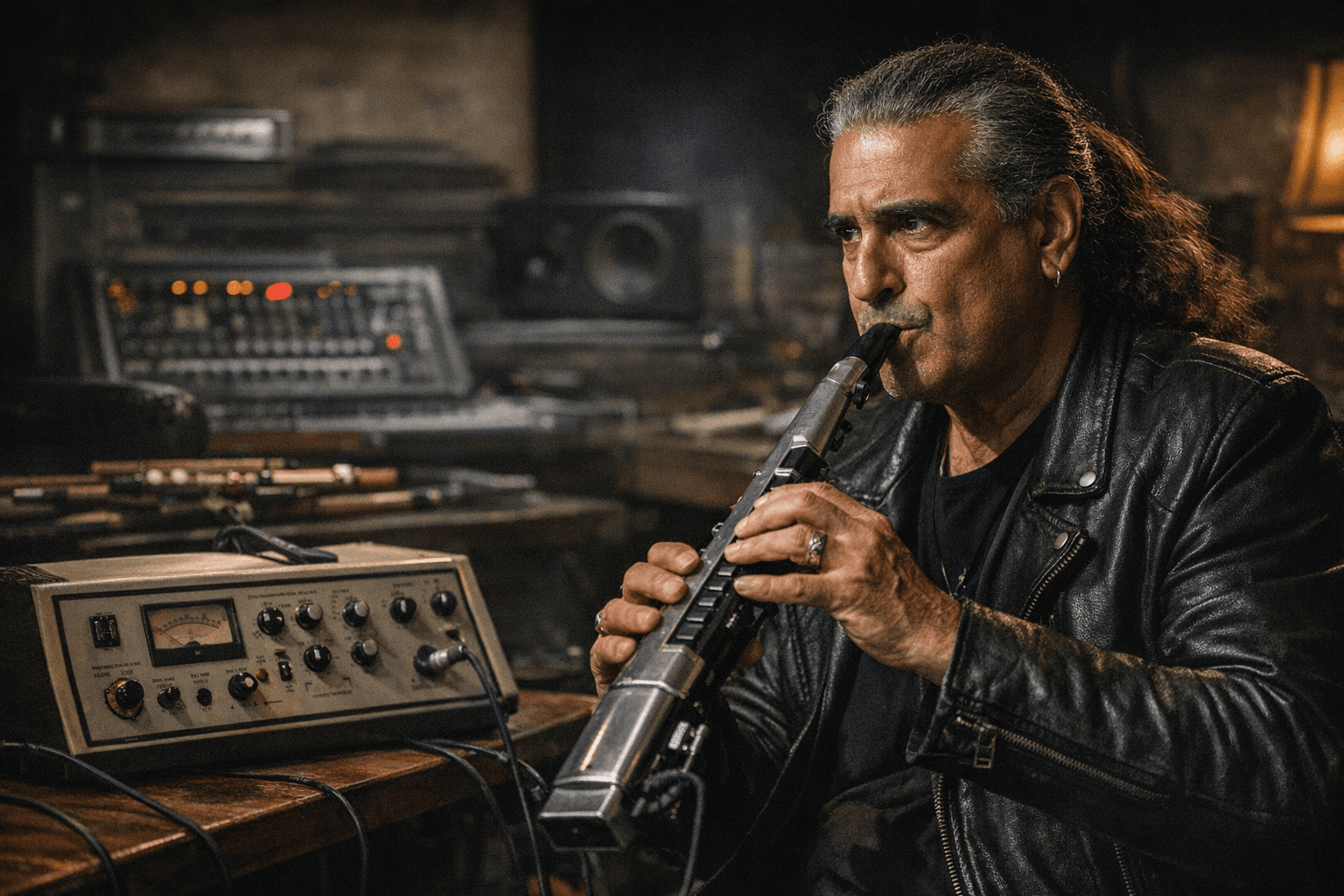
Pedro Eustache's single "JOY," the second release in his Live Studio Series, puts one of the most obscure instruments in vintage synthesis front and center: the Lyricon, an analog wind synthesizer he plays alongside newer electronic wind instruments including the Sylphyo and Photon2.
The Lyricon is an electronic wind instrument invented by Bill Bernardi and produced by Computone Inc. in small numbers from 1974 until roughly 1980. It holds the distinction of being the first wind controller, predating MIDI and the widespread adoption of digital synthesizers. Of the original Lyricon I, only about 200 units were hand-built, while roughly 2,000 units of the Driver and Lyricon II models were manufactured. That scarcity alone makes any working example a serious collector's instrument, but Eustache has gone further, deploying his in an original composition.
Using a form of additive synthesis, the Lyricon allowed players to switch between types of overtones via a key switchable between fundamentals of G, B-flat, C, E-flat, and F, with an octave range selectable between low, medium, or high. The instrument also included controls for glissando, portamento, and "timbre attack," a type of chorusing. Expressivity came from a bass clarinet mouthpiece fitted with a sprung metal sensor that detected lip pressure, while wind pressure was read by a diaphragm that changed the light output from an LED, sensed by a photocell for dynamic control. The result is a playing experience unlike anything in the current wind controller market: genuinely breath-responsive, fully analog, and deeply physical.
Eustache has developed his voice as a woodwinds player, composer, and researcher over more than 40 years, contributing as lead woodwinds player on original scores for films including Blood Diamond, War Horse, The Passion of the Christ, Kung Fu Panda, and Pirates of the Caribbean, while performing with artists from John Williams and Hans Zimmer to Paul McCartney and Gustavo Dudamel. In addition to acoustic woodwind instruments, Eustache has worked as a wind synthesist, both analog and MIDI, for more than four decades.
On his website, Eustache has singled out inventor Bill Bernardi's L1 and L2 Lyricons as vintage classic analog wind synthesizers offering "unparalleled expression." That long-standing relationship with the instrument gives "JOY" its authenticity: the Lyricon appears not as a novelty but as the primary melodic voice, heard in both the intro and across the track's central melodic lines.
The Lyricon I in particular houses fragile 1970s-era electronics, and for years the only person capable of reliably repairing them was Bernardi himself. He passed away in February 2014. As of 2025, community efforts continue with custom MIDI and CV modifications for Eurorack integration, and new driver units with updated logic have been announced.
Introduced by Computone in the 1970s, the Lyricon produced colorful, futuristic horn sounds that fit naturally with the jazz-fusion and progressive rock of the era, and was taken up by jazz greats like Sonny Rollins and Rahsaan Roland Kirk. Eustache's "JOY" demonstrates that its analog expressiveness remains unmatched on its own terms, half a century after it first appeared.
Know something we missed? Have a correction or additional information?
Submit a Tip