Waldorf Iridium Desktop MK2 adds Aphex Twin note-by-note locks
Aphex Twin helped shape the Iridium Desktop MK2’s per-note locks, and Waldorf backed the feature with more memory, new multitimbral muscle, and an upgrade path.
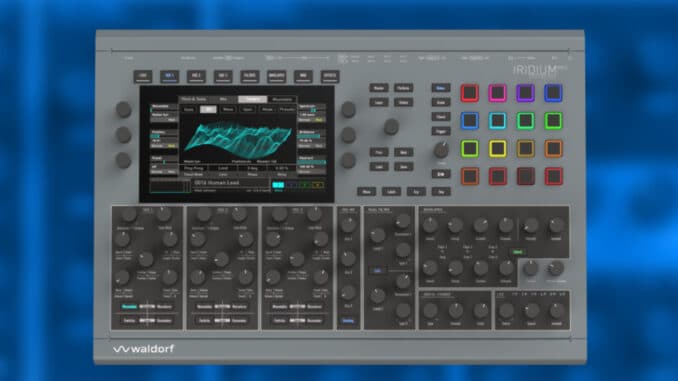
Waldorf did more than refresh the Iridium Desktop at Superbooth 2026 in Germany. It turned the compact flagship into a far more performable instrument, headlined by Per-Note-Parameter-Locks developed with Aphex Twin, a long-term Iridium Desktop user.
The new system lets each of the 128 notes hold up to 16 individual parameter variations. In practice, that means one sustained note can mutate as it rings, with oscillator synthesis modes and effect settings shifting note by note instead of staying frozen inside a static patch. Waldorf said the feature can be saved with a patch and edited on a dedicated page, which matters because this is not just a novelty trick for the demo booth. It is a workflow change that pushes the Iridium deeper into live manipulation territory.
That is the real MK2 story. Waldorf described the Iridium Desktop MK2 as a new generation of the Iridium Desktop synthesizer introduced in 2020, and said that after six years it was time to move the sonic story forward. Trade coverage also pointed to more RAM and flash storage, a new CPU board, four multi-timbral parts, and the Seeds synthesis model. That combination makes the MK2 feel less like a cosmetic bump and more like Waldorf tightening the bolts on an already serious hybrid engine.
For players comparing it with old digital monsters and wavetable classics, the pitch is clear: this is still the Quantum-derived architecture in desktop form, but with more memory, more parts, and a more immediate performance layer. The original Iridium already won fans by packing a lot of Quantum-style depth into a rack-friendly box. The MK2 now adds a more radical way to animate that depth in real time, which is exactly the sort of thing that can make a modern hardware synth feel less like a preset machine and more like a small performance system.
Existing owners were not left with a dead end. Synth Anatomy reported that a hardware upgrade for Mk1 users was set to begin in mid-August 2026, covering Iridium Desktop, Keyboard, Core, and Quantum variants, though pricing and availability for that upgrade were still to be announced. Waldorf had also kept the platform moving with firmware support, including 3.3.0 for MIDI 2.0 compatibility and high-resolution control, and a later 4.0 update with a Mutator patch randomizer, a polyphonic arpeggiator, and microtonal scaling support.
Retail listings placed the Iridium Desktop MK2 at about €2,399, or $3,699, with first batches expected in May or June 2026. For collectors chasing older digital boxes, studio users who need deep multitimbral hardware, and Waldorf loyalists hoping the line still had room to grow, the MK2 made the case plainly: keep hunting vintage if you want the old feel, but wait for this if you want the old depth with a genuinely modern control brain.
Know something we missed? Have a correction or additional information?
Submit a Tip