Why Synths With the Same Curtis Chips Still Sound Different
Same Curtis chips can still hide very different synths. Architecture, calibration, and output stages decide whether a clone feels alive or just familiar.
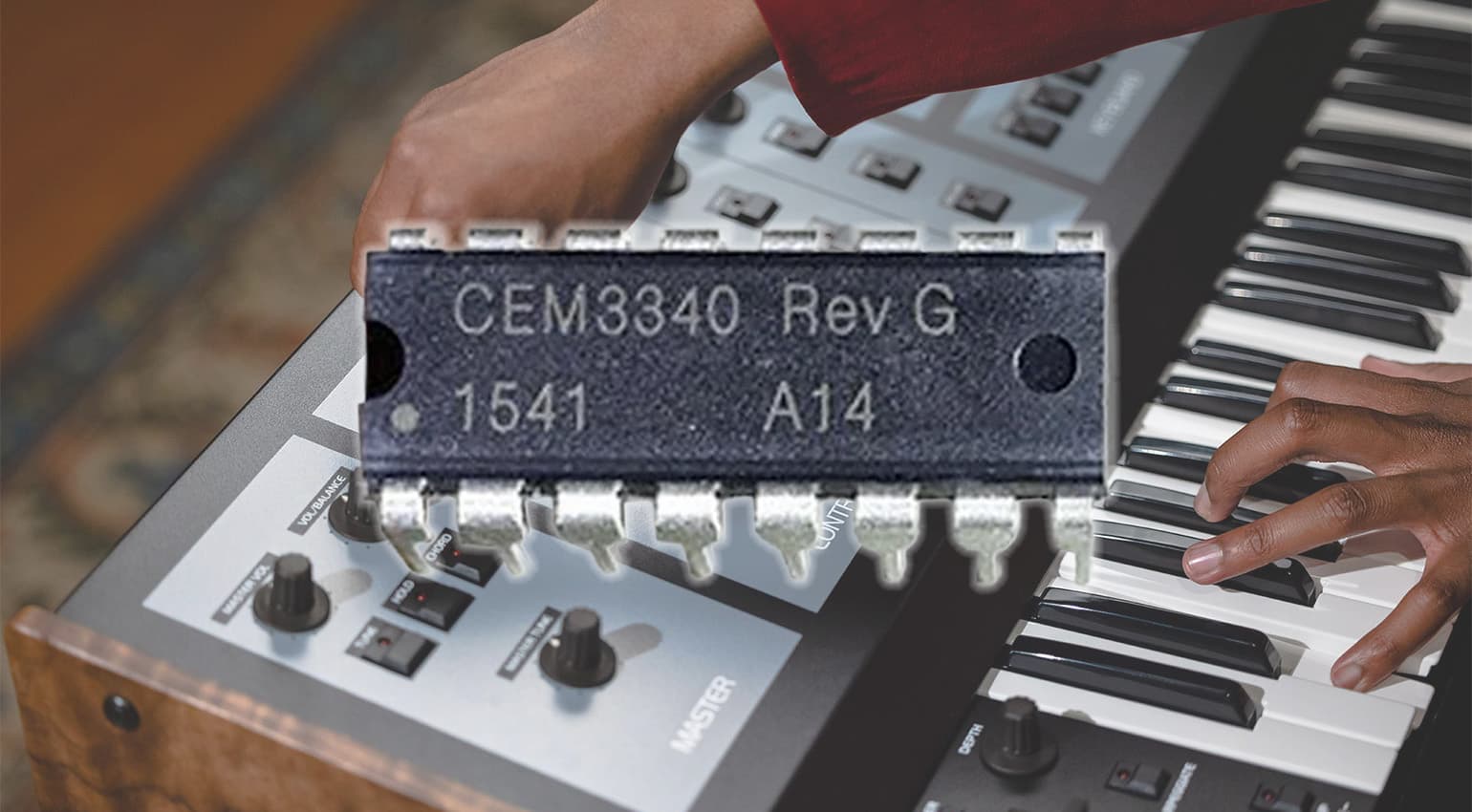
Shared chips are not shared instruments
A Prophet-5, an OB-Xa, and a Jupiter-6 can all sit in the same conversation about Curtis chips, but that does not mean they land the same way under your fingers. Doug Curtis’s CEM3340 and CEM3320 families became so widespread, from late-1970s designs into early-1980s mass-market polysynths, that the chip itself can look like a shortcut to understanding a vintage instrument. It is not. The collector’s trap is assuming a familiar IC equals a familiar sound, when the real result is shaped by the whole instrument around it.
That matters more than ever because Curtis’s parts became foundational across brands and decades. Doug Curtis, founder of Curtis Electromusic Specialties and later OnChip Systems, died on January 10, 2007, yet his chips are still discussed, cloned, and reissued because they were embedded in so many landmark machines. When the same building blocks show up in an Oberheim, a Sequential, a Roland, and even a Stylophone CPM-DS-2, the interesting question stops being “which chip is in it?” and becomes “how did the designer use it?”
Why integrated circuits changed the vintage landscape
The rise of integrated circuits transformed synth design from expensive, sprawling hardware into instruments that could be built smaller, cheaper, and in far greater numbers. That shift is part of why the vintage market is full of names that feel mythical today: the sound was never just one magic component, but a careful balance of chip choice, surrounding circuitry, and production decisions. Curtis chips, Roland’s IR3109, and SSM parts all made that compact, repeatable mass-production era possible.
The historical evidence is easy to hear in the headline models. The Prophet-5, created in 1977 by Dave Smith and John Bowen at Sequential Circuits, went through distinct revisions, and independent references note that Rev. 1 and Rev. 2 used SSM chips while Rev. 3 moved to Curtis parts. That is already a clue that “Prophet-5 sound” is not one fixed recipe. The machine’s identity changed as the underlying electronics changed, even though the name on the panel stayed the same.
The chip is only the starting point
If two synths share a CEM3340 oscillator or a CEM3320 filter, the rest of the circuit still decides how they behave. Architecture shapes the voice count, the signal path, and the way the synth responds when several voices stack up. Calibration determines whether oscillators track tightly, drift a little, or settle into a sweeter kind of imperfection. Envelope design affects attack snap, decay shape, and how quickly a patch moves from percussive to glassy to woolly.
Tuning behavior is one of the most obvious differences collectors hear in practice. A synth with stable chips can still feel alive or unruly depending on how the surrounding components are set up and how well the instrument is calibrated. Output stages matter too, because the final gain structure, headroom, and filtering before the jack can change whether a machine feels polished, aggressive, or slightly congested. That is why two instruments with the same Curtis core can still diverge in the low end, in transient bite, and in how they sit in a mix.
The classic comparison points that keep proving the rule
The Oberheim OB-Xa is a perfect example of why chip pedigree alone never tells the full story. It was released in December 1980 and is widely documented as a cost and stability-driven move away from the OB-X’s discrete SEM filter approach toward Curtis CEM3320-based filters. That change mattered, but it did not turn the OB-Xa into a copy of anything else. The panel layout, voice architecture, and supporting circuitry all contributed to a sound that still reads as Oberheim rather than generic Curtis.
Roland’s own use of the IR3109 tells a similar story. That filter chip appears in instruments including the SH-101, Jupiter-6, Jupiter-8, Juno-6/60, and Juno-106, yet nobody mistakes those machines for one another. The Juno-106 adds another useful wrinkle: its filter and VCA circuitry were packaged as the D80017A module rather than as a bare chip, and the service notes are dated July 31, 1984. That is the kind of implementation detail that matters to collectors, because a module, a replacement part, or a repair path can subtly change how the synth behaves.
What this means when you are buying, restoring, or comparing
For a vintage buyer, the main lesson is not that chips do not matter. They absolutely do. It is that chip identity is only one filter in the decision tree, and often not the most important one. A Curtis-equipped synth can sound more stable, brighter, darker, snappier, or more forgiving depending on how the voice card is built, how the envelopes are tuned, and how the output stage is voiced. That is also why clones and reissues can be accurate in one sense and still miss the feel of the original.
- Two instruments with the same chip family may age differently because their surrounding parts and calibration drift in different ways.
- Repairs and replacements can preserve the basic topology while still changing the instrument’s response in small but audible ways.
- Reissues can reproduce the headline circuit and still diverge in envelope timing, gain staging, or tuning behavior.
There are three practical reasons to care:
That is especially relevant when you compare famous Curtis-heavy machines. The Sequential Prophet-5 Rev. 3, Prophet-10, Prophet-600, Pro-One, Prophet T8, Oberheim OB-Xa and OB-8, Roland Jupiter-6, SH-101, MC-202, early MKS-80, Moog Memorymoog, Crumar Spirit, and Synton Syrinx all sit somewhere in the same broader chip conversation, but none of them are interchangeable. The CEM3340 and CEM3320 are shared ingredients, not the finished recipe.
The collector’s myth, finally put in its place
The most useful way to think about Curtis chips is as a family resemblance, not a fingerprint. They tell you what era a synth came from and what design language it may share with other classics, but they do not erase the role of implementation. Architecture, calibration, envelopes, tuning behavior, and output stages are where one machine becomes a Jupiter-6, another becomes a Juno-106, and another becomes an OB-Xa.
That is why the vintage market keeps rewarding people who listen past the chip label. The real value is not in owning the same silicon as everyone else. It is in understanding how a designer turned that silicon into a voice with its own balance, its own drift, and its own unmistakable feel.
This article was produced by Prism’s automated news system from verified source data, official records, and press releases, then run through automated quality and moderation checks before publishing. The system is built and supervised by the people who set the standards it runs under. Read our full AI policy.
Did this article answer your question?