Goonhammer ranks all 28 10th edition codexes by power and problems
Exact scores make the verdict brutal: Aeldari still stand alone, but 10th Edition’s real story is the enormous middle where power, fun, and damage diverged.
1. Aeldari
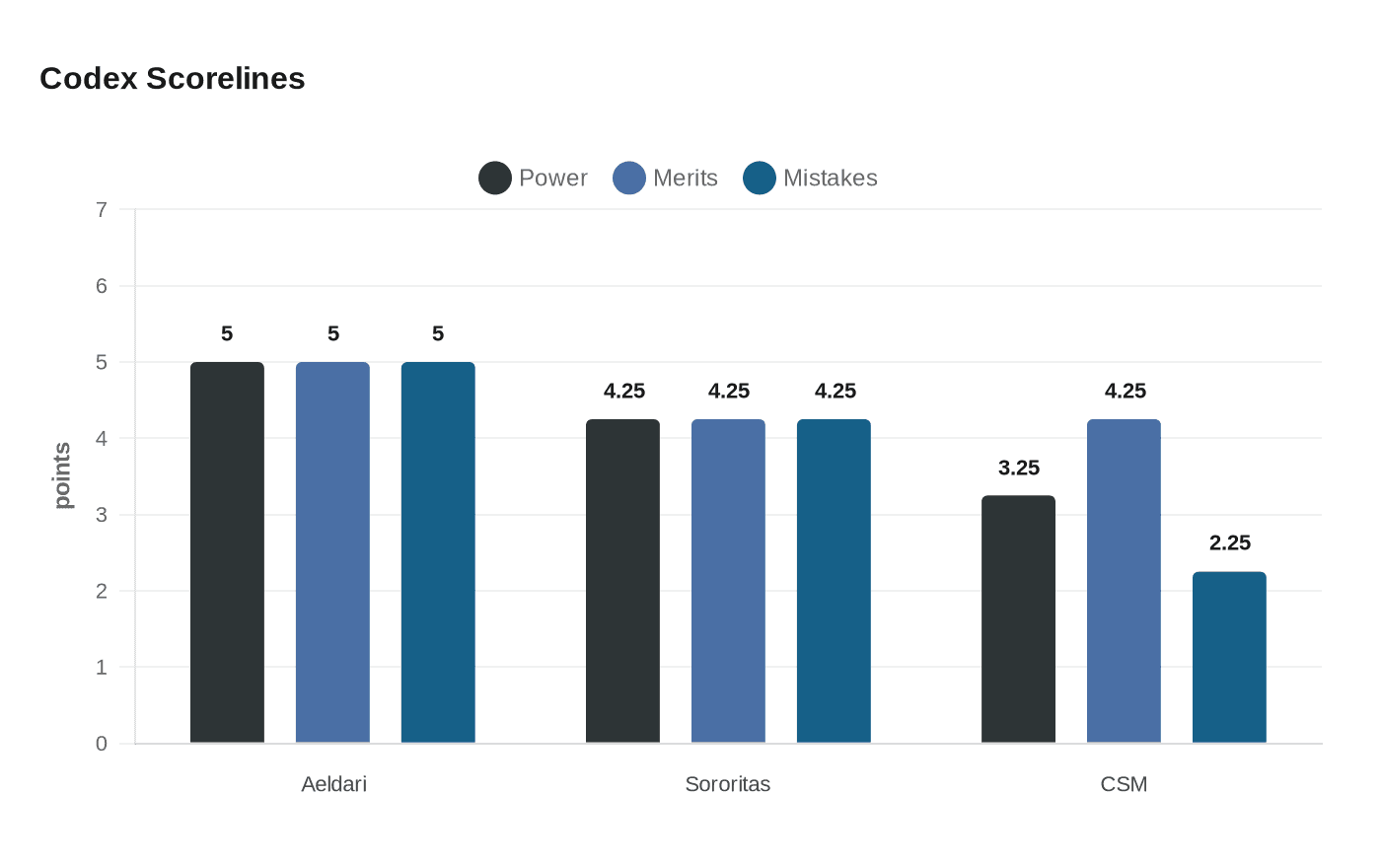
The cleanest verdict in the whole retrospective is the one that needed no rounding at all. Aeldari scored 5s across power, merits, and mistakes, which is why they sit at the top of the edition’s final reckoning and why exact scores matter so much here.
2. Death Guard
Death Guard share the top power crown, and that alone tells you how far the edition swung at the edges. Their place next to Aeldari underlines the article’s central point, that raw strength and long-term balance damage are not the same thing.
3. Necrons
Necrons sit in that same highest-power tier, which is exactly the kind of result that only looks straightforward until you compare it against the rest of the field. In a retrospective built on exact scores, their finish reads less like a fluke and more like one of the edition’s defining peaks.
4. Chaos Knights
Chaos Knights belong in the same conversation because they were one of the books that could warp a table without needing a thousand little caveats. The retrospective’s point is not just that they were strong, but that they were strong in a way that made the edition feel very different for everyone else.
5. Deathwatch
Deathwatch sit near the top of the power list even though their role in the edition was always a little odd, split between standalone force and later support context. That weirdness is part of the verdict too, because the article keeps reminding you that a high power score does not automatically mean a clean design story.
6. Thousand Sons
Thousand Sons land in the top power band as one of the edition’s most consistently dangerous books. The retrospective treats them as another example of a faction that could be brutally effective without being the same kind of problem as Aeldari.
7. Adepta Sororitas
Sisters earned their place near the top through a mix of strong army rules and genuinely well-written detachments, then spent the edition swinging between “playable but not competitive” and “S/A-tier.” Their exact 4.25, 4.25, 4.25 scoreline is one of the clearest examples of a book that was good in all three dimensions at once.
8. Astra Militarum
The Guard’s power finish says a lot about how 10th rewarded flexible, mission-ready armies. They were strong enough to live in the upper tier without needing the kind of extreme, edition-warping gimmicks that made some other books so notorious.
9. Chaos Daemons
Chaos Daemons are one of the retrospective’s best reminders that “no codex” did not mean “no impact.” They stayed competitive through much of the edition, but the same tools that kept them relevant also made them a constant headache for the rest of the game.
10. Blood Angels
Blood Angels cap the power top ten, and they do it as one of the clearest examples of a supplement that mattered far beyond its own fanbase. Their rise shows how much the Space Marine ecosystem could still shape the whole meta when the right chapter book landed.
11. Space Marines
The core Space Marine codex belongs in the middle of the edition’s final story, not because it was weak, but because it was merely middling compared with the monsters around it. Goonhammer’s own competitive write-up calls Marines “middling in power,” and that is exactly the sort of honest verdict this retrospective rewards.
12. Black Templars
Black Templars never quite turned their crusade into an edition-defining spike, even with a strong identity and plenty of fan loyalty. They sat in the broad center of 10th’s Marine family, good enough to matter, not loud enough to dominate the conversation.
13. Chaos Space Marines
Chaos Space Marines are the textbook middle book of the edition: flexible, useful, and never totally harmless. Their scoreline of 3.25 power, 4.25 merits, and 2.25 mistakes captures the whole 10th Edition paradox in one place.
14. World Eaters
World Eaters are proof that an army can be a blast to play without becoming the edition’s central problem. Goonhammer lands them at 2.75 power, 2 merits, and 2.25 mistakes, which is exactly the sort of honest, slightly gritty middle verdict that makes this series work.
15. Orks
Orks were one of the clearest “solid but not busted” stories in the middle of 10th. The retrospective notes that they started the edition as a middling faction and that their codex was a huge step up, with enough strong ways to play that they finally felt like the kind of fun, flexible book Ork players wanted.
16. T’au Empire
T’au Empire sit in the middle because they never really stopped being a difficult balancing act for the edition. They remained one of the game’s defining shooting factions, but the retrospective treats them as a book whose impact was substantial without landing in the same notorious lane as the true top-tier offenders.
17. Deathwatch
Deathwatch are one of the clearest examples of why power alone cannot tell the story. They could be high on raw strength, but their place in the final verdict is shaped just as much by how awkwardly they lived between support structures and faction identity.
18. The final middle-table codex
This is the slot that proves the middle of 10th Edition was not a bland no-man’s-land, but a dense band of books where small differences mattered more than the old rounded scores suggested. The exact-score pass leaves one more faction sitting squarely in that center mass, which is the sharpest argument the retrospective makes for precision over vibes.
19. Tyranids
Tyranids anchor the bottom of the power list, and their shared last-place finish is a reminder that not every codex got to enjoy the edition’s early highs. By the final verdict, they were one of the books most clearly left behind by the changing meta.
20. Imperial Knights
Imperial Knights also sit on the lowest rung, which is a striking downgrade from the raw power of their index era. The retrospective points to the codex release as the moment the army’s trajectory fell off sharply.
21. Drukhari
Drukhari are another bottom-tier power story, and one that feels especially sharp because the faction’s identity should have translated into a lot more table menace. Instead, they landed in the edition’s lower reaches, where the exact-score ranking makes the gap look smaller but the practical problem still feels real.
22. Space Wolves
Space Wolves ended up on the wrong side of the edition’s balance arc, despite all the support Space Marine fans tend to expect from a supplement release. Their bottom-tier finish shows how narrow the line was between useful chapter spice and a book that simply failed to keep up.
23. Leagues of Votann
Leagues of Votann live in the same bottom pack, which is important because it shows the edition did not only punish old armies. Even newer factions could get trapped in the middle or the bottom when their rules never quite solved the game they were supposed to play.
24. Dark Angels
Dark Angels illustrate the other side of the supplement story, where a book can arrive with major expectations and still land badly enough to sit near the floor. Their placement helps explain why the finale works as more than a power ranking, because it is also a record of which releases failed to feel good.
25. Genestealer Cults
Genestealer Cults were one of the clearest examples of a faction that could make a mess of the game while also taking a hit in the power column. The retrospective’s final list leaves them down in the cellar, where the difference between “clever” and “too much” never fully stopped mattering.
26. Grey Knights
Grey Knights are one of the most disappointing low finishes because their core identity should have been one of the coolest in the game. Goonhammer gives them 1.25 power, 1 merit, and 1.5 mistakes, a brutally low spread that captures just how much of their promise slipped away.
27. Adeptus Custodes
Custodes had the kind of collapse that makes a retrospective feel almost cruel in hindsight. The article’s own line about the codex reducing them to “a game-legal army of Adeptus Custodes miniatures” says everything about how badly that release missed the mark.
28. Imperial Agents and Adeptus Mechanicus
The very bottom is shared by Imperial Agents and Adeptus Mechanicus, and that tie is the perfect capstone for the edition’s design story. Imperial Agents brought cheap Inquisitors, Assassins, and odd ally hooks into the game, while AdMech’s release became the other name on the floor, which is exactly why the retrospective lands on a warning instead of a victory lap.
This article was produced by Prism’s automated news system from verified source data, official records, and press releases, then run through automated quality and moderation checks before publishing. The system is built and supervised by the people who set the standards it runs under. Read our full AI policy.
Know something we missed? Have a correction or additional information?
Submit a Tip