Power armour through the ages, a history of Space Marine marks
Every mark of Space Marine armour is a clue to era, battlefield role, and kitbash potential, from Thunder Armour to the Primaris reset.
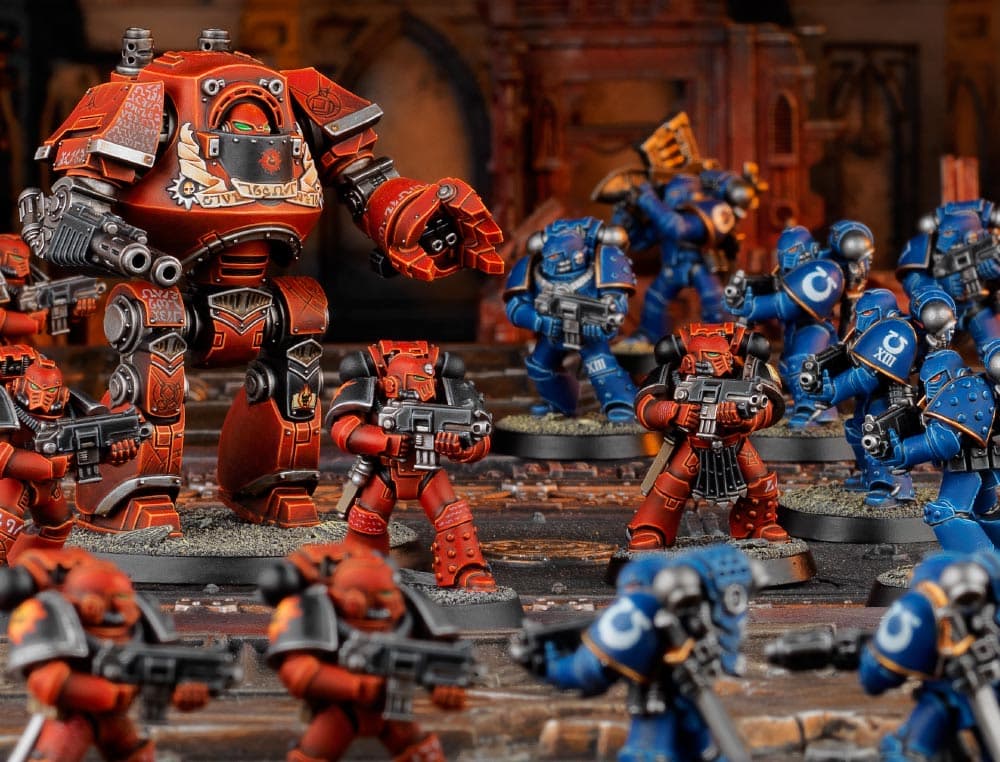
A beak helm, a slabbed siege chest, a Mark X Gravis frame — a squad of Space Marines tells you its war story before you ever pick up the model. The helm shape, the chest plate, the way the armour is layered across the torso and shoulders, all of it points to a specific era of the Imperium and a specific kind of war. Once you learn to read those silhouettes, you stop seeing “just power armour” and start seeing Great Crusade frontier kits, Horus Heresy siege suits, classic Firstborn icons, and the modern Primaris family in one continuous visual language.
The armour mark is the timeline
The Great Crusade runs roughly from 798.M30 to 005.M31, and the Horus Heresy follows as the civil war in M31. Lexicanum and Warhammer Community’s “Power Armour Through the Ages” treat each mark as a timestamp: these suits are the Imperium’s industrial history worn on the body.
Mark I tells you expeditionary warfare, Mark III suggests brutal void fighting and siege work, Mark V says battlefield improvisation, and Mark X points you straight at the modern Primaris era. If you collect, paint, or kitbash, the mark matters because it changes what the model is telling the viewer before the first brushstroke even hits the plastic.
Reading the classic marks
Mark I, often called Thunder Armour, is the earliest shape in the chain and feels exactly like Great Crusade-era wargear should: rugged, frontier-ready, and built for dangerous work at the edge of human expansion. It looks like armour made for a crusade that still had to claim ground rather than hold it. When you see that silhouette in art or conversion work, it signals a very early, very rough phase of Astartes history.
Mark II, the Crusade pattern, is the classic long-campaign suit. It is the armour of armies that have moved beyond the first rough expeditions and need reliable protection for extended operations. Mark III, Iron Armour, is where the design starts shouting siege and boarding actions, with extra frontal protection that makes sense for void warfare and trench fighting.
Mark IV, Maximus, is the late-Heresy refinement point. It is the elegant, mass-produced suit that became a template for later generations, which is why it reads as both advanced and familiar. Mark V is the most interesting in a hobby sense because it is the armour of improvisation, the kind of thing you expect when supply lines are collapsing and Techmarines are patching suits together under fire. That makes it perfect if you want a veteran squad that looks battered by a long campaign rather than cleanly issued from a forge world.
Mark VI, Corvus, is the one most people can spot from across the table. The beak-helmet silhouette has enormous visual memory because it connects old Space Marine imagery with modern Horus Heresy kits, and Warhammer Community has kept returning to it with pieces such as “A Brief History of Mark VI Power Armour” and “Heresy Thursday - The Raven Guard Are Here to Pilfer a Pile of Shiny Mark VI Armour Upgrades.” If you want a model that reads instantly as Heresy-era, this is still the easiest mark to recognise.
Mark VII, Aquila, is the classic Firstborn look most people picture when they think of a standard 40k Space Marine. It is the armour of the post-Heresy era and the design language that dominated the old tabletop for decades. If you are building a chapter force that is meant to feel traditional, this is the silhouette that still carries the most weight.
What the modern range changed
Mark X is not one suit but a family, and that distinction matters. Warhammer Community’s “40 Years of Warhammer - Primaris Intercessors and the Dawn of a New Age” marked Primaris armour as a major design shift, and the range itself makes the point by splitting into Tacticus, Gravis, and Phobos. Tacticus is the baseline battlefield suit, Gravis is the heavier, more durable pattern, and Phobos leans into stealth and reconnaissance.
That split is useful on the hobby desk because it turns armour into doctrine. A Gravis marine does not just look bulkier, he reads as the kind of soldier you send into punishment zones. A Phobos model looks leaner because the job is infiltration and screening, not sitting in the front line and taking the hit. This is the modern equivalent of reading Mark III as siege armour or Mark VI as a fast-moving Heresy suit.
Why collectors and converters care
Power armour marks are one of the best tools for making a force look like it has a history. Mixed-mark squads can tell a believable campaign story, especially if you want veterans wearing scavenged or repaired gear beside newer suits. That is where the old and new ranges play nicely together, because a Mark VII helmet on a newer body or a Mark VI shoulder paired with a Primaris torso can suggest inheritance, rescue, or a chapter with long service records.
A few practical uses make the subject more than lore wallpaper:
- Use older marks for veteran squads, relic units, or kill teams that need a worn, storied look.
- Use Mark III or heavy armour details when you want a siege force or boarding party to feel grounded.
- Use Mark VI or Mark VII silhouettes when you want instant recognisability on the table.
- Use Mark X variants to signal role clearly, especially when building around Tacticus, Gravis, or Phobos doctrine.
Power armour is worn primarily by Space Marines, Sisters of Battle, Adeptus Custodes, and Chaos Space Marines, so the mark system is bigger than one faction’s wardrobe. Adeptus Custodes armour is a supreme marvel of science and technology, far superior to standard Space Marine armour, which gives you a sharp comparison point for scale and prestige whenever Custodes appear beside Astartes.
Why the topic still lands now
Arbitor Ian’s 2022-11-29 video “The Evolution of POWER ARMOUR: Every Mark from I to X,” SleepySack’s 2020-06-01 “SPACE MARINE POWER ARMOUR: Mk.1 to Mk.X History,” and Auspex Tactics’ 2024-03-04 “Every Mark of Space Marine Power Armour in Warhammer 40K” all tackle the same practical question: how to identify these suits and place them in the setting. The question comes up every time a new kit, artwork piece, or conversion shows up: what am I actually looking at?
This article was produced by Prism’s automated news system from verified source data, official records, and press releases, then run through automated quality and moderation checks before publishing. The system is built and supervised by the people who set the standards it runs under. Read our full AI policy.
Did this article answer your question?