Warhammer 40,000 Big Summer Preview gathers Orks, Custodes, starter sets
Orks, Custodes and starter kits did the real work here. The preview also shows Games Workshop using 40k to pull in new players, not just sell veterans another release.
The biggest story in the Big Summer Preview is not a single shiny kit. It is the way Games Workshop used Orks, Custodes and starter products to show what actually changes at the table, in the cabinet, and for anyone trying to get into Warhammer 40,000 without already owning a pile of plastic. The roundup page, posted on 26 June 2026 at 20:23, pulled the evening’s reveals into one hub and made the shape of the event obvious: this was a broad franchise push, but the 40k pieces carried the clearest practical payoff.
The real 40k winners
For active players, the new 40k Starter Set is the cleanest win of the night. It comes with two complete Combat Patrol armies, Space Marines and Orks, plus a Core Rules book, 15 pieces of unpainted terrain, a double-sided game board, range rulers, dice and a Starter Guide. That is not just a box for beginners, it is a structured on-ramp that can get two people playing a proper game fast, with enough terrain and rules support to make it feel like a real start rather than a shrink-wrapped sample.
The Introductory Set goes even further down the entry ladder. It packs in 12 miniatures, six paints, an introductory book, folding card terrain and a game mat, which makes the hobby ask feel much smaller for someone testing the water. In practical terms, this is the clearest signal that Games Workshop wants the next wave of 40k players to arrive with a brush in one hand and a rulebook in the other, not just a codex wishlist.
Warhammer Academy pushes that same idea harder. The launch includes more than 150 videos on Warhammer 40,000, with free lessons that cover lore, collecting, building, painting and gameplay. That matters because onboarding has always been the hidden friction point in 40k, and this is a direct attempt to flatten it. Between the Starter Set and the Academy, the company is not just selling entry points, it is building a ladder.
Why Custodes are the collector’s win
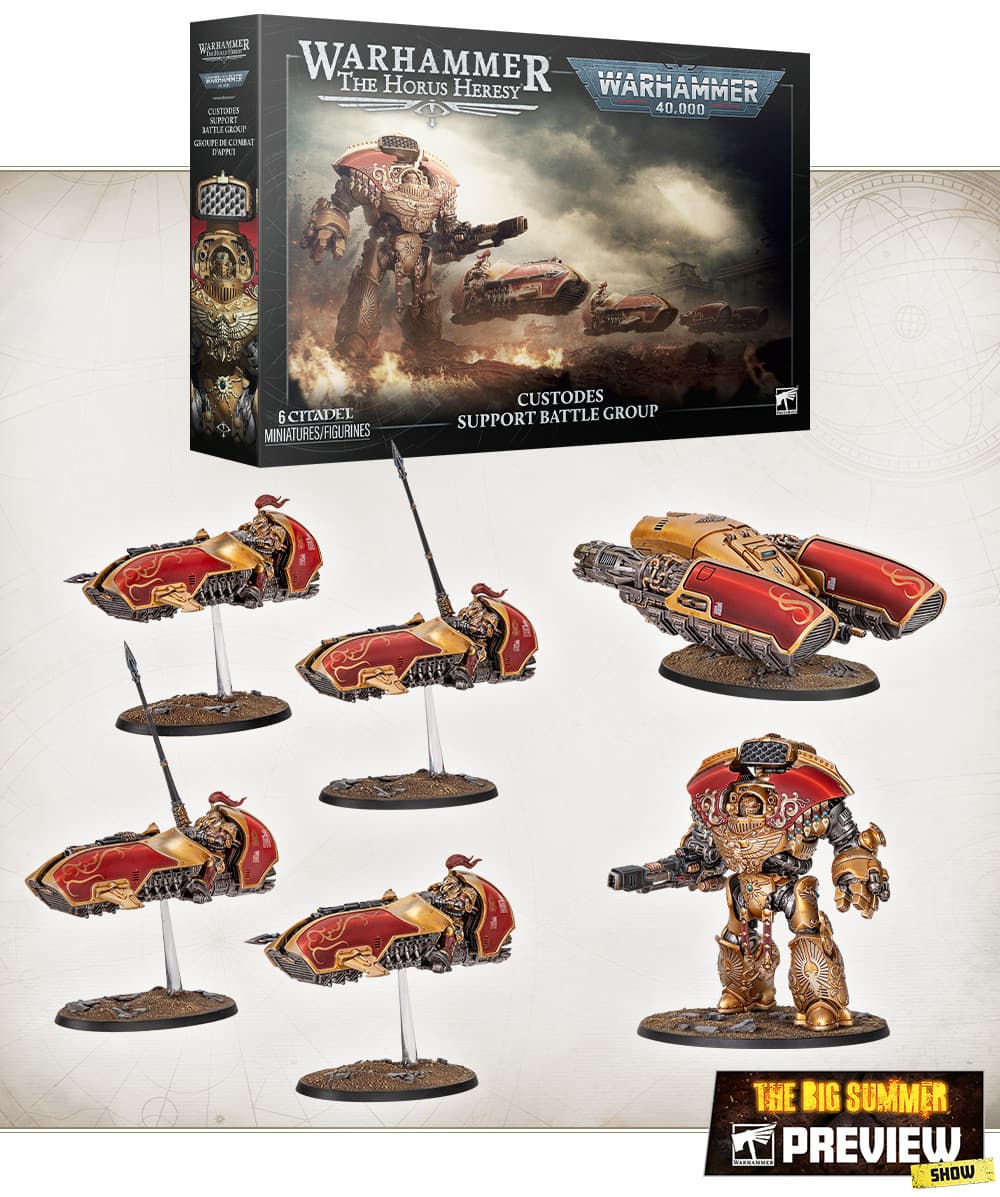
The Custodes Support Battle Group is the kind of reveal that lands with both collectors and existing players. Three classic Custodian units make their plastic debut here, and the box contains four Gyrfalcon Jetbikes, a Pallas Grav-attack and a Telemon Heavy Dreadnought. Warhammer Community says it is the first boxed set branded with both the Warhammer 40,000 and Warhammer: The Horus Heresy logos, which makes it feel like a bridge product rather than a single-system oddity.
That crossover branding is the real story for Custodes fans. It tells you these kits are being positioned as shared iconography across the wider Imperial range, not locked into one shelf of the range. The Telemon is especially notable, since it is one of the largest Dreadnoughts deployed by the Imperium and is described as rivaling the Saturnine-pattern in size, which is exactly the kind of fact that keeps lore readers and model painters equally hooked.
For anyone building an elite Imperial army, this is the sort of release that matters immediately. A box like this does not just add new units, it gives the faction a fresher visual center of gravity and a cleaner route for players who want spectacle without giving up army cohesion.

The reveals that matter, even when they are not pure 40k
The preview page also gathered the broader franchise story, and that matters because it shows how 40k sits inside Games Workshop’s bigger release machine. Aeldari Exodites got a first look in miniature form for Kill Team, which is the sort of reveal that fires up lore readers and kitbashers even if it does not send them straight to a tournament list. It is a reminder that the Webway and Maiden Worlds still have room to produce something new-looking, not just another familiar battlefield package.
Necromunda also got a major reset, with a new edition, refreshed rules and a new core set called the Necromunda Skirmish Core Set. Even though it lives in the Underhive rather than the standard 40k battlefield, this is still relevant to 40k fans because Necromunda is one of the best places in the range for terrain, gang culture and grimy side stories. If you care about the city-planet side of the setting, this is not background noise.
Legions Imperialis got its own serious collector bait: two new Warlord Titan kits and one new Reaver Titan kit in plastic. That is not a release aimed at casual 40k buyers, but Titan collectors and Epic-scale veterans know exactly what it means when more big engines move into plastic. The night also brought Titan weapons into the mix for that range, which reinforces the same message: Games Workshop wants the giant-war-machine end of the hobby to keep growing alongside the mainline game.
There was more on the schedule, but much of it sits farther from the average 40k list-builder. Ogor Mawtribes, Blood Bowl Sevens and Warhammer: The Old World all appeared in the wider preview, along with a new Warhammer+ World Eaters animation focused on the Butcher’s Nails. Those reveals help explain the breadth of the event, but they do not change the day-to-day decisions of most 40k players the way Orks, Custodes and starter kits do.
What the preview is really saying
The smartest way to read the Big Summer Preview is as a split screen. On one side are the releases that directly affect what gets built, painted and played in 40k right now, especially the Starter Set, the Introductory Set and the Custodes battle group. On the other side is the wider ecosystem, where Kill Team, Necromunda, Legions Imperialis, Warhammer+ and The Old World all keep the brand loud and connected.
That is why the preview hub matters so much. It is not just a convenience page, it is the map of where the hobby is being pulled next. And in that map, the clearest route runs through Orks, Custodes and the new starter boxes, with the rest of the evening filling in the universe around them.
This article was produced by Prism’s automated news system from verified source data, official records, and press releases, then run through automated quality and moderation checks before publishing. The system is built and supervised by the people who set the standards it runs under. Read our full AI policy.
Did this article answer your question?