Curious Millennial guide compares cartridge refills and double-edge blades
The real choice is not blades vs blades, but cartridges versus double-edge systems, where cost-per-shave, waste, and technique all tell a different story.
A cartridge refill and a double-edge blade are not interchangeable products. Here, “blade” is doing two different jobs, and treating them like they are the same blurs the real decision: whether you want convenience and a built-in shave system, or a lower-cost, more hands-on setup that asks more of your technique.
Why this comparison matters
In cartridge land, you are buying lubrication strips, pivoting heads, and brand-specific handle compatibility; in double-edge shaving, you are buying a stack of thin steel blades and the freedom to pair them with a safety razor you actually know how to use.
Cartridge refills are sold by blade count, but blade count alone does not tell you much about the feel on your face, the cleanup, or the cost over time. A 50-count box of double-edge blades, by contrast, makes the economics obvious before you even load the razor: there is less packaging and less plastic.
The cartridge logic: comfort, speed, and less technique
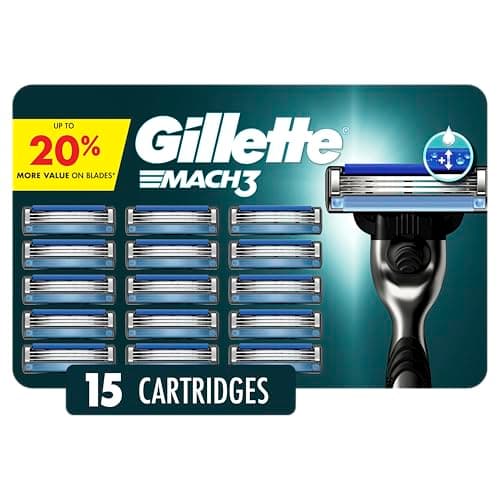
Gillette Mach3 sits in the familiar daily-shave lane. Its refill uses three blades progressively positioned to cut hair gradually closer, and each refill lasts up to 15 comfortable shaves. That is the cartridge pitch in a nutshell: enough cutting power to keep the shave efficient, with a design that stays friendly for people who do not want to think hard about angle or pressure every morning.
Amazon Basics MotionSphere pushes a different part of the same formula. The five-blade refill has a multi-pivot design, a hypoallergenic lubricating strip with vitamin E, an anti-clog rinse design, and a precision beard trimmer for goatees, sideburns, and under the nose. That is not a traditional wet-shaving approach so much as a convenience package, built for quick rinsing and contour-following rather than blade feel or ritual.
Gillette Fusion5 is the other end of the cartridge spectrum in this roundup. Its refills use five antifriction blades, a lubrastrip, microfins, and a back-of-handle precision trimmer, with each refill lasting up to 20 shaves. If Mach3 is the easy everyday cartridge, Fusion5 is the more feature-loaded version for someone who wants closeness and gadgetry in one system.

Cartridges are easier to rinse, simpler to swap, and designed to ask less of the shaver. The tradeoff is waste, because every refill brings more plastic, more moving parts, and a higher burden on the manufacturer’s ecosystem.
Where double-edge blades still make sense
SHAVING REVOLUTION’s Double Edge blades are sold in a 50-count pack and positioned as a long-term value option built around platinum Japanese stainless steel. That is the sort of detail that tells you exactly who the product is for: people who want consistency, a lower per-shave cost, and a blade format that belongs in a safety razor instead of a cartridge handle.
A hoe-shaped safety razor was produced in the United States in 1880, and King Camp Gillette later combined that idea with the double-edged replaceable blade. Stainless-steel safety-razor blades began being manufactured in several countries in the early 1960s, which improved longevity and made the modern wet-shaving blade far more practical than the older carbon-steel model.
Britannica puts Gillette’s first sale in 1903 at 51 razors and 168 blades, and by the end of 1904 the company had produced 90,000 razors and 12.4 million blades.
What actually changes at the sink
The technical demands are where the two systems diverge most sharply. Cartridges are built to be forgiving. They lean on pivoting heads, lubricating strips, and trimmer edges so you can move quickly and still get something presentable. That is a real advantage if your morning routine is rushed or your skin reacts badly to too much blade work.

Double-edge shaving asks for more discipline. You pay attention to angle, pressure, and lather quality because the razor does not compensate for sloppy technique the way a cartridge often does. The upside is that once your technique clicks, you get sharper feedback from the blade and a much more controlled shave.
A practical way to think about it:
- If you want speed and minimal learning curve, cartridges make sense.
- If you want lower ongoing cost and less waste, double-edge blades are hard to beat.
- If your skin prefers extra glide, a lubricating strip and antifriction cartridge design may help.
- If you care about edge consistency and the ritual of building a shave, DE blades are the more satisfying tool.
Harry’s, compatibility, and the hidden cost of convenience
Harry’s Original refills show how even a premium-feeling cartridge setup still lives inside a closed system. Its Original blades use five German-engineered blades made from Swedish steel, with a flex hinge and lubricating strip, and the refills are compatible only with Harry’s Original razor systems, previously known as Truman or Winston. Once you are in, the handle and the refills are designed to stay together.
Cartridge systems offer real convenience, especially if you value comfort features and a familiar shave. Double-edge blades, especially a 50-count pack like SHAVING REVOLUTION’s, ask more from your hands but give more back in per-shave value, lower waste, and freedom from brand-specific handles.
This article was produced by Prism’s automated news system from verified source data, official records, and press releases, then run through automated quality and moderation checks before publishing. The system is built and supervised by the people who set the standards it runs under. Read our full AI policy.
Did this article answer your question?