Wet shaving guide helps users find the right blade sampler
Blade choice is the most personal variable in wet shaving, and a sampler pack works best when you test each blade the same way, over several shaves.
A full box of 100 blades is a commitment you do not need to make blind. Blade choice is the most personal variable in wet shaving, so a sampler pack should feel like a test bench, not a shopping cart. The right double-edge blade can make the same razor feel smooth, efficient, or unforgiving, depending on sharpness, coating, beard growth direction, skin sensitivity, and your own technique. Primadian’s June 27, 2026 sampler-pack guide lands on the same practical lesson long held in wet shaving: there is no universal “best blade,” only the blade that clicks with your razor and your face.
Why sampler packs make sense
Blade feel can change dramatically from brand to brand, and even from one coating to another, so a sampler pack gives you a way to compare real-world performance before you buy in bulk. It is a money-saving move, but it is also a frustration-saving one, because a blade that feels perfect in one razor can feel rough, dull, or overly aggressive in another.
That matters even more if you are still learning the basics. Traditional wet shaving has a lot of moving parts, and Sharpologist calls the razor-and-blade search intimidating because the same razor can shave very differently depending on the blade you load into it. Blade gap, razor design, prep, and shaving angle all shape the result, which is why you want to isolate one variable at a time instead of throwing everything into the mix.
How to test a blade the right way
If you want meaningful results, you need a repeatable routine. The cleanest method is simple: keep the same razor, the same soap, the same prep, and the same pass pattern while you test each blade. That lets you feel the blade itself instead of confusing its behavior with a new lather, a different angle, or a bad lather day.
Watch four things across several shaves:

- Sharpness, meaning how easily the edge cuts your beard without extra pressure
- Smoothness, meaning how much drag or scratch you feel on the skin
- Irritation, especially on the neck and any spots that burn after the shave
- Consistency, meaning whether the blade feels the same on shave one, shave two, and shave three
That last point is easy to overlook. Badger & Blade’s DE blade data table separates sharpness, smoothness, longevity, consistency, price per 100 blades, and manufacturing location. A blade that feels great for one shave but falls apart fast is not the same thing as one that stays predictable over multiple uses.
What the sampler packs are trying to solve
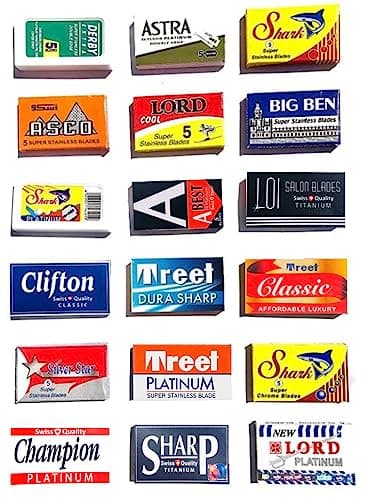
The 100-blade Razor Blades Club sampler spans 18 brands and is the broadest testing set. It makes sense if you enjoy comparing blades across a lot of faces, razors, and beard types. That kind of pack is also useful for barbers and long-term testers who want a wide sample instead of a narrow guess.
The 100-blade Lotus pack covers 10 brands, and the 40-blade Razor Blades Club mix covers eight brands. Those smaller mixes are better entry points if you want less complexity while you learn what your skin likes. A 35-blade stainless-steel sampler is an even smaller test bed, a smarter place to start if you know you only want to compare a few blades before settling in.
Why coatings and construction matter
A DE blade is not just a strip of steel with a brand name stamped on it. Current blades are commonly stainless steel, but coatings and finishes can change how they feel and how long they last. Common finishes include chrome, platinum, tungsten-chromium polymer, PTFE, and nano-Teflon, and those layers are where much of the smoothness and corrosion-resistance discussion actually lives.

The current market makes that visible. BIC’s DE blades are chrome-plated stainless steel. Parker Shaving’s premium blades are stainless steel plated with platinum-tungsten-chromium polymer. Rex Supply Co.’s platinum DE blades use chrome and platinum coating plus a nano-Teflon layer.
Razor Blade Company ties coated versus non-coated blades to friction and microscopic layers in cutting performance.
The old problem is still the same one
Wet shaving’s modern sampler culture sits on top of a very old problem, which is how to make shaving safer and easier without forcing every user to master a straight razor. Safety razors were originally developed to reduce the skill needed for injury-free shaving and to reduce reliance on professional barbers. King C. Gillette’s original razor patent was due to expire in November 1921, and Gillette introduced the New Improved Gillette Safety Razor in spring 1921 as the company moved to stay ahead of competition.
A better way to build your routine
If you are building a repeatable wet-shaving setup, start with one razor and one soap, then work through a sampler in a steady order. Give each blade several shaves before deciding, because a first impression can be misleading. A blade that feels merely decent on day one may settle in by shave three, while another one that feels sharp right away may turn harsh once your beard and skin start talking back.
This article was produced by Prism’s automated news system from verified source data, official records, and press releases, then run through automated quality and moderation checks before publishing. The system is built and supervised by the people who set the standards it runs under. Read our full AI policy.
Did this article answer your question?