Ashley Harwood Brings Sea Urchin Ornaments, Wet-Bowl Turning to Tylden Seminar
Freehand sharpening to a 40/40 grind and wet-bowl Push-Cut technique were the twin pillars of Ashley Harwood's sold-out one-day seminar in Tylden.
A Charleston-based production turner who built her system around a 40/40 bowl gouge grind led a sold-out one-day seminar at Glen Rundell's workshop in Tylden on April 4, turning Ashley Harwood's Australian visit into a compact masterclass in both spindle and wet-bowl technique.
Harwood made the trip from South Carolina as one of six international guest artisans at the Lost Trades Fair in the Macedon Ranges, where she demonstrated alongside more than 150 local makers across a full weekend. The Tylden seminar was added on as a separate booking, keeping the group tight and the floor time high.
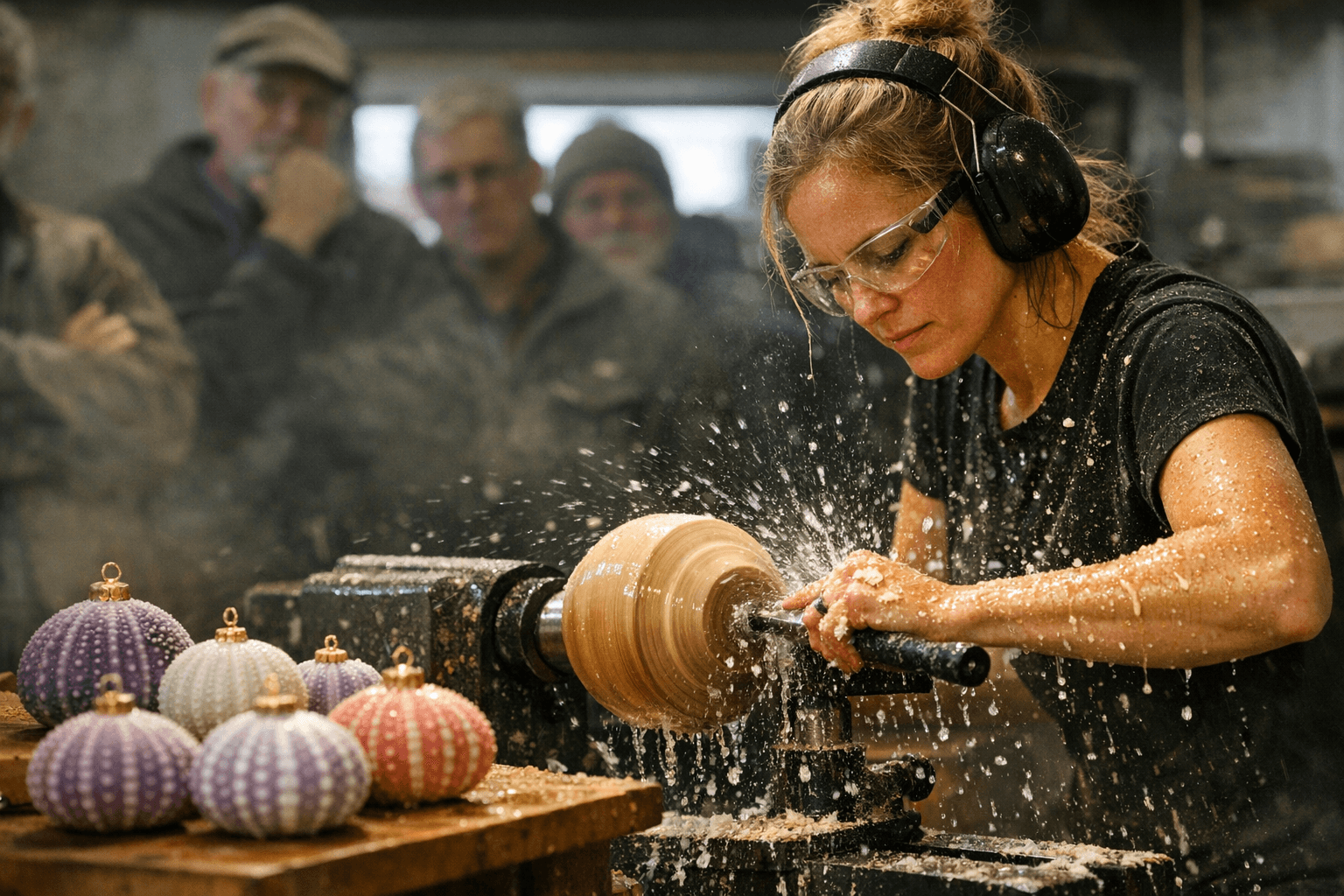
The morning session centred on the Sea Urchin Ornament, the fine spindle piece that has become the clearest showcase of Harwood's technical range. She worked through the form using three tools: a half-inch bowl gouge, a detail spindle gouge, and her vortex tool, each sharpened freehand to match her 40/40 grind. That profile, a 40-degree flute angle paired with a 40-degree bevel, is the configuration she has codified into her own USA-made tool line. She demonstrated it at the wheel without a jig, talking through bevel contact and tool control before moving into the cuts that build the ornament's signature ridged and tapered form. Assembly, shell preparation, and packaging were included, giving the session a production-facing finish. For anyone planning to replicate this curriculum at a club night, arriving with a bowl gouge already roughed into a near-40/40 shape saves the opening half-hour and lets the freehand discussion build on something familiar rather than starting from scratch.
The afternoon shifted to wet-bowl turning on Glen Rundell's Vicmarc VL300 long-bed lathe. Harwood used the session to demonstrate her Push-Cut method for exterior finishing, a technique she advocates for its combination of cleaner surfaces and reduced physical exertion compared to conventional approaches. Wet wood moves differently than dried stock, and turning fresh off the round requires reading the grain in real time. Attending with even a passing feel for bevel contact on a benchtop lathe makes the Push-Cut's geometry far easier to follow when it's running on a machine as torquey as the VL300.
For club organisers thinking about booking a visiting turner, the Tylden structure offers a useful model. The host workshop needs to supply a lathe capable of wet bowl turning, a grinder with a tool rest platform that can be set to the demonstrator's preferred angles, and enough clear floor space for safe sightlines across both stations. Three questions worth asking a prospective demonstrator upfront: What lathe specifications does the demonstration actually require, and is your shop's machine genuinely up to it? Does the turner cover sharpening in depth, or will attendees need pre-set tools to follow along? And is the programme tiered by experience, or does it run as a single session regardless of background?
Harwood's tool line, which includes Push-Cut bowl gouges in M2 steel hardened to 62-64 Rockwell and her Angle Wrench jig for dialling in the 40-degree platform setting, reflects the same production logic she brought to Tylden. A codified grind angle and a lower-fatigue cutting method together form the kind of pairing that tends to outlast a single seminar and actually change how someone works at the lathe.
This article was produced by Prism’s automated news system from verified source data, official records, and press releases, then run through automated quality and moderation checks before publishing. The system is built and supervised by the people who set the standards it runs under. Read our full AI policy.
Did this article answer your question?