Turner Shapes Oak Burl Into Striking Bottle Form on the Lathe
A raw oak burl blank, costing pennies per pound, becomes a convincing Prime Hydration bottle on the lathe — a project that demands taper control, void management, and a steady nerve.
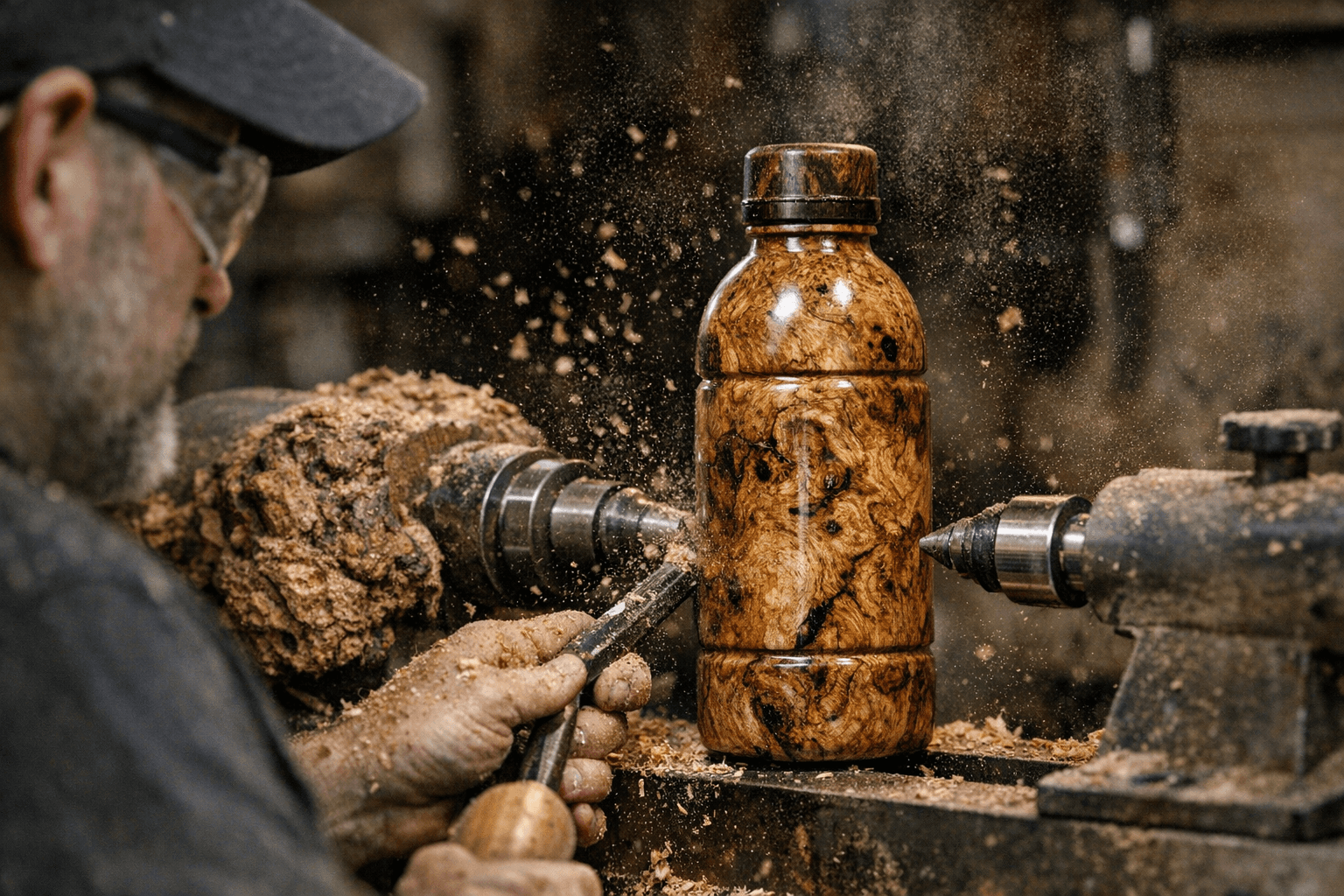
A $0.25-a-pound oak burl blank and a bottle silhouette recognized by virtually every person under 25: that is the entire pitch of a lathe demonstration that has been pulling in viewers well outside the usual turning community. The bottle in question is the Prime Hydration form, co-created by content creators KSI and Logan Paul, which peaked at over $1.2 billion in revenue in 2023 and whose tapered, boldly shaped vessel is one of the most instantly recognizable objects in Gen Z culture. Recreating it in figured oak burl is a clever project because it forces skills that most hobby turners sidestep: controlled taper, consistent wall thickness, a clean neck transition, and a surface finish that has to survive scrutiny from every angle.
Beyond the Bowl: Why Bottle Forms Change the Game
Bowl turning dominates beginner content for good reason, but a bottle profile demands a genuinely different skill set. Where a bowl forgives slight wall variations because viewers only see one face, a bottle form is examined in the round: the shoulder taper must be smooth and repeatable, the neck must be concentric, and the transition from body to neck cannot waver. Add oak burl to the equation and you are no longer turning predictable, cooperative grain. Burl grew in response to stress, injury, or disease, and its fiber direction shifts every few millimeters. The result is a piece that looks casual and quick but takes real discipline to execute cleanly, which is exactly why this kind of project travels on social video. It is quick to watch and slow to demystify.
The Sequence: Blank to Finished Form
1. Blank Preparation
Start with an oak burl blank that has been air-dried or kiln-dried to a stable moisture content. Green burl moves dramatically as it sheds moisture, so rushing this step will cost you the form. Knock off loose bark and probe every surface for soft spots, voids, and inclusions with a tool handle before switching the lathe on. Cracks that look cosmetic on the surface can run deep; flood them with thin CA glue now, not after an hour of roughing. The target rough blank for a Prime-style bottle form is approximately 10 to 12 inches long and 3 to 4 inches in diameter at the widest point. You need enough length to accommodate the body, shoulder, and neck with waste at each end for chuck and tailstock mounting.
2. Mounting
Chuck the blank between centers first to true it up. Once you have a rough cylinder, cut a tenon or recess for a four-jaw chuck at the base. This gives solid purchase when the piece grows top-heavy as the neck section develops. Keep the tailstock engaged for as long as possible during roughing; burl wants to grab a tool edge and pull, and the tailstock keeps it honest.
3. Turning the Profile
Rough the outside profile with a 1/2-inch bowl gouge or a spindle roughing gouge, taking passes that barely kiss the wood. Work from the widest point of the body toward the neck to avoid catches on interrupted grain. The Prime bottle silhouette is defined by a flat-bottomed, slightly tapered body that pinches into a narrow neck; rough the taper in two stages, getting the body-to-shoulder transition right before refining the neck. Use calipers consistently. The body should finish at roughly 2.5 to 3 inches in diameter; the neck drops to 1 to 1.25 inches and runs 2 to 2.5 inches in length. These numbers are close enough to the original silhouette to read as a bottle at a glance without requiring obsessive exactness.
4. Refining Neck and Shoulders
This is where the bottle illusion either holds or collapses. The shoulder — the angled transition from body to neck — needs a clean, crisp curve, not a gradual fade. A spindle gouge with a fingernail grind gives the most control here. Take shearing cuts along the shoulder, working downhill with the grain as much as burl allows, and check the profile frequently against a cardboard template cut to the bottle's silhouette. The neck itself is a narrow cylinder with a slight flare at the top. A skew chisel delivers a glass-smooth surface on this section but demands a confident, committed cut; a hesitant pass with a skew on burl is an invitation to a catch. If you are not yet comfortable with the skew, a small spindle gouge finished with light scraping passes will get you there.
5. Hollowing and Fitting
Bottle forms intended for display can remain solid, but hollow versions are both lighter and more dramatic when held up to light. If hollowing, bore an initial hole down the neck axis with a Forstner bit, then widen carefully with a hollowing tool. Keep wall thickness in the neck above 1/4 inch to survive sanding and handling. Check concentricity as you go; the neck axis must stay true or the piece will look amateurish regardless of how good the exterior profile is.
6. Sanding and Finishing
Work through the grits progressively: 80, 120, 180, 240, and 320. With burl, skipping grits costs you time rather than saving it. Irregular grain tears out in every direction, so change sandpaper often and sand lightly across the grain before going with it. This is the stage where the burl's figure fully reveals itself: swirling flame patterns, eyes, and chatoyance that justify every careful cut made to get here. Finish with friction polish for immediate sheen, a wipe-on poly for durability, or an oil and wax combination if you want the figure to breathe rather than sit behind glass. A higher-gloss finish amplifies the figure; a matte oil keeps it organic.
Burl Reality Check
Burl is photogenic and punishing in equal measure. Before committing a blank to the lathe, work through these considerations:
- Stabilization: Particularly soft or punky burl should be stabilized with penetrating resin before turning. Unstabilized punky sections crumble under even light tool pressure and will not hold a crisp surface or edge.
- Crack management: Fill visible cracks with thin CA glue before roughing, and re-assess at every stage. A crack that looks stable at 3 inches in diameter can open as wall thickness reduces. Stop the lathe and inspect frequently.
- Safety: Burl voids and bark inclusions can throw material at lathe speed. Always wear a full face shield, stand to the side during initial roughing passes, and keep speed conservative: 500 to 800 RPM for roughing a 3 to 4-inch burl blank, stepping up only once the form is in balance. A hidden void at 2,000 RPM is a genuine hazard, not a theoretical one.
- Tool sharpness: A dull edge grabs rather than cuts on burl. Keep a bench grinder within arm's reach and touch up edges every 10 to 15 minutes of turning time.
Why This Video Travels
The American Association of Woodturners, founded in 1986 and now representing over 16,000 members across more than 365 chapters globally, has understood for decades that moments of public visibility are the fastest route to new membership. A project like this one, pairing a material that appeals to experienced turners with a shape that appeals to everyone who has ever picked up a Prime bottle, creates exactly the kind of double-take that drives social sharing. The material and the form are completely unexpected together, and that visual friction is what converts a passive viewer into someone who forwards a clip.
For working turners, the economic case is just as compelling. A usable bottle-sized oak burl blank runs a few dollars in raw material at green pricing. Stabilized, turned, and finished to show standard, that same piece sits comfortably in the $80 to $150 range at craft markets, depending on figure quality. That return makes the extra technique investment worthwhile and opens up an alternative use for blanks that might otherwise default to another bowl. The lathe does not require traditional forms to produce good ones, and burl that genuinely challenges your skills almost always rewards you for rising to meet it.
This article was produced by Prism’s automated news system from verified source data, official records, and press releases, then run through automated quality and moderation checks before publishing. The system is built and supervised by the people who set the standards it runs under. Read our full AI policy.
Did this article answer your question?