David Ellsworth's hollow forms shaped modern woodturning
Ellsworth made the hollow form a proving ground, where thinner walls, sharper profiles, and his own tools set the modern standard.
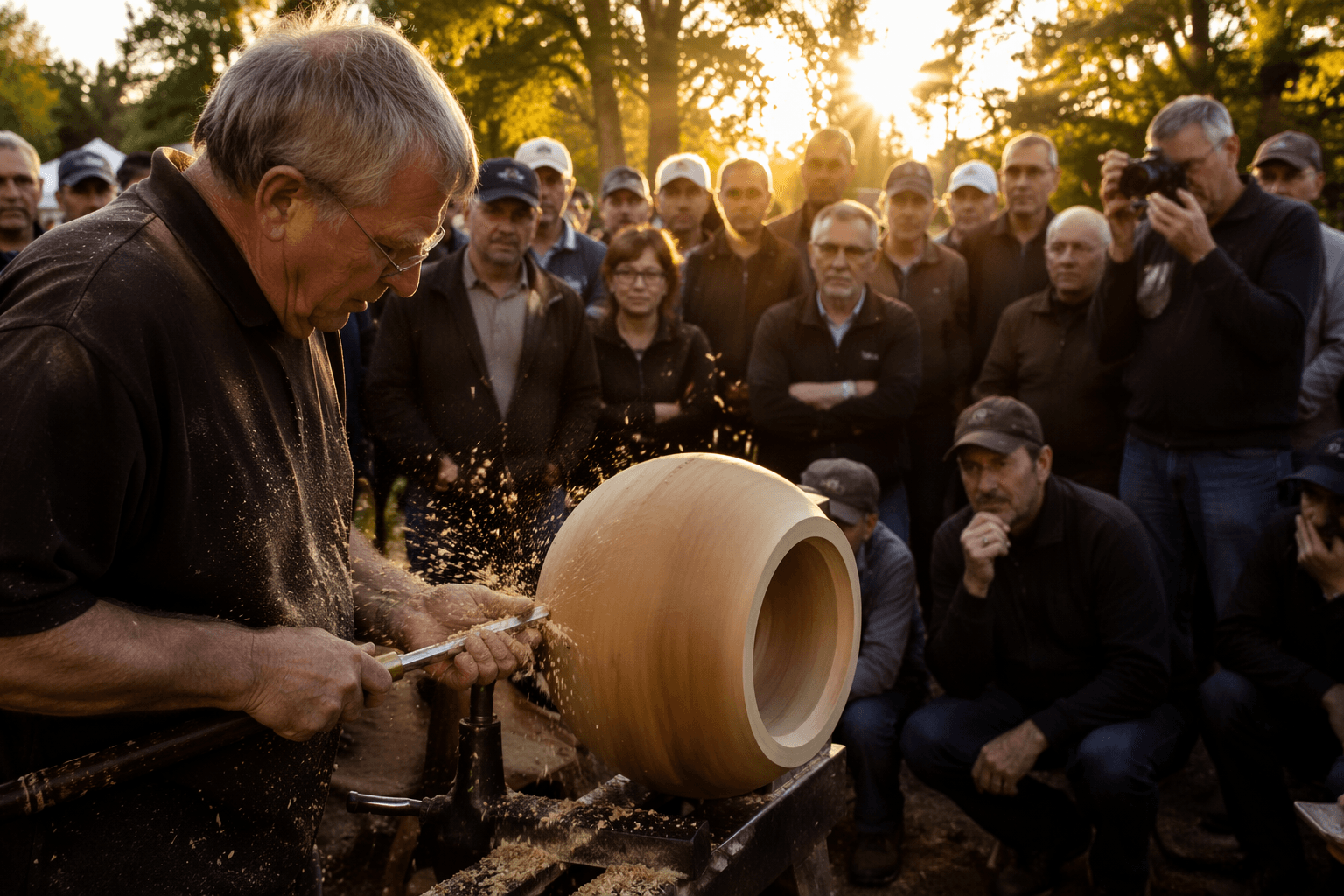
A hollow form can look simple until the wall gets thin enough to hold light. David Ellsworth took that tension and turned it into a standard, proving that a vessel could be both technically exacting and visually spare. In modern woodturning, his name still marks the point where ambition moved past basic bowls and into a new idea of what the lathe could produce.
The hollow form that reset the standard
Ellsworth’s first major statement arrived in print with “Hollow Turning,” published in the May/June 1979 issue of Fine Woodworking Magazine. By then, he had already been developing bent turning tools and the methods needed for thin-walled hollow forms since the mid-1970s, which meant the article was not a passing demonstration but the public debut of a practice he had spent years refining. That combination of ultra-thin walls and cleaner, more resolved vessel shapes made his work one of the most imitated forms in the field.
The reason the form mattered is still easy to feel at the lathe. A thick vessel can hide a lot of uncertainty; a thin one exposes every decision in the cut, the curve, and the finish. Ellsworth’s hollow forms became a benchmark for turning skill because they demanded control inside the vessel, not just on the outside profile, and that changed what ambitious turners believed was possible.
Tools that made the form repeatable
Ellsworth did not leave the form as an isolated studio feat. The Ellsworth Signature gouge became his tool of choice in 1982, and thousands of turners eventually bought his hollow-turning tools, including that gouge and his sharpening jig. That matters because it turned a signature aesthetic into a repeatable workflow, one that could be learned, sharpened, and adapted at benches far from his own shop.
His books and videos pushed that same logic further. They cover the history of “Blind Turning,” the geometry of his bent turning tools, sharpening, making tool handles, correct body positions, cutting the interior of a hollow form, and measuring wall thickness. In other words, he did not just show people what the finished vessel should look like, he taught them how to survive the interior cut long enough to get there.
The organizer who gave the craft a public face
Ellsworth’s influence was never limited to the shape of a vessel. He was part of the group that formed the American Association of Woodturners, then was voted in as the organization’s first president at the 1985 Vision & Concept conference at Arrowmont School of Arts and Crafts, which also made him, by default, member number one. Later AAW materials describe him as a co-founder, the first president, and the organization’s first Honorary Lifetime Member.
That organizational role mattered because the AAW’s outreach program was built to connect professional turners with local chapters, lectures, demonstrations, and exhibitions. Ellsworth was selected as the first chairman of that Professional Outreach Program, which put his name on the practical infrastructure that spread woodturning knowledge beyond a single studio. The result was bigger than one artist’s following: it helped create the public network through which techniques, standards, and expectations moved through the craft.
From studio work to museum walls
Ellsworth’s early-1980s natural-edge burl bowls helped shape the visual vocabulary of the period, but the hollow forms remained the work that best defined his legacy. His pieces are represented in more than 40 museums worldwide, including the Metropolitan Museum of Art and the Smithsonian American Art Museum, which shows how far his language traveled beyond the woodturning shop. The work did not stay inside a hobbyist circle; it became part of the broader record of contemporary craft.
Arrowmont’s retrospective on Ellsworth described his teaching there as a 40-year commitment and framed his legacy as one that helped transform woodturning from a survival craft into a globally recognized fine art form. That long teaching run helps explain why his influence feels so embedded in the community. He was not simply admired from a distance, he was present in classrooms, demonstrations, and the shared vocabulary that turners use when they talk about proportion, rim treatment, and interior wall thickness.
The benchmark still in the hand
Ellsworth died on June 16, 2025, nine days before his 81st birthday, but the standard he set is still built into the way turners judge a vessel. A hollow form that is elegant outside and disciplined inside still carries his imprint, whether the maker learned from one of his books, one of his videos, or a gouge shaped by his ideas. The form remains a test because he made it one: a place where shape, thinness, and tool control all have to agree.
That is why Ellsworth’s hollow forms still matter every time the lathe spins up. They did not just add a new style to woodturning, they changed the craft’s sense of what precision looks like when the wall gets so thin that the whole vessel seems to hover between tool mark and object.
This article was produced by Prism’s automated news system from verified source data, official records, and press releases, then run through automated quality and moderation checks before publishing. The system is built and supervised by the people who set the standards it runs under. Read our full AI policy.
Did this article answer your question?