Elizabeth Weber blends texture, color and math in woodturning
Elizabeth Weber turns engineering logic into a vivid woodturning language, using texture, color and carving to push bowls, spoons and boxes into studio art.
Pat Carroll’s introduction frames Elizabeth Weber as the kind of maker advanced turners want to study closely: someone who uses texture, color and structure as a visual language, not just surface decoration. Based in Seattle and originally from Tennessee, Weber brings civil engineering thinking into work that feels anything but mechanical, and that tension is part of the appeal.
From engineering to expressive turning
Weber’s path helps explain why her pieces read with such clarity. She earned an M.S. in civil engineering from the University of Tennessee at Knoxville, worked in several engineering jobs, moved to Seattle in 2012, and decided in 2015 to nurture her artistic side through woodworking. The turning came a little later, after a bowl-turning class in August 2018, and that sequence matters because it shows how deliberately she moved from structure to expression.
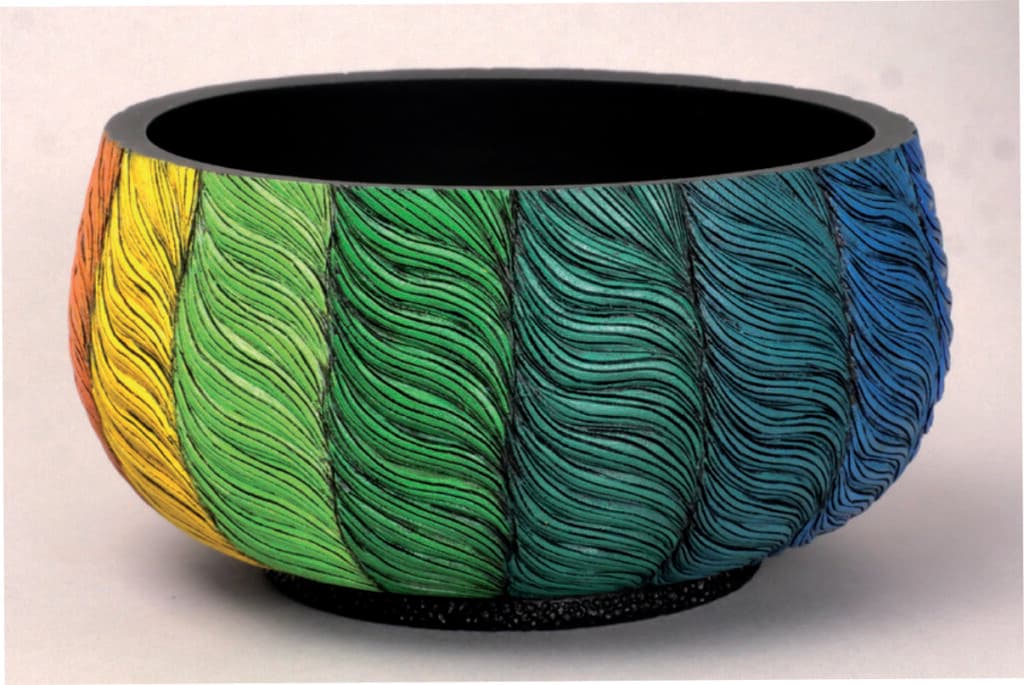
That background also gives her work a distinct logic. Survey lines, contour maps and the language of geometry show up in the way she thinks about form, while the visual energy comes from warped, textured, colorful surfaces that reject plain utility. Tom Henscheid’s early influence clearly stayed with her, especially his textured and colorful work, and Weber has carried that lesson forward into a practice that makes engineering and art feel like complementary tools.
What her work teaches you to borrow now
Weber now works across bowls, spoons and boxes, ranging from simple natural-finish pieces to highly carved and painted forms that echo natural motifs. That range is useful because it shows a path many experienced turners can adopt: start with a strong turned foundation, then decide how much the surface needs to say after the form comes off the lathe.
Three choices stand out in her work:
- Let the surface carry meaning. In Weber’s hands, carving and texture are not afterthoughts. They are the part that changes a bowl or box from a clean object into a statement.
- Use color with purpose. Her painted work is not loud for its own sake. It tends to reinforce the idea behind the piece, whether that idea is memory, landscape or movement.
- Build concept into the form. Weber often works from a visual idea rooted in place, and the geometry of the object helps carry that idea without overexplaining it.
That is why the auction records are so useful for reading her process. Threads of Time, a sycamore and acrylics piece measuring 3 x 5.5 x 2.5 inches, sold for $950 in the American Association of Woodturners’ 2022 Contemporary Wood Art Auction. The lot description ties the threads together with the space between past and present, and the colors with the way memories can be both joined and separate. Green As Grass, a cherry and acrylics piece measuring 1.125 x 12 inches, sold for $700 in the 2023 auction and drew directly from the hills of East Tennessee, with survey lines and contour lines echoing her engineering background.
Somnium pushed that same approach into a larger sculptural idea. The alder and acrylics work, measuring 4 x 3.5 x 7 inches, sold for $2,200 in the 2025 auction and was inspired by the Port Townsend shoreline, with a carved driftwood-like base and a shell-on-driftwood form that suggests home and longing. Reflections extended the idea again with nested boxes inspired by the Pacific Northwest coast and themes of transition and transformation. If you want a clear lesson from Weber’s work, it is this: the most memorable pieces often begin with a form, then gain their meaning through the treatment of the surface and the idea behind it.
A maker who works in public, not just in the shop
Weber’s visibility comes from more than one outlet. She was the American Association of Woodturners’ 2023 POP Artist Showcase recipient, and she has taught and demonstrated at craft schools and woodturning clubs across the United States. She also serves as program director and Women in Turning liaison for the Seattle Woodturners, and helps run the Seattle Spoon Club. That combination of making, teaching and organizing matters because it places her in the center of the contemporary turning conversation rather than at its edge.
The broader profile also shows how her work travels across communities. A later introduction on the American Association of Woodturners forum had Weber describing herself as a Seattle maker who loves to turn pieces and carve on them, carves spoons and is moving further into color. That brief self-description matches the rest of the record: she is not separating turning from carving, or carving from paint. She is building one language out of all three.
For advanced hobbyists, that is the part worth borrowing now. Weber does not treat the lathe as the finish line. She treats it as the first sentence, then lets texture, color, carving and geometry carry the rest of the thought.
This article was produced by Prism’s automated news system from verified source data, official records, and press releases, then run through automated quality and moderation checks before publishing. The system is built and supervised by the people who set the standards it runs under. Read our full AI policy.
Did this article answer your question?