How the four-jaw scroll chuck changed woodturning forever
The four-jaw chuck turned remounting, bottom finishing, and batch turning into a repeatable lathe routine. It solved the workholding problems that once pushed turners back to faceplates, jam chucks, and extra cleanup.
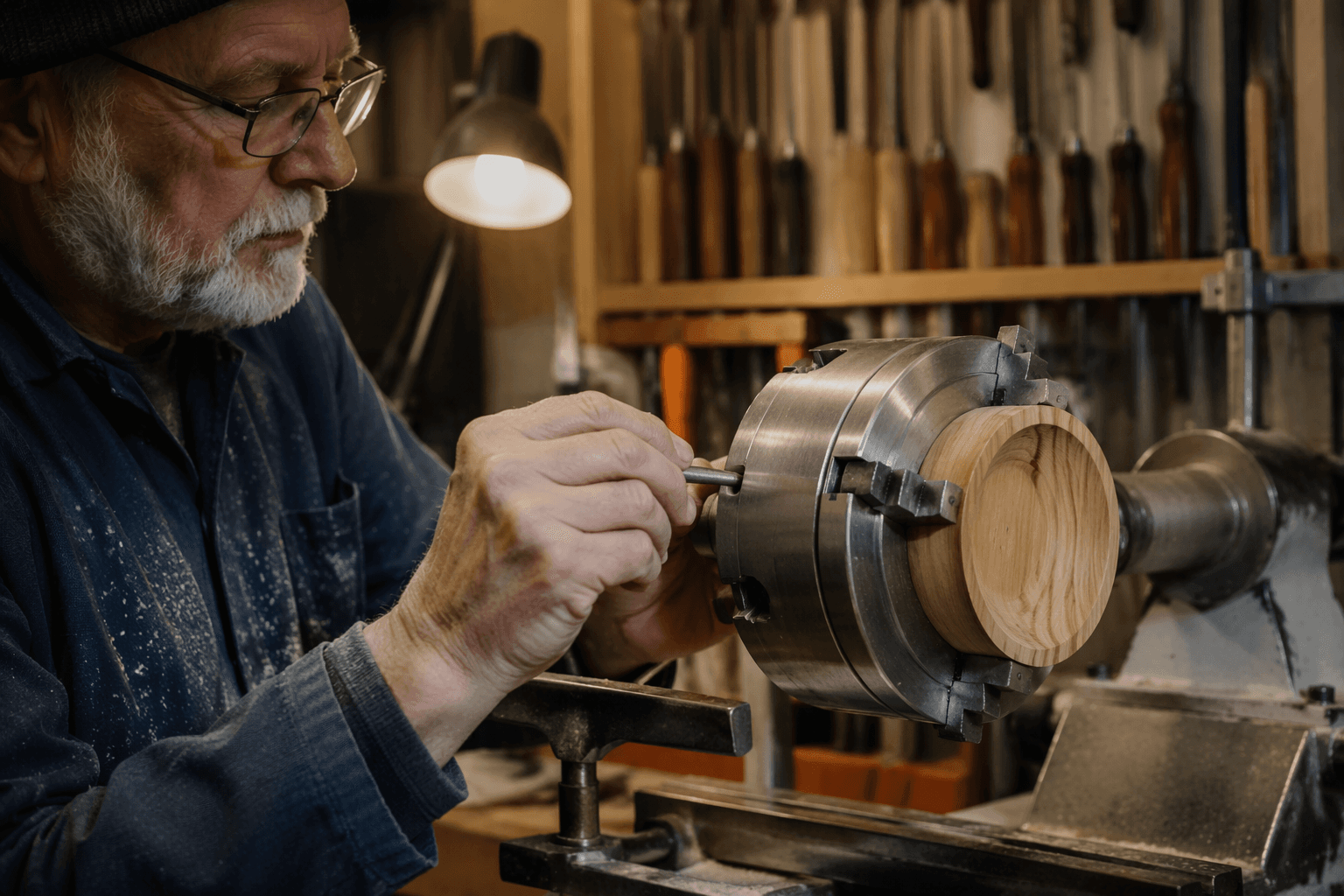
In the mid-1970s, scroll chucks moved onto wood lathes after borrowing the gear-driven idea long used in metalworking. Before they became common, finish work often meant more screw holes, more setup churn, and more time spent fighting the same blank twice. The self-centering chuck gave ordinary turners a faster way to mount wood, remount it accurately, and finish pieces with a cleaner underside. The American Association of Woodturners treats it as the first-choice way to secure wood on the lathe and, for many turners, the number one accessory.
The workflow shift that mattered most
Turners could plan a project from roughing cut to final finish around accurate remounting. Faceplates and jam chucks still had their place, but the scroll chuck made it easier to return a bowl, box, or vessel to the lathe and pick up the same workpiece without the old round of extra fastening and cleanup.
That shift also changed the design possibilities. Because screw holes are not left in the bottom of the piece, the underside can stay cleaner and the final form can be more open and deliberate. In practical shop terms, that means less compromise at the base of a bowl and more freedom to finish the bottom as part of the design instead of as an afterthought.
What the chuck actually grips, and why that matters
The four-jaw chuck is not limited to bowls. Its jaws can hold a round tenon, also called a spigot or foot, and they can also grip square spindle stock, which makes the tool useful across both faceplate and spindle work. Some scroll chucks also support indexing and off-center turning, so the same chuck that holds a bowl blank can help repeat layout, create symmetry breaks, or speed up production work where the same mounting move gets repeated over and over.
When stock changes take much less time than with traditional means, a turner can spend more time cutting and less time resetting the lathe. For anyone making multiples, that difference shows up immediately in the day’s output.
When a chuck earns its place on the lathe
A scroll chuck is worth buying when your work regularly needs to be remounted, when you want to finish the bottom cleanly, or when you make small runs of similar pieces and want faster stock changes. It is especially useful if you turn bowls, boxes, and vessels that benefit from a tenon or recess, or if you use indexing and off-center setups as part of your design language.
Large, tall, heavily out-of-round stock is still safer on a faceplate. Nothing beats a faceplate for the strongest hold and the least vibration when the work is awkward or potentially dangerous. Use the chuck when the blank is suited to it, and reach for the faceplate when the piece is too tall, too heavy, or too far out of round to trust to convenience.
- Use the chuck first when the piece can be held on a tenon, spigot, foot, or recess.
- Use it when repeated remounting accuracy matters, especially on bowls and other turned forms that need a clean bottom.
- Use it when small-batch efficiency matters, because stock changes are faster than with traditional methods.
- Skip it in favor of a faceplate when the work is tall, heavy, or out of round enough that maximum holding power matters more than speed.
Reverse chucking and finishing the bottom
The same self-centering action that grips a tenon also makes reverse chucking practical. When the jaws are loosened, they expand concentrically, so you can open them into a recess in the wood and use that as an alternate mounting method. That is the move that lets you flip a bowl or other form, true the bottom, and finish the underside without starting the piece from scratch.
For bowl work, wooden jaws are a strong example of how far this idea can be pushed. Dale Larson writes that jumbo jaws and Mega Jumbo jaws, as well as Nova Cole Jaws, often come with eight rubber bumpers, but those bumpers can leave dark spots in open-pore light woods and only contact the rim at eight points. His wooden jaws hold the piece at 360 degrees with no give, and he says they are quicker because you do not have to keep moving the eight bumpers to fit different bowl sizes. He uses red alder because it is softer than the bowl wood, and he builds the jaws from a 2 x 6 cut into pie-shaped pieces with 45-degree cuts.
The rest of the workholding family
Twin four-jaw chucks, one mounted on the headstock and the other on the tailstock, can dampen vibration on long, thin spindles. On production runs, including a batch of spindles measuring 1 1/4 inches by 44 inches, a steady rest can solve one problem but add another by creating an obstacle that takes more time and effort to work around.
This article was produced by Prism’s automated news system from verified source data, official records, and press releases, then run through automated quality and moderation checks before publishing. The system is built and supervised by the people who set the standards it runs under. Read our full AI policy.
Did this article answer your question?