How to Turn a Square Plate on the Lathe from a Round Blank
A square profile from a round blank forces interrupted cuts at every corner, a grain direction challenge that woodturning's 16.8 million U.S. households rarely tackle head-on.
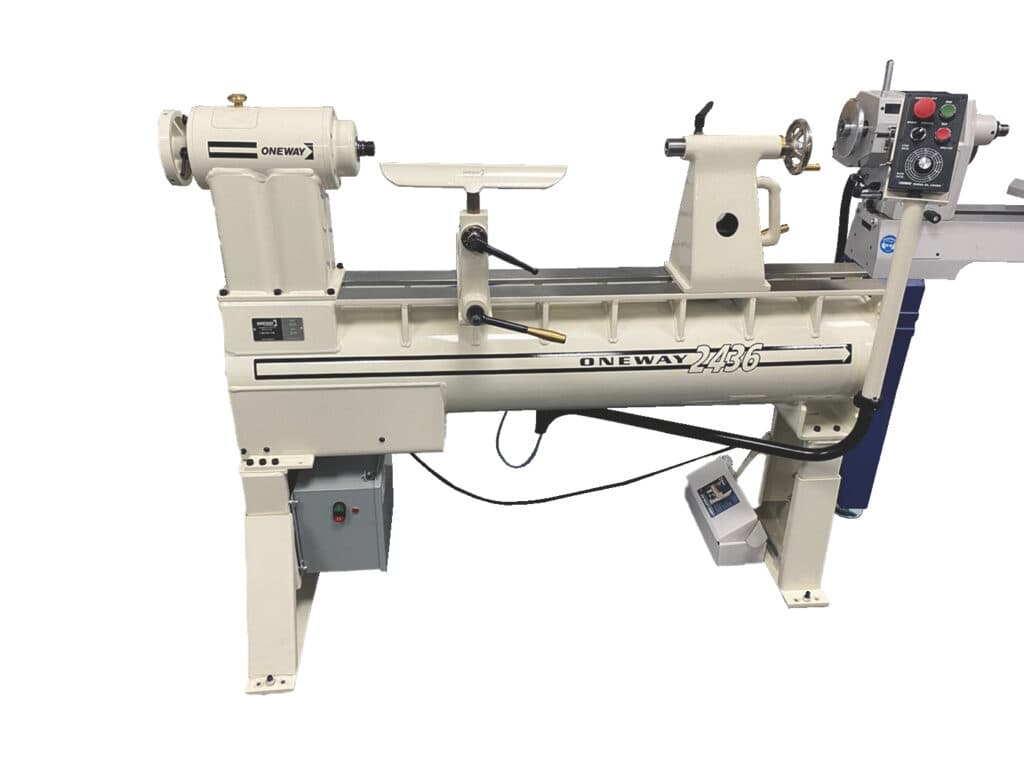
The lathe doesn't know it's holding a square. Every time a corner of an unrounded plate blank sweeps past the cutting edge, it delivers a micro-impact that ripples through the tool, the tool rest, and both hands. Run four corners at even a moderate speed and you're managing thousands of interruptions per minute: a cycle of cut, air, cut, air that simply doesn't exist with a fully round blank. That arithmetic is the fundamental reason a square plate is a categorically different project from a round platter, even when the basic turning skills look identical on paper.
The good news: with correct setup and disciplined speed management, a square outer profile is achievable directly from a round blank, without band-sawing the geometry first. The resulting form stands out on any display shelf and consistently commands higher perceived value at craft markets, which helps explain why the technique circulates so persistently in club demos and workshop warm-ups across the American Association of Woodturners' network of more than 365 local chapters worldwide.
The Geometry Problem: Interrupted Cuts and Grain Direction
The core hazard of any non-round form on the lathe is the interrupted cut. Where a round blank presents a continuous surface to the tool, a square blank removes material in pulses. At the corners, the tool is momentarily cutting air, and the transition back into wood arrives with a small shock. Repeated over hundreds of rotations, those shocks create cumulative vibration that fatigues your grip, shifts tool presentation, and increases tearout risk dramatically. Woodturning educators describe this precisely: working with non-round forms on the lathe "really emphasise the problems of grain direction," because the corner-to-flat-to-corner cycle means the cutting edge is constantly transitioning between favorable and unfavorable grain orientation.
Where a round bowl allows a turner to dial in one consistent approach angle, a square plate demands ongoing awareness of which quadrant the tool is entering at any given moment. The practical mitigation is lighter cuts than you'd use on a fully round blank, especially during the roughing phase when the corners still carry full mass. Reduce your depth of cut, keep the tool rest positioned as close to the work as safely possible, and reach for a bowl gouge rather than a scraper. A bowl gouge's shearing cut is far more tolerant of grain reversal than a scraper's trailing edge, which tends to catch hard on re-entry after each air gap.
Two-Stage Workholding: Faceplate First, Chuck Second
Safe plate turning of any kind relies on a two-stage mounting strategy, and that discipline becomes more critical the moment corners are involved. The standard sequence, documented across multiple turning references including the Sawmill Creek Woodworking Community forum and Fundamentals of Woodworking, runs as follows:
1. Mount the blank on a faceplate with firm, fully seated screws and turn the underside profile first, shaping the foot and the overall form while the blank is at its most stable.
2. Cut a clean recess (a "rebate") into the underside to accept a 4-jaw scroll chuck. This recess becomes the sole mounting point for the face-side turning, so its depth and diameter need to match the specific jaw set precisely. A straight or negative taper on the recess wall is the most common cause of a chuck losing grip mid-cut.
3. Reverse the piece onto the 4-jaw chuck and complete the rim and face of the plate, now working from the security of the chuck's compression grip in the recess.
Some turners insert a glue block between the faceplate and blank to avoid leaving screw holes in the finished piece, particularly on plates where the underside will be visible in display or on the table. The Woodworkers Journal documents this approach as useful for presentation-grade work. For a square plate specifically, the faceplate phase is the highest-risk stage: the blank is at its heaviest and most asymmetric, so speed should begin at the lowest setting the lathe offers.
Speed Management for Non-Round Forms
The correct approach to lathe speed on an asymmetric blank isn't to pick a number from a chart; it's to let the lathe tell you. Bring the RPM up gradually from the lowest setting until vibration becomes perceptible, then back off to the last smooth operating point. This method, widely discussed in AAW community forums, accounts for the specific mass distribution of each individual blank, which no printed formula can fully anticipate.

Popular Woodworking cites approximately 500 RPM as a practical starting reference for large platter roughing, and that figure functions as a ceiling rather than a target for square-form work at the early stages. As corners are progressively removed and the blank's mass distribution evens out, speed can be carefully increased. Finishing cuts on the face benefit from a slightly higher RPM than roughing: the faster surface speed produces a cleaner shear with less tool chatter, provided the blank is well balanced by that stage.
Sanding the Danger Zones
The corners are simultaneously the defining feature of the finished piece and the most hazardous section to sand. Expert guidance for non-round forms is unambiguous on this: the corner sections should be sanded with the lathe completely stationary, using a cork block with abrasive sheet or a random orbital sander. Attempting to sand spinning corners risks a catch that can abrade fingers or drag the abrasive into the workpiece in an uncontrolled direction.
The face and interior areas can be sanded with the lathe running in a standard progressive grit sequence. Begin around 120 or 150 grit to remove tool marks, step through 220 and 320, and finish to 400 grit or finer depending on the species and desired surface quality. For a particularly refined result, 600 grit wet/dry paper used with oil applied directly to the surface sands through the heat friction of the spinning work, producing both a fine abrasion and an initial penetration of the finish simultaneously.
Finishing for Edge Crispness and Safe Handling
The edge treatment on a square plate is a design decision and a safety decision in the same moment. Left sharp from the tool, a precisely formed square corner in dense hardwood is a genuine handling hazard. Most turners soften the corner arrises (the sharp ridges) very slightly by hand with fine abrasive, enough to eliminate the risk without visually compromising the geometric profile. The goal is a corner crisp enough to read as intentional but comfortable enough to pick up without hesitation.
For finishing, penetrating oil finishes suit the form well: pure tung oil, Danish oil, and food-safe mineral oil all enter the wood rather than filming over it, which means there is no surface coating to chip at the corners under use or over time. For display and gallery pieces, friction polish applied over a sanding sealer base produces a high sheen that makes the square geometry pop under directional lighting. The sealer is applied by brush, burnished with mutton cloth while the lathe runs, cut back with fine abrasive, and followed by the polish coat, building a reflective surface that turns the plate's crisp profile into its strongest visual argument.
An Intermediate Form Worth Mastering
The square plate sits at a productive intersection of faceplate skills and geometric planning that most standard round platters never require. It bridges the gap between basic bowls and more complex multi-axis forms, and it recurs regularly in local club demos precisely because it extends familiar technique into unfamiliar territory without demanding entirely new equipment.
The American Association of Woodturners, headquartered in Saint Paul, Minnesota and led by Executive Director Gretchen Wilbrandt, is marking its 40th anniversary in 2026, with the Annual International Symposium, widely recognized as the largest woodturning event in the world, scheduled for Raleigh, North Carolina this year. The AAW's current membership of more than 16,000, spread across over 365 chapters globally, reflects the scale of an organized community that traces its modern roots to early 1980s teaching programs at institutions like the Arrowmont School of Arts and Crafts in Gatlinburg, Tennessee. That community, embedded in a U.S. craft sector the Craft & Hobby Association places at more than 16.8 million woodworking households, is exactly the audience for which the square plate project makes the most practical sense: a form that rewards the skills already in the room, asks something genuinely new of the maker, and finishes as a piece distinct enough to be worth making again.
This article was produced by Prism’s automated news system from verified source data, official records, and press releases, then run through automated quality and moderation checks before publishing. The system is built and supervised by the people who set the standards it runs under. Read our full AI policy.
Did this article answer your question?