Turned giant eyeball on a lathe showcases sculptural realism
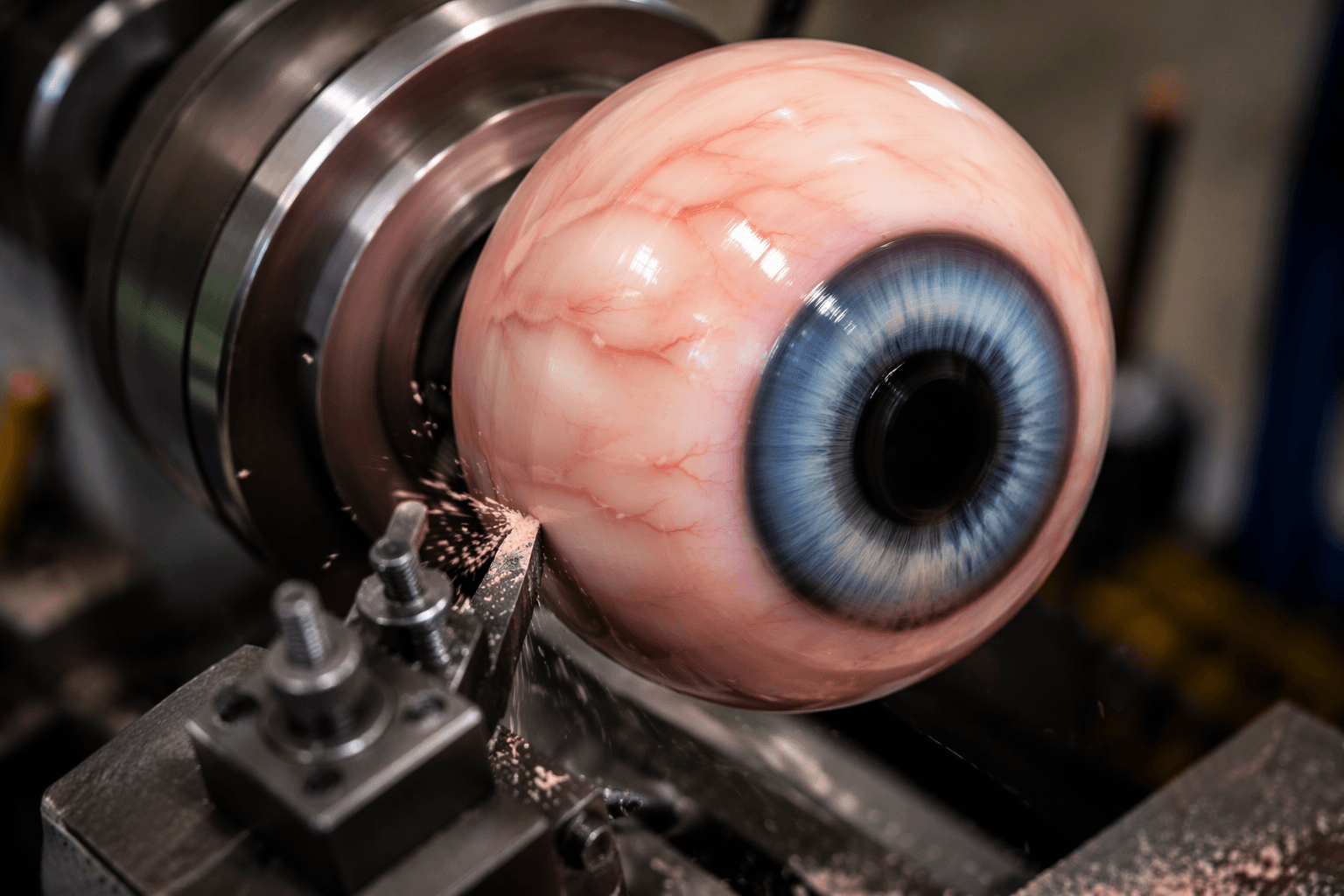
A giant resin eyeball on the lathe turns novelty into a real turning test. Its shape only works if symmetry, control, and finish are dead on.
A novelty piece that still has to earn the illusion
A giant eyeball on a woodturning lathe is the kind of project that stops the scroll because it refuses to pretend to be anything else. It is a novelty piece, but it is also a sculptural one, built from polyurethane resin and pushed hard toward realism. That combination makes it more than a stunt: the lathe is being asked to deliver a form that has to read instantly and cleanly from across the room.
The appeal is not just that the object is unusual. It is that the project puts familiar turning fundamentals under a bright light. If the shape is even a little off, the eye stops reading as an eye and becomes a generic sphere. If the surface is rough, the illusion collapses. That is exactly why this kind of showpiece can be more instructive than a safer bowl or vessel.
What the form reveals about setup
The eyeball works because roundness alone is not enough. A turn like this depends on the kind of setup discipline that keeps a workpiece centered, stable, and predictable while the shape is refined. When the subject is a giant eye, every deviation in symmetry becomes visible immediately, so the maker cannot lean on grain figure or decorative texture to hide errors.
That makes the lathe part of the story as much as the subject itself. The machine is not simply spinning a blob of resin into a curiosity. It is being used to hold shape, control mass, and establish a profile that reads as intentional rather than accidental, which is the same visual logic that supports cleaner bowls, tighter hollow forms, and crisp spindle work.
Shaping strategy matters more than spectacle
The strongest lesson in a project like this is that novelty only works when the shaping strategy is precise. A realistic eyeball needs curves that feel deliberate and balanced, not just generally spherical. The maker is effectively sculpting with rotation, and that means the silhouette has to do the heavy lifting from every angle.
That is why this kind of piece belongs in the same conversation as more traditional turning, even if the subject sounds playful. A turner can admire the joke and still recognize the craft underneath it: reading profile, checking proportion, and making small corrections until the form lands. In mixed-media work, that ability to control the outline is often what separates a one-off gag from a memorable object.
The finish is what sells the illusion
With polyurethane resin, the finish cannot be an afterthought. The surface has to be clean enough that the eye reads as a polished sculptural object, not a rough workshop experiment. In a piece built around realism, the final surface is part of the form, because any scratchy or uneven finish pulls attention away from the illusion.
That is one reason the project is useful beyond the novelty factor. It shows how finishing choices are not merely cosmetic when the goal is visual believability. A clean surface, careful refinement, and enough polish to make the object feel intentional all help the piece cross the line from oddity to convincing display work.
Why turners keep watching projects like this
Part of the reason short-form turning videos keep finding an audience is that they compress a full set of shop decisions into a single, memorable object. A giant eyeball can work as a demo prop, a Halloween display, or a conversation starter at a club meeting, but it also does something subtler. It reminds the turning community that a lathe can make sculptural work that reaches well beyond bowls and spindle forms.
That reminder matters in a hobby where it is easy to settle into a comfortable loop of familiar projects. A piece this visually aggressive resets expectations. It says that props, art pieces, and custom display objects are not side quests from real turning, they are legitimate shop goals that still rely on the same core skills.
A useful benchmark for mixed-media work
For makers who already live at the lathe, the value of a project like this is not the eyeball itself. It is the way the eyeball exposes whether the fundamentals are solid enough to support a more ambitious idea. Symmetry has to hold. Control has to stay tight. The finish has to be good enough to let the form speak for itself.
That is what makes the giant resin eye more than spectacle. It turns a novelty shape into a test case for disciplined turning, and it shows how a lathe can be pushed into sculptural realism without losing the core craft that makes the work believable.
This article was produced by Prism’s automated news system from verified source data, official records, and press releases, then run through automated quality and moderation checks before publishing. The system is built and supervised by the people who set the standards it runs under. Read our full AI policy.
Did this article answer your question?