turner intentionally cracks wood for epoxy-filled bowl forms
Craig Duncan flips a turning rule on its head, using dry-time, geometry, and support to make controlled cracks part of the bowl’s design.

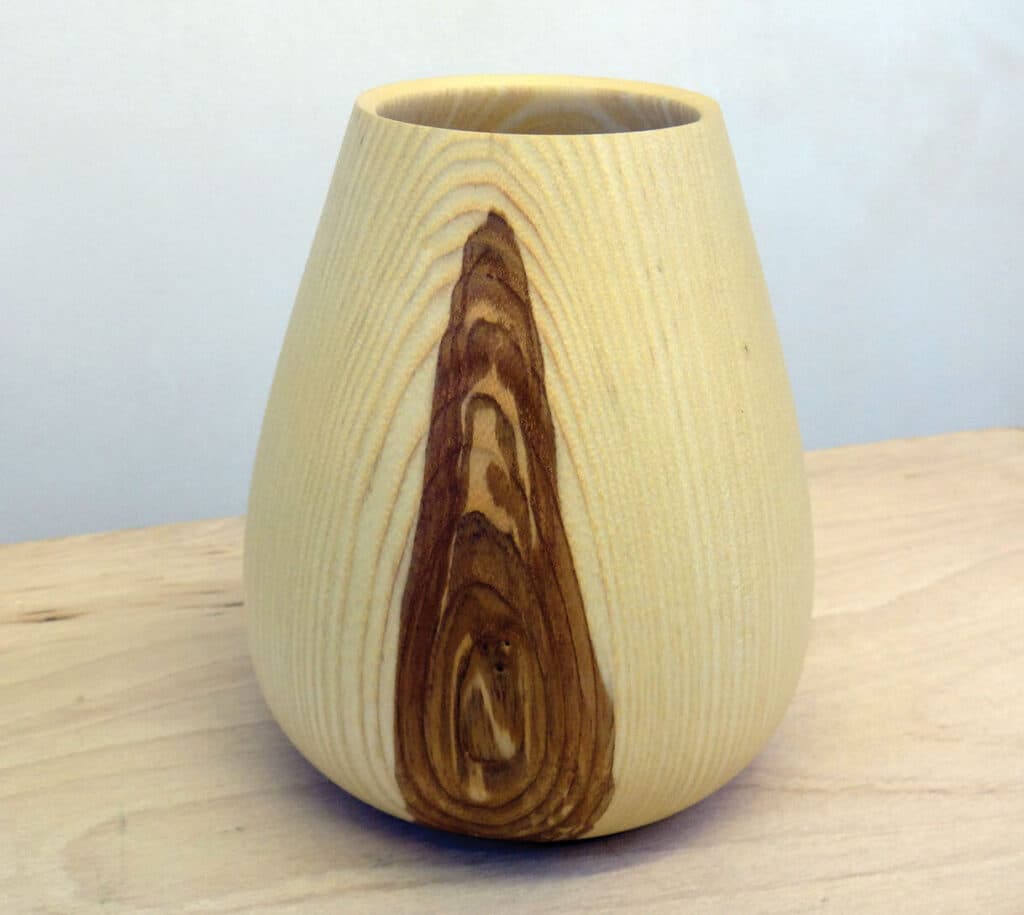
Craig Duncan took one of woodturning’s oldest instincts and reversed it. Instead of fighting checks and splits, he set out to make wood crack on purpose, turning 4x4 blocks into three-legged bowl-like forms, then planning to fill the openings with colored epoxy resin before stabilizing the result with vacuum and pressure-pot steps. The twist was not just in the finish idea. It was in the way the whole project forced a conversation about moisture, structure, and how much risk a turner can harness before a blank gives way.
Cracks as a design choice
The appeal of Duncan’s experiment is that it treats failure as texture. In normal turning, cracks are a defect to prevent; here they become the feature that gives the form its visual edge. That only works when the turner understands what makes wood split in the first place: pith, grain orientation, wall thickness, and drying speed all push a blank toward or away from cracking. In American Association of Woodturners forum discussions, removing the pith is treated as a first rule for reducing cracks, while bowls with flat bottoms and straight sides are called out as especially prone to splitting as they dry.
That is why the shape matters so much in a project like this. A three-legged bowl-like form already introduces uneven support and a more awkward load path on the lathe, which makes the blank part sculpture and part stress test. The same geometry that makes a conventional bowl troublesome can be the very thing that produces the crack pattern a turner wants to highlight.
Moisture is the real lever
The most important part of Duncan’s setup was not the crack itself but the water still moving through the wood. He reported moisture readings between about 12% and 26%, depending on where he measured, even though the tree had been down for a year. That spread explains why the conversation quickly turned from design to drying: Penn State Extension notes that wood keeps gaining or losing moisture until it reaches equilibrium moisture content with the surrounding air, and that once it gets there it will not move again unless temperature or relative humidity changes.
That environmental pull is not abstract. Penn State gives an example where 80% relative humidity at 80 degrees Fahrenheit produces an EMC of about 15.5%. It also notes that the end use of the lumber determines the moisture content it should be dried to. John Lucas kept his advice blunt and practical: if the wood is still that wet, it needs time. Kevin Jenness added the sharper warning for Duncan’s plan: wood should be thoroughly dry before resin is introduced, or the bond may fail.
That point matters because System Three Resins says wood should be at 12% moisture content or below for epoxy adhesive or solvent-free coating to bond well. A blank reading up to 26% is not just a little green. It is far above a level where epoxy can be expected to hold cleanly, especially if the goal is to preserve a dramatic crack rather than watch the whole thing keep moving after the resin goes in.
How the drying can be pushed on purpose
Once the goal becomes controlled cracking, drying speed becomes a tool instead of a threat. Kevin Jenness suggested a toaster oven or even a thrift-store microwave as ways to drive off moisture faster, and he pointed out that weighing the blanks until they stop losing weight is a more reliable sign of equilibrium than guessing. That simple advice is useful because it shifts the question from “does this feel dry?” to “has the mass stopped changing?”
He also commented directly on Duncan’s black plastic tote strategy. With the lid off, it will dry and crack faster; with the lid on, it will dry more slowly. That gives the turner a crude but effective control over the pace of moisture loss. Faster drying tends to increase stress, and stress is what opens the crack lines that can later be filled with epoxy.
There is a caution hidden in that tactic: even very old wood can still crack if conditions and drying stress are right. A discussion tied to Bruce Hoadley’s work, repeated in AAW forum threads, makes the same broad point. Age alone does not stop movement. Geometry and environment still get the final say.
Support the form before the crack decides the shape
The other useful piece of the exchange was mechanical, not chemical. Kevin Jenness warned about the centered layout shown in the referenced video and recommended a live tailstock center without a point, or another cup-style support, for better security when turning a difficult three-cornered form. That advice matters because a deliberately cracking blank is already unstable enough without adding a weak support arrangement at the lathe.
This is where the project becomes more than a drying exercise. The turner is not simply waiting for cracks to appear. The form has to be held in a way that lets the wood move, but not fail catastrophically. A cup-style support, a careful center, and a layout that respects the asymmetry of the blank all help keep the piece in the realm of controlled experiment rather than broken scrap.
Resin turns the fracture into the finish
Once the cracking has been encouraged and the wood is dry enough to accept a bond, resin becomes the visual bridge between damage and design. Craft Supplies USA describes stabilization as a process that uses pressure to force resin deep into the cells of a blank, then heat to cure the resin. That matches the broader resin-impregnation logic behind vacuum and pressure-pot work: vacuum removes air from the pores, pressure drives material deeper into the wood, and curing locks the result in place.
In Duncan’s case, the colored epoxy is doing two jobs at once. It marks the crack as part of the form’s identity, and it helps turn a split surface into a finished object. That is what makes the project feel so specific to woodturning rather than generic mixed-media work. The crack is not an accident to disguise. It is the line the whole piece has been built to reveal.
Phil Hamel’s comment about an old bowl that split after being left in a refrigerator full of apples adds one more reminder that wood is always negotiating with its environment. The lesson from Duncan’s experiment is not that cracking is easy to control. It is that, with the right moisture targets, the right drying pace, and the right support, a turner can steer a crack from unwanted surprise to deliberate surface language.
This article was produced by Prism’s automated news system from verified source data, official records, and press releases, then run through automated quality and moderation checks before publishing. The system is built and supervised by the people who set the standards it runs under. Read our full AI policy.
Did this article answer your question?