Why grain direction changes everything in woodturning
Read the grain before the gouge touches wood, and the lathe will tell you where tear-out, catches, and endless sanding are already waiting.

Grain direction determines whether the edge rides on supported fibers or dives into a patch of end grain that wants to tear, fuzz, or grab. That is why the same tool can feel perfect in one cut and miserable in the next.
Spindle grain: when the cut has a clear path
Spindle orientation, in American Association of Woodturners terminology, is grain running parallel to the lathe bed and spindle axis. That is the classic setup for stair balusters, chair parts, and similar furniture components, where the wood’s long fibers run with the length of the turning. In that orientation, the usual rule is to cut downhill, from larger diameter to smaller diameter, so the edge is moving with the fiber support instead of lifting into it.
On the lathe, that shows up fast. A clean spindle cut leaves a crisp surface and a consistent ribbon of shaving, while cutting uphill or against the grain often announces itself with chatter, torn fibers, or a catch that feels like the tool suddenly found a seam in the wood. If the surface looks ragged even though the edge is sharp, the problem may not be the tool at all. It may be that the cut is moving the wrong way through the grain.
Faceplate work: why bowls and platters change the rules
Faceplate orientation runs perpendicular to the lathe bed and spindle axis. That is the setup used for bowls and platters, where the grain lies across the spinning face rather than along the bed. In that arrangement, each revolution presents alternating end grain and side grain to the tool, so the cut can feel silky for a moment and then abruptly turn grabby or torn.
That alternating behavior is the heart of most bowl-turning frustration. One part of the rim may cut cleanly, then the tool meets end grain and the fibers start to peel or fray instead of severing. The visible result is easy to spot: a rim or shoulder that looks smooth in one zone and fuzzy in the next, or a wall that sands clean in one pass and still shows torn patches after several more.
How to read the blank before it goes on the lathe
Reading grain starts with looking at the board faces and edges, not with choosing a gouge. If the long fibers run with the length of the blank, you are looking at spindle orientation. If the blank will present its face across the lathe so the rings and fibers cross the rotation, you are in faceplate territory and should expect the cut to switch between side grain and end grain as the piece turns.
That preview matters because many surfaces blamed on dull tools are really grain-direction problems. A sharp edge cannot make end grain behave like side grain, and no amount of polishing will erase a cut that was fighting the fibers from the start. Once you train your eye to spot the grain before mounting, a lot of mystery defects stop being mysteries. The rough patch on the shoulder, the torn band near the rim, the stubborn fuzz on one side of a spindle can all point back to how the blank was read.
Bowl exterior and interior: the same blank, two different conversations
A bowl blank can fool you because the exterior and interior ask different things of the tool, even though they come from the same piece of wood. On the exterior, the bevel may ride cleanly through one section and then stumble as the cutting edge crosses alternating grain. That is where the bowl can develop a torn shoulder or a scraped looking patch that never quite finishes flat.
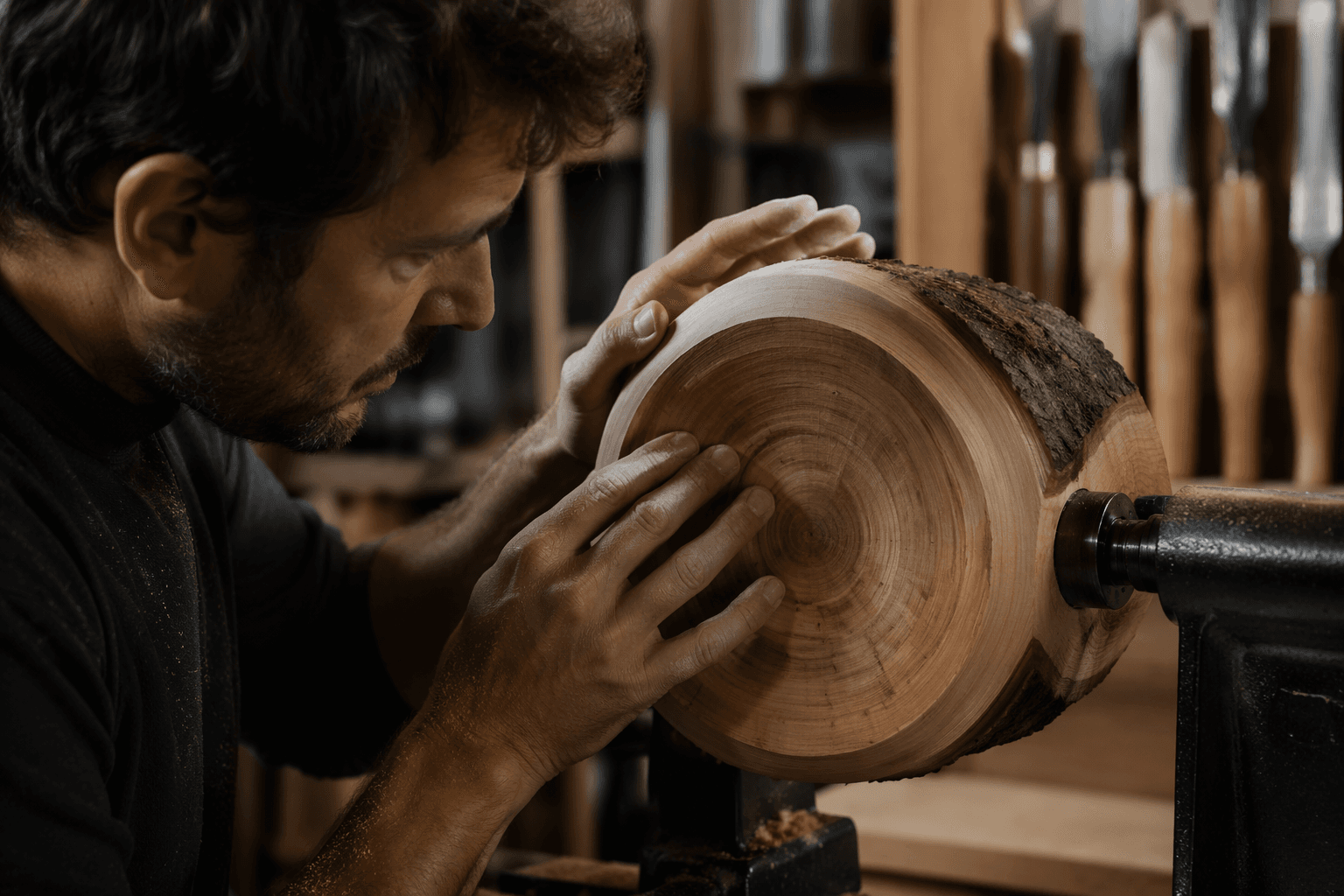
Inside the bowl, the grain change becomes even more obvious. The cut repeatedly moves between with-the-grain and against-the-grain conditions, especially as the tool travels from rim to bottom and back again. The result is often the familiar end-grain tearout that turns a promising curve into a sanding project. In bowl turning there is always some tearout in end grain because the cut keeps alternating between cutting with and against the grain.
Paul Hannaby’s bowl-turning guidance covers both orientations: bowls are mainly turned with the grain running perpendicular to the lathe axis, but they can also be turned with the grain parallel to the axis, the same orientation used for spindle turning.
When the wood itself is working against you
Some woods simply fight harder than others. Interlocked grain is naturally more prone to tearout, so the species matters as much as the bevel. Bhilwara and Albizia are examples where the grain structure itself invites trouble, which is why sharp tools, light passes, and better technique are emphasized instead of blaming only the edge.
That is also why blank selection matters before the tool ever touches wood. In a WoodturningOnline grain-evaluation demo, Stuart Batty highlights the need to inspect blanks for knots, ring shakes, and drying cracks before cutting. Those flaws do more than spoil a surface. They can make a piece unsafe to turn, or at the very least turn a promising blank into a patchy, unpredictable job that never cleanly resolves.
End grain, side grain, and the finish you see at the end
Grain direction keeps mattering after the cut is over. End grain is harder than side grain and absorbs finish more readily, so the same turning can look different once sanding and finish go on. End grain may drink finish faster, go darker, or appear to sink lower under the surface, while side grain can stay lighter or look more even.
That is one more reason grain-reading pays off. If a section is already torn because the fibers were cut in the wrong direction, finish will not hide it. If a section is end grain, it may show a different sheen or color even after careful sanding.
A rule that has stayed central for decades
The American Woodturner journal archive goes back to 1986, and the American Association of Woodturners has more than 360 chapters worldwide.
This article was produced by Prism’s automated news system from verified source data, official records, and press releases, then run through automated quality and moderation checks before publishing. The system is built and supervised by the people who set the standards it runs under. Read our full AI policy.
Did this article answer your question?