Woodturning evolved from ancient lathe craft to artistic expression
From twine-driven centers to sculptural bowls, woodturning runs through 2,000-plus years of shop history and keeps the same core motion alive.
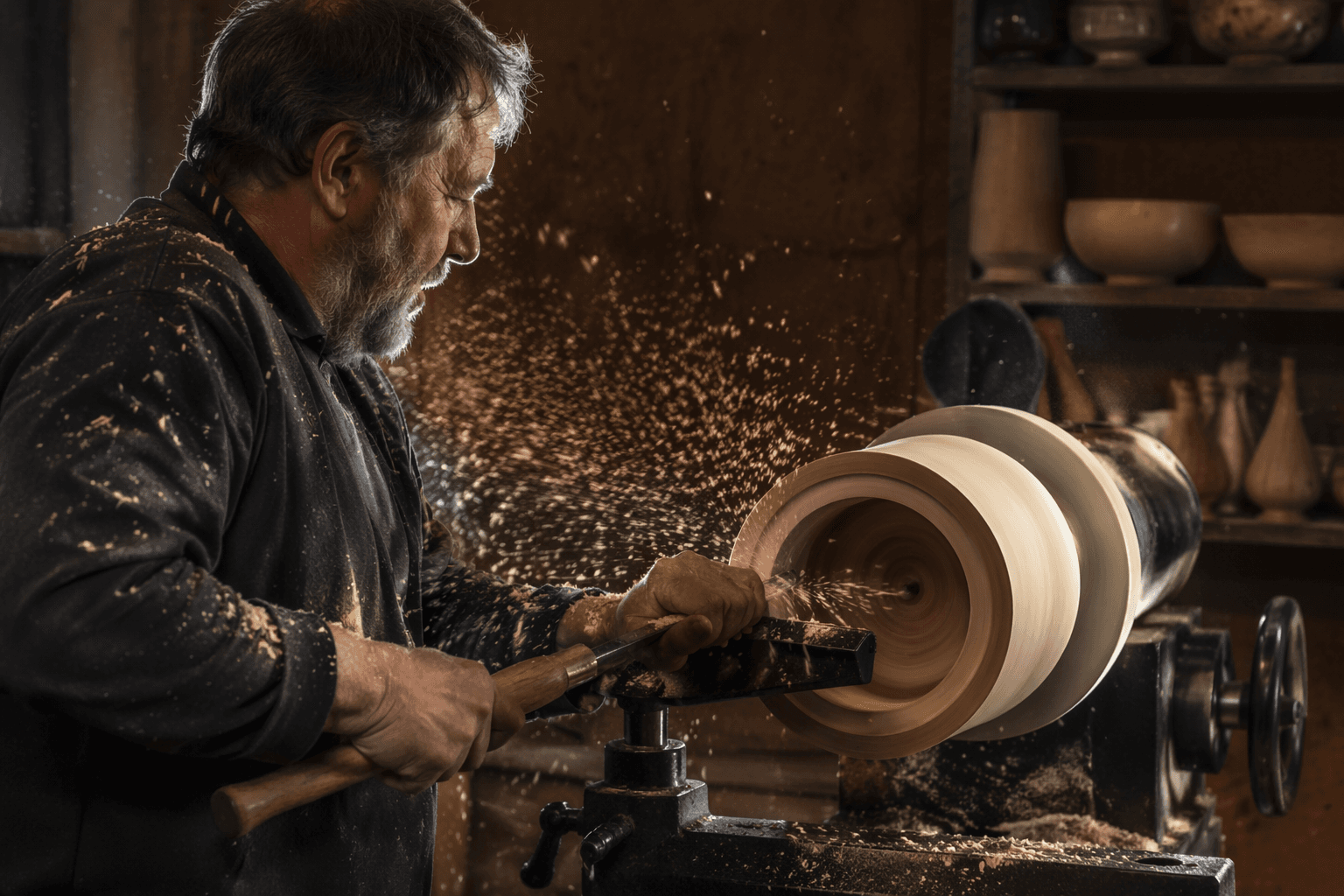
A piece of twine could once spin the work, and that simple motion still sits at the heart of woodturning. What began as an ancient craft used across many cultures grew into a foot-powered shop staple, then into a machine process that helped shape bowls, spindles, treenware, and eventually sculpture.
The oldest motion in the shop
Woodturning belongs to the oldest layer of workshop technology. The American Association of Woodturners describes it as an ancient craft known to many cultures worldwide, and a 2024 archaeological study pushes the practice back to the late 8th to early 7th centuries BCE, based on two presumed lathe pivots from Thebes, Egypt. That same study showed through experimental archaeology that a lathe could reach speeds of up to 400 RPM with a 4 cm workpiece, which makes the old technology feel startlingly exact rather than primitive.
The basic formula is still as clear as it was in the earliest shop: centers, a sharp tool, and some means of revolving the work. In the simplest version, even a piece of twine can do the revolving. That is the first big lesson of the craft’s history, because it shows that the lathe was never about one fixed machine design. It was about controlling a turning blank long enough to shape it.
- centers hold the work
- a sharp tool cuts the form
- twine, foot power, or a motor makes the blank turn
That stripped-down system explains why turning could survive for so long before the Industrial Revolution. Once the work is spinning, the maker can shape a spindle, a vessel, or a bowl, and the same principle keeps returning in every later version of the lathe.
From foot power to industrial precision
For many hundreds of years before the Industrial Revolution, the foot-powered woodturning lathe was the only woodworking machine in common use, according to the American Association of Woodturners. The Smithsonian Institution goes even further, calling the lathe a 4,000-year-old mechanized tool and noting that early turners powered it by foot before steam power arrived near the start of the Industrial Revolution. That progression matters because each power source widened what a turner could actually make in a day.
Britannica places wood lathes in France as early as 1569 and says the machine was later adapted for metal cutting during the Industrial Revolution in England. That shift is one of the crucial pivots in tool history. The wood lathe did not merely survive the industrial age, it helped point the way toward machine-tool precision, and Henry Maudslay, the British engineer and inventor of the metal lathe, stands as one of the key figures in that transition.
The industrial period also changed scale. The Smithsonian says factory woodturning in the late 18th and 19th centuries mass-produced furnishings and bowls, moving the lathe from one-off handcraft toward repeatable production. The American Association of Woodturners underlines that contrast with examples at the far edge of size, including an Oliver 18-A lathe that is 62 feet long and a faceplate lathe capable of 100-inch-diameter work. From a single blank spun by twine to a machine large enough for industrial-scale turning, the range is enormous, but the underlying action never changes.
In the early American colonies, abundant virgin timber made treenware an everyday necessity. Woodenware was not decoration first, it was daily life, and turning answered that need with bowls, cups, and household forms that could be made quickly from local wood. That practical role is easy to miss now, but it explains why turning was so deeply embedded in material culture long before it became something people collected or displayed.
When utility opened the door to expression
At the start of the 20th century, the lathe was still not widely seen as a place for bold new art. The Smithsonian American Art Museum notes that modern art was largely developing in painting and sculpture, not on the lathe. That left woodturning in the shadow of fine art even as the machine itself kept evolving in the shop.
The Arts and Crafts movement helped keep handwork culturally visible. Britannica places it in the second half of the 19th century as a response to the Industrial Revolution, and William Morris became one of its best-known figures. The movement did not make the lathe artistic by itself, but it preserved respect for handcraft at a moment when factory production was reshaping taste and labor. That mattered later, because turners already had a craft tradition to build on when artistic ambitions arrived.
The Smithsonian American Art Museum says the critical history of wood turning as an art form begins around the 1930s, when artist-craftsmen began experimenting with lathe turning as art. That is the point where the old machine stops looking only like a means to produce useful objects and starts looking like a medium in its own right. The Smithsonian’s A Revolution in Wood exhibition highlighted the expressive capacity of turned wood and the growing sophistication of the field, making clear that turned forms could carry visual ideas as well as function.
What the lineage still means at the lathe
Seen across the full span, the history of woodturning is not a break between utility and art. It is a steady widening of possibilities. The ancient lathe made a spinning blank controllable. The foot-powered shop lathe made it practical. Industrial power made it scalable. The artist-craftsman revival made it expressive.
That continuity is why the modern turner can still recognize the old craft in today’s work. A spindle still depends on the same centers and cutting control. A bowl still begins as a rotating blank that has to be held true. A sculptural piece still rests on the same first question that faced the earliest turner in Thebes: how do you make the wood move in a way the tool can shape?
The American Association of Woodturners, with nearly 16,000 members, shows that this remains a living community, not a museum label. And if the craft now stretches from small shop work to giant industrial machines, it is because the oldest idea in turning was never narrow. A piece of twine, a foot treadle, a steam engine, or a modern motor can all do the same essential job, and that is the lineage every turner inherits at the lathe.
This article was produced by Prism’s automated news system from verified source data, official records, and press releases, then run through automated quality and moderation checks before publishing. The system is built and supervised by the people who set the standards it runs under. Read our full AI policy.
Did this article answer your question?