Yoga finds a place of healing in Malawi refugee camp
In Dzaleka, yoga has become a daily tool for trauma recovery, routine and community inside Malawi's only refugee camp.

In Malawi’s Dzaleka Refugee Camp, yoga is not a studio luxury or a lifestyle add-on. It has become a popular part of daily life for residents living with displacement, uncertainty and constant pressure, and the story centers on the two people who helped carry the practice into the camp: refugee Donatien Fundi and Boston-based teacher Daniel Max. What makes it work in Dzaleka is not mysticism or wellness branding. It is the fact that yoga can deliver structure, emotional regulation, physical relief and a sense of control in a place where so much else is unstable.
Why yoga took root in Dzaleka
Dzaleka is Malawi’s only refugee camp, established in 1994 by the Government of Malawi and UNHCR. It was originally designed for about 10,000 to 12,000 people, but it now holds far more than that, with UNHCR documents putting the population at roughly 55,000 to 60,500 refugees and asylum-seekers depending on the date cited. UNHCR says Malawi hosts refugees and asylum-seekers primarily in Dzaleka, which sits in Dowa District, about 41 kilometers from Lilongwe.
That scale mismatch matters. A practice like yoga becomes more significant when it can be done with little equipment, in a small space and without the supply chains that humanitarian settings often struggle to maintain. UNHCR’s August 2024 fact sheet said Malawi had more than 55,000 refugees and asylum-seekers, with about 200 new asylum-seekers and 150 births registered every month. Its 2025 annual results report said the refugee and asylum-seeker population had risen to about 60,500 from 56,681 in December 2024, driven by steady arrivals and natural growth.
The camp has also been under pressure from the outside. In April 2021, the Malawian government issued a relocation order requiring refugees living outside Dzaleka to return to the camp. That put even more weight on a facility already carrying more people than it was built for. In a setting like that, the appeal of yoga is practical: it is portable, cheap to teach, and easier to scale than many forms of care.
What the practice does when the stakes are high
The humanitarian case for yoga in Dzaleka is not about flexibility goals or polished poses. It is about how the practice helps people manage the body’s stress response, reset routines and reconnect with one another. UNHCR says refugee mental health and psychosocial wellbeing are part of its protection, public health and education approach, and the World Health Organization says refugees and migrants exposed to adversity are more likely than host populations to experience depression, anxiety, PTSD, suicide and psychoses.
That context makes the function of yoga clearer. Repeated breathwork and movement give residents something predictable to return to. A class can also create a container for emotion without requiring expensive equipment, a therapist’s office or a medication supply that may be hard to maintain. In Dzaleka, the value of yoga lies in its simplicity: it asks for a body, a breath and enough room to practice.
The camp’s reality makes that simplicity even more valuable. A 2025 report on Malawi said UNHCR had received only 12 percent of the $26.3 million needed for the year by late March, while other reporting warned of severe hunger and collapsing services after funding cuts. When food, medicine and basic services are strained, low-cost community practices become more than a wellness extra. They can help hold people together.
The people who turned yoga into a camp resource
Donatien Fundi is the heart of the Dzaleka story. Related coverage identifies him as a refugee who first learned yoga as part of rehabilitation and recovery from past trauma. That detail matters because it explains the program’s logic from the inside out: yoga was not imported as a trend, it was adopted because it had already shown value in recovery.
Daniel Max, a Boston-based yoga teacher, worked with Fundi to make the program possible despite infrastructure limits and a seven-hour time difference between Malawi and Boston. That kind of partnership is what makes many humanitarian yoga programs function at all. It takes local trust, outside technical support and a willingness to work around the realities of camp life instead of pretending they do not exist.
The program’s growth tells its own story. Related coverage says it began outdoors, then later gained a dedicated studio through donations. That shift from improvised open-air practice to a fixed space signals that residents saw enough value in the work to keep it going. In a camp setting, even a small studio is a serious marker of permanence.
How the classes are built for real-world need
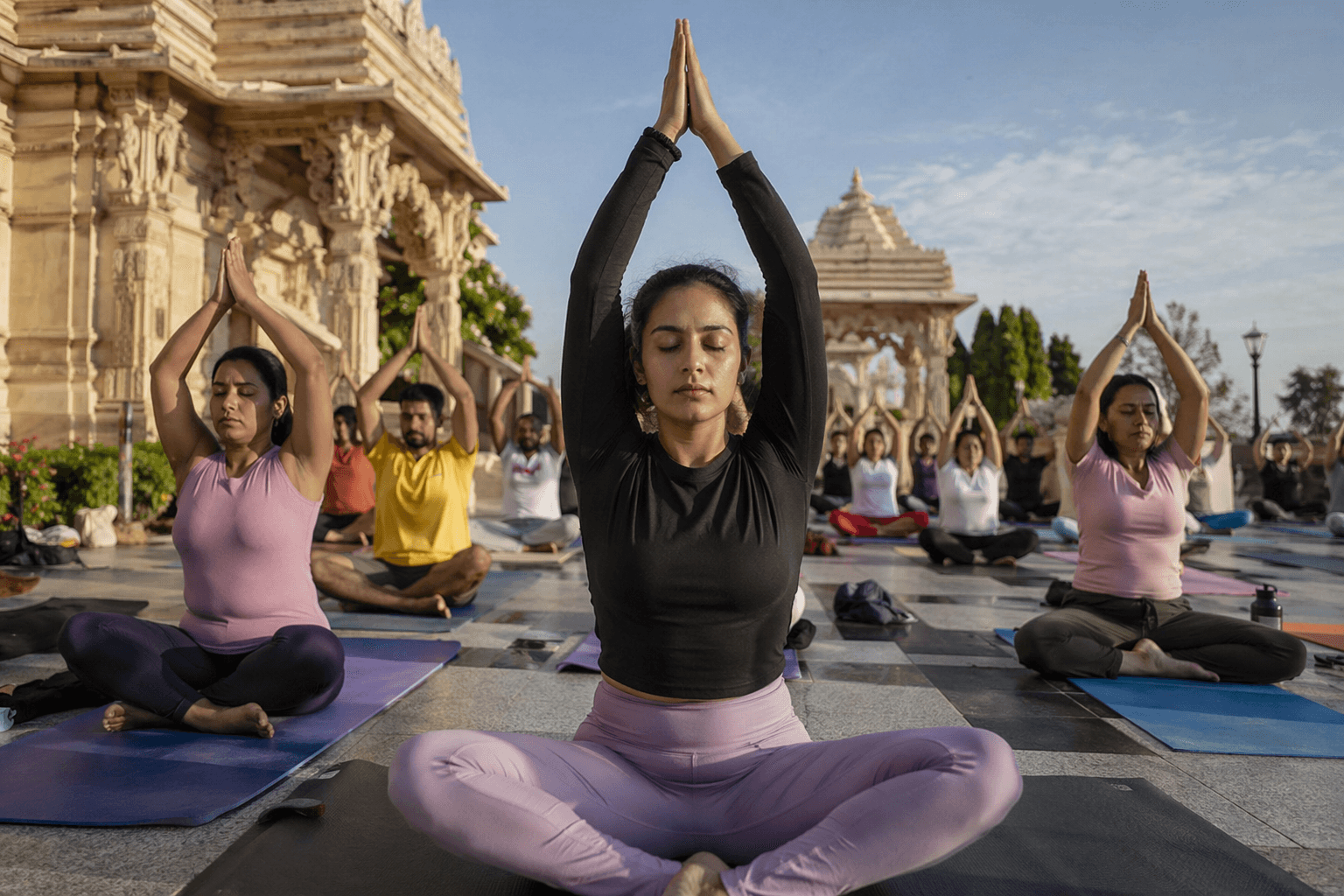
JP Centre Yoga says the Dzaleka program trains and employs refugees in the camp. That matters because it moves the practice beyond outside charity and into local ownership, which is the difference between a temporary intervention and something that can last. The classes are not limited to one type of student either. Teachers offer about 30 classes each week for children, adults and people with special needs, reaching around 3,000 refugees each month.
That breadth is important in a refugee camp because stress does not land on only one age group or one body type. Children need movement and routine. Adults need a way to downshift from tension. People with special needs need access that is adapted, not assumed. A program built around a narrow “advanced yoga” model would miss most of the camp. Dzaleka’s setup works because it treats yoga as a flexible support system rather than a performance.
- It trains refugees as teachers, which builds local capacity.
- It reaches multiple age groups, which helps make practice communal rather than isolated.
- It grew from outdoor classes to a donated studio, which shows how donated infrastructure can anchor consistency.
- It serves roughly 3,000 people monthly, which gives the work scale instead of symbolism.
Part of a wider pattern in refugee wellbeing
Dzaleka is not an isolated case. UNHCR has previously highlighted yoga in Kakuma refugee camp in Kenya, where a Ugandan refugee used the practice to support self-acceptance and mental wellbeing. That precedent suggests something bigger than one camp or one teacher: yoga can travel across displacement settings because it is adaptable, nonverbal when it needs to be, and strong on routine.
That is the real lesson from Dzaleka. In a camp built for 10,000 to 12,000 people and now holding many times that number, yoga survives because it does not demand much and gives back a lot. It helps residents regulate stress, recover physically, and share something steady with each other when nearly everything else is in flux. In Malawi’s only refugee camp, that is not a side story. It is the point.
This article was produced by Prism’s automated news system from verified source data, official records, and press releases, then run through automated quality and moderation checks before publishing. The system is built and supervised by the people who set the standards it runs under. Read our full AI policy.
Did this article answer your question?