כורי ביטקוין מוכרים עתודות: מימון הבינה המלאכותית משנה את השוק
Bitcoin miners are dumping record reserves to fund AI data centers, turning old BTC treasuries into cash for a far more stable business model.
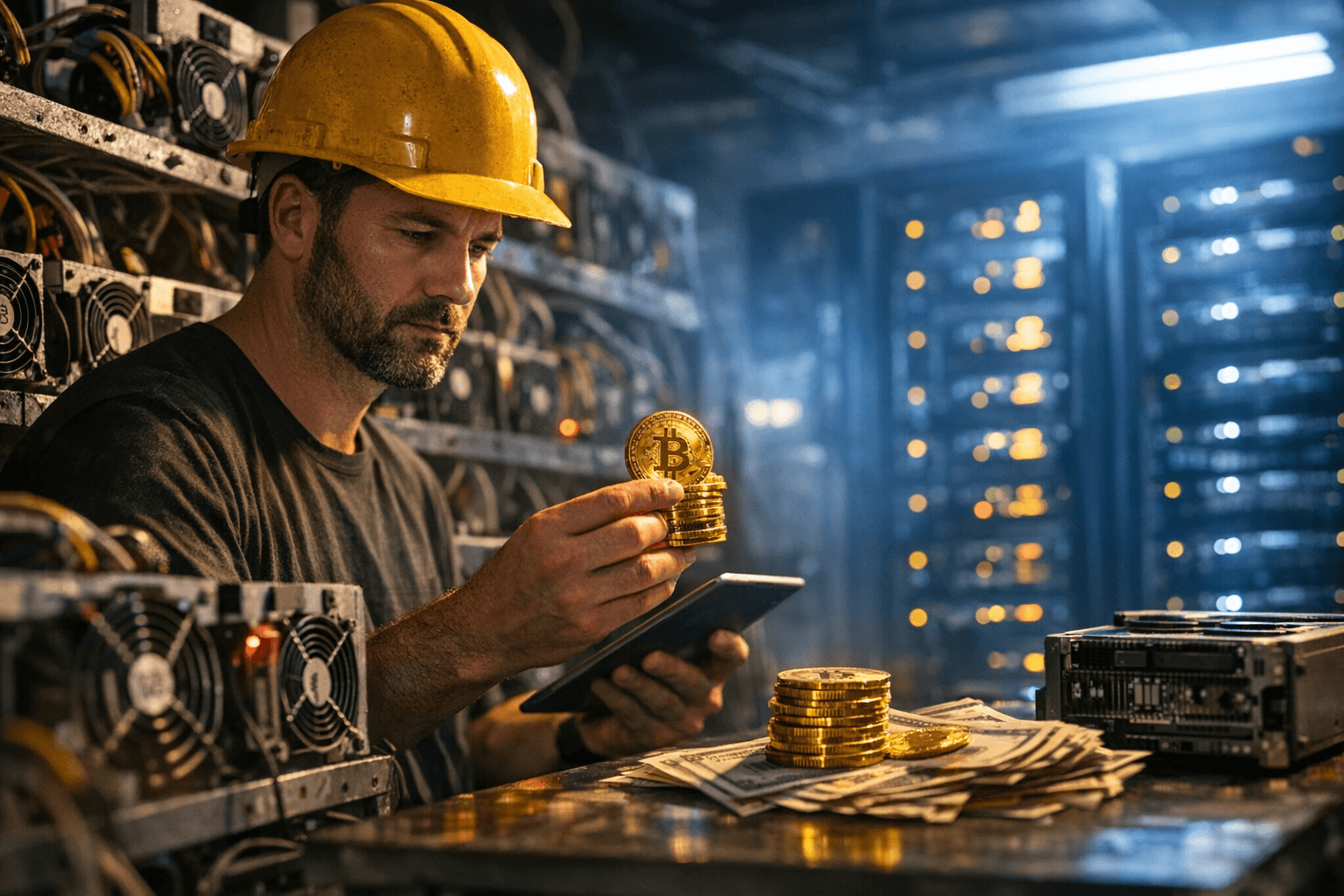
Bitcoin miners are no longer treating their coin stacks like sacred collateral. In the first quarter of 2026, publicly traded miners sold more than 32,000 BTC, a record that topped all of 2025 and even the roughly 20,000 BTC dumped during the Terra-Luna panic in 2022. The message is blunt: when the average public miner’s cash cost to produce one bitcoin sits near $79,995 while BTC trades around $70,000, holding the coin can start to look less like conviction and more like deferred pain.
Why the selling wave began now
Why are miners selling Bitcoin when prices are still high in dollar terms?
Because “high” is not the same as profitable. A miner that spends about $79,995 to create one bitcoin and can sell it for roughly $70,000 is burning margin on every coin unless it has ultra-cheap power, newer hardware, or another business line to absorb the pressure. That gap explains why the industry is moving from treasury hoarding to treasury monetization, even before the market fully breaks down.
The real shift is that miners are being forced to think like infrastructure operators, not crypto maximalists. As AI and high-performance computing contracts pile up, the capital that once sat in BTC reserves now looks more useful when it is turned into debt reduction, data-center capacity, and long-term hosting revenue. That is why the market is reading this as a strategic reset, not just a round of profit-taking.
What changed in the economics of mining?
Two things moved against the sector at the same time: revenue per unit of hash power fell, and the cost base stayed sticky. When Bitcoin sits near $70,000 and production costs are closer to $80,000, the classic “mine and hold” playbook becomes fragile, especially for public companies that have to answer to lenders and shareholders every quarter.
That is why the market is seeing the biggest miners act less like long-term BTC vaults and more like rolling capital allocators. They are not abandoning Bitcoin completely, but they are clearly saying that coins on the balance sheet are now a funding source for something they believe can earn steadier cash flow than block rewards.
Core Scientific and MARA show the new playbook
How did Core Scientific turn its BTC stash into AI firepower?
Core Scientific is the clearest example of the pivot. Its 2025 annual report showed 2,537 BTC at December 31, 2025, worth about $222 million, and the company said it expected to monetize substantially all of those holdings during 2026, with most sales likely concentrated in the first quarter. It had already sold about 1,900 BTC in January for roughly $175 million, then added another signal of intent when it increased term loan commitments by $500 million to $1 billion total on March 18, 2026.
That combination matters because it shows the company is not merely cashing out of a winning trade. It is pairing BTC sales with a much larger financing effort for data-center expansion, which is exactly how miners become AI infrastructure companies. In other words, the coin stash is being converted into power, land, equipment, and financing capacity.
Why does MARA’s 15,133-BTC sale matter so much?
MARA Holdings went even further in scale. Between March 4 and March 25, 2026, it sold 15,133 BTC for about $1.1 billion, then used the proceeds to repurchase convertible notes and shrink its debt load. The company framed the move as a balance-sheet decision that also expands its ability to push beyond pure-play mining into digital energy and AI/HPC infrastructure.
That is a major break from the old market narrative around Marathon Digital Holdings. For years, investors treated the company as a leveraged Bitcoin proxy; now the company is openly using Bitcoin as a financing tool. Once that logic takes hold, the question stops being whether MARA is “bullish on BTC” and starts being whether it can earn a better return by selling BTC and reinvesting the cash elsewhere.
Where does Riot fit into the picture?
Riot Platforms is part of the same rotation. In its first-quarter 2026 update, Riot said it sold 3,778 BTC for net proceeds of $289.5 million, while its holdings fell to 15,680 BTC and its all-in power cost dropped to 3.0 cents per kilowatt-hour. That is not a miner abandoning discipline; it is a miner using the treasury more actively while sharpening the economics of the operating base.
The larger point is that the public-miner universe is becoming less homogeneous. Some companies are still leaning on Bitcoin reserves to fund operating needs, some are paying down debt, and others are building toward AI and colocation revenue. The common denominator is that BTC is increasingly being treated as working capital, not as an untouchable store of value.
Is this a business turning point or just a cash grab?
Why this looks like a structural pivot, not just profit-taking
The strongest case for a turning point is revenue mix. Bloomberg said on April 15, 2026, that the companies that built billion-dollar Bitcoin mining businesses are on track to generate most of their revenue from artificial intelligence by the end of 2026. CoinDesk also noted that more than $70 billion in AI and HPC contracts have been signed and that some miners could derive up to 70% of revenue from AI by year-end.
That changes the identity of the industry. A miner that relies on AI hosting, colocation, and HPC leases is no longer living or dying by the next halving cycle alone. It is becoming a landlord of compute, with more predictable revenue and, in many cases, better margins than pure BTC mining.
What does this mean for Bitcoin’s supply side?
For Bitcoin investors, the key issue is supply discipline. When the biggest corporate miners turn into net sellers, the market loses one of its classic sources of long-term accumulation. That does not automatically break BTC’s bull case, but it does create a heavier supply overhang whenever price rallies meet fresh miner liquidation.
It also raises a second, longer-term question: if more miners divert capital and attention toward AI, what happens to hash rate growth and the security budget of the network? Some analysts see a healthy reallocation of capital toward higher-value uses, while others worry that a weaker pure-mining class could eventually reduce the backbone of Bitcoin’s security model.
For Israeli investors, the shift is not abstract. At a USD/ILS rate of about 2.989, a $70,000 bitcoin is worth roughly NIS 209,230, and Core Scientific’s $222 million BTC stash was worth about NIS 663.6 million. In Tel Aviv trading rooms and on local brokerage apps, that is the kind of balance-sheet move that shows up fast in shekels, not just in headlines.
שאלות נפוצות
Is this mainly miners taking profits after a good run?
Not really. The scale of the selling, more than 32,000 BTC in one quarter, is too large to read as simple profit-taking, especially when it exceeded all of 2025 and came while production costs hovered around $79,995 per coin. This looks more like a response to margin stress and a strategic reallocation toward AI and data-center infrastructure.
Does selling BTC to fund AI mean miners are bearish on Bitcoin?
Not necessarily bearish on Bitcoin, but clearly less dependent on it. MARA and Core Scientific both used BTC sales to strengthen their balance sheets and fund broader infrastructure plans, which suggests they still value the asset but prefer not to let treasury exposure define the business.
Could this hurt Bitcoin’s network security?
It could, if the shift becomes widespread enough to slow capital investment in mining hardware and hash rate growth. The counterargument is that healthier balance sheets and better cash flow from AI could give miners more staying power, even if their role inside Bitcoin changes.
What should crypto investors watch next?
Watch whether miners keep selling reserves, whether AI becomes the dominant revenue line, and whether Bitcoin’s price can rise back above the sector’s cost curve. If BTC stays below production cost for long, the pressure to liquidate reserves and pivot harder into AI will stay very real.
יודעים משהו שפספסנו? יש לכם תיקון או מידע נוסף?
שלחו טיפ