אסטרטג'י עוקפת את בלאקרוק: אוצר הביטקוין הגדול בעולם מתרחב שוב
Strategy now controls 815,061 bitcoin, more than BlackRock's IBIT, after a $2.54 billion buy. The real story is whether that concentration is a bullish signal or a new market risk.

Strategy just turned its bitcoin treasury into a market structure event. With 815,061 BTC on its books, the company now holds more bitcoin than BlackRock’s IBIT, and that shifts the conversation from “another corporate buy” to “who actually controls the supply narrative.” For investors watching bitcoin from New York, Tel Aviv, or anywhere else, the question is no longer only where the price goes next. It is whether one leveraged corporate holder can keep absorbing coin after coin, or whether that concentration becomes the next big fragility in the trade.
Why this purchase changes the market map
Strategy overtakes BlackRock's IBIT in bitcoin holdings
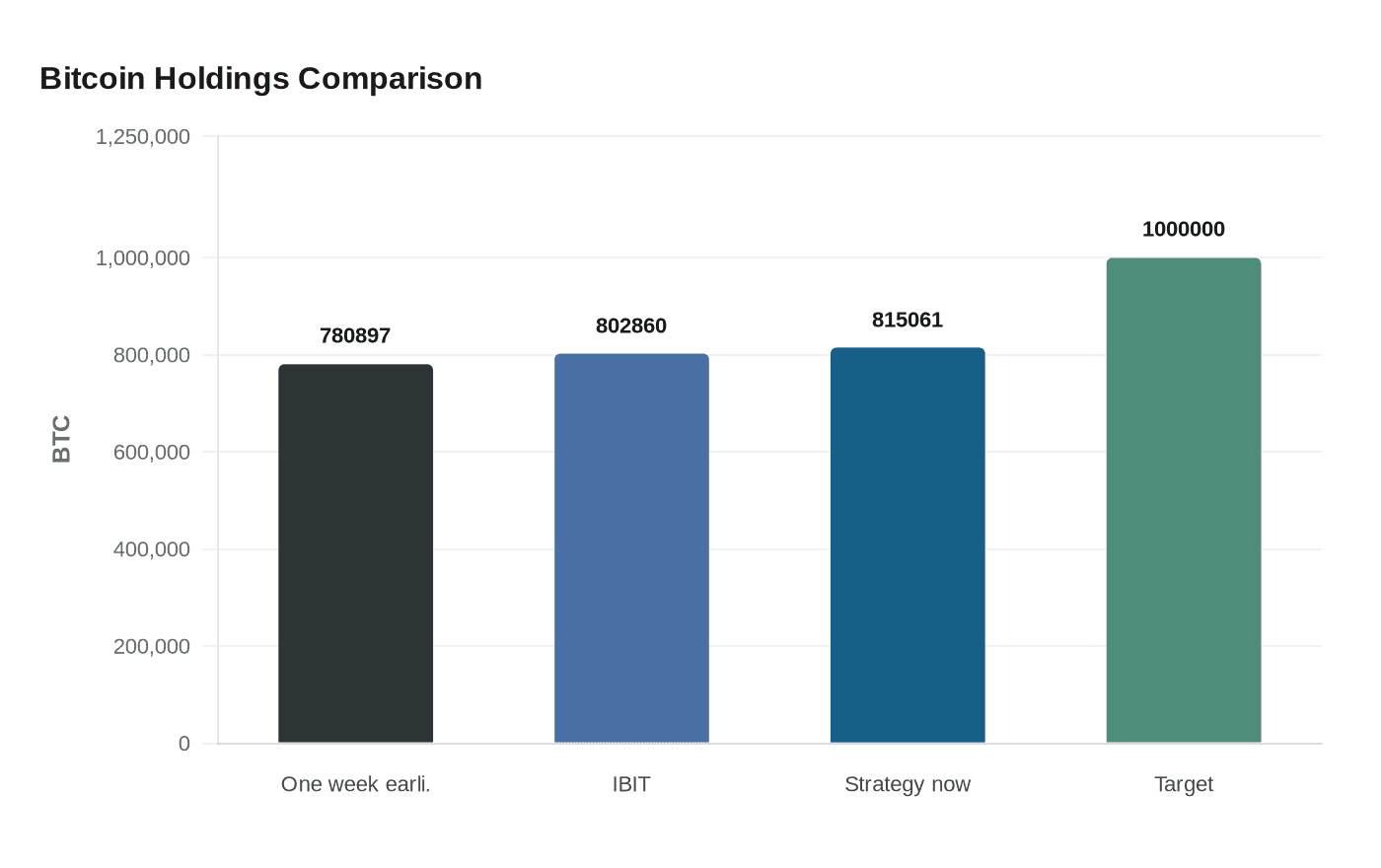
Strategy added 34,164 BTC for about $2.54 billion at an average price of $74,395 per coin. That lifted total holdings to 815,061 BTC, above IBIT’s roughly 802,860 BTC at the same point, which makes Strategy the largest corporate bitcoin holder in the world and, for that moment, the biggest single institutional accumulator too.
That matters because the market has spent years treating ETFs as the dominant institutional wrapper for bitcoin. Here, a public company with a balance-sheet strategy has outpaced the flagship spot ETF in raw coin count. In other words, the company that once sold software is now competing with the most powerful asset manager on the planet in the business of hoarding bitcoin.
Why the million-BTC target is not just marketing
Strategy’s target of 1,000,000 BTC still looks distant, but the gap is smaller than it sounds. From 815,061 BTC, the company needs another 184,939 BTC to hit the milestone, which means it is already about 81.5% of the way there.
The pace is the real shock. One week earlier, the company held 780,897 BTC, so it added more than 34,000 BTC in seven days. That is not normal treasury management. That is a capital market machine moving at speed, and it tells the market that the company still has both the appetite and the financing access to keep pushing the leaderboard higher.
How the accumulation machine is financed
Stock and preferred sales keep the flywheel alive
This is not operating cash flow buying bitcoin. The latest purchase was funded through proceeds from stock and preferred-stock sales, including STRC and MSTR, which means Strategy is using the capital markets as its fuel tank.
That model is why the stock matters almost as much as bitcoin itself. When investors bid up MSTR, the company can raise more money more easily. When it raises more money, it buys more bitcoin. When bitcoin rises, the treasury looks stronger and the loop starts again. It is a reflexive structure, and it works best when sentiment is hot and liquidity is open.
What BTC Yield says, and what it does not say
Strategy said its BTC Yield was 9.5% year to date in 2026. That metric is central to the company’s pitch, because it tries to show how much bitcoin exposure grows relative to share count over time.
But BTC Yield is not the same thing as profit, cash flow, or even clean treasury efficiency. It can look impressive while the company keeps leaning harder on share sales and preferred issuance. For supporters, that is proof that dilution is being used to buy a scarce asset at scale. For skeptics, it is a polished way to describe a leverage loop that depends on market confidence staying intact.
Bullish signal or structural risk?
The bullish case: a permanent bid under bitcoin
There is a real bullish argument here. A company that keeps buying tens of thousands of BTC creates a persistent source of demand that does not disappear after a one-day headline. It also reinforces the idea that bitcoin is not just a trading instrument, but a reserve asset that balance sheets can hold for years.
That helps sentiment. It helps scarcity psychology. And it helps other institutions justify their own exposure, because a company with a public equity wrapper is showing that large-scale accumulation is still possible even after bitcoin has already matured into a mainstream asset.
The risk case: concentration and leverage in one place
The darker side is just as obvious. When more than 815,000 BTC sit inside one corporate treasury, market influence becomes concentrated in a way bitcoin was never supposed to be. A single company, especially one financed through repeated capital raises, can affect supply dynamics, volatility, and sentiment almost by itself.
That creates a structural risk. If the equity window weakens, if preferred issuance gets expensive, or if bitcoin suffers a deep drawdown, the same machine that accelerates accumulation can slow down fast. In that sense, the story is not only about how much bitcoin Strategy owns. It is about how much of the market’s confidence now sits on one aggressive balance sheet and one very specific financing philosophy.
Why this matters for Israeli investors
Bitcoin in dollars, returns in shekels
For an investor in Tel Aviv, Herzliya, or Haifa, this is not a remote Wall Street story. Bitcoin is priced in dollars, but the local return is shaped by the dollar-shekel rate, brokerage fees, and the route used to get exposure. A sharp move in bitcoin can look even larger once it passes through the currency layer.
That matters because Strategy’s buying can shape global sentiment before the move filters into local portfolios. If a company with more than 815,000 BTC keeps absorbing supply, the scarcity narrative stays alive. If the flywheel breaks, Israeli holders feel that too, because the price of bitcoin and the mood around it are global long before they are local.
The market is really asking who owns the float
The bigger question is no longer whether Strategy believes in bitcoin. It clearly does. The real question is whether a public company can keep becoming the marginal buyer of last resort while also staying healthy enough to finance the next wave of purchases.
If it can, then the bitcoin bull case gets a powerful institutional backstop. If it cannot, then the market is left with a new kind of concentration risk, one built not around miners or exchanges, but around a single corporate treasury that has decided to turn scale itself into strategy.
שאלות נפוצות
Why does Strategy overtaking IBIT matter?
Because it changes the institutional hierarchy around bitcoin. An ETF from the world’s biggest asset manager is usually supposed to dominate passive accumulation, yet a single public company has now crossed that line in raw holdings and pushed the market toward a new debate about concentration.
Is this more bullish or more dangerous for bitcoin?
Both. It is bullish because it shows that capital can still flow into bitcoin at a massive scale, but it is dangerous because so much of that demand now depends on one company’s financing access, stock price, and management conviction.
How close is Strategy to 1 million BTC?
Strategy holds 815,061 BTC, so it needs 184,939 more coins to reach 1,000,000. That means the company is already about 81.5% of the way to its target.
How is Strategy paying for these purchases?
The company is funding the buys through capital raises, mainly stock and preferred-stock sales such as STRC and MSTR. That makes the model highly dependent on market appetite, not on operating profits from a traditional business.
Why should an Israeli investor care?
Because bitcoin is a global asset, but your return is local once it is measured in shekels. A giant buyer like Strategy can move sentiment worldwide, and that flow reaches Israeli portfolios through price, currency, and access costs very quickly.
יודעים משהו שפספסנו? יש לכם תיקון או מידע נוסף?
שלחו טיפ