Diamonds are April’s best friend: see the coolest diamonds ever
From a 3,106-carat rock pulled from a South African mine to 9,888 diamonds stitched onto a Coca-Cola bottle, April's birthstone has a habit of going to extremes.
Long before jewelers began marketing April birthdays with solitaire pendants and diamond-set stacking rings, the stone's sacred significance was already three thousand years old. The tradition of assigning gemstones to months traces back to the breastplate of Aaron described in the book of Exodus, a ceremonial breastplate set with twelve stones representing the twelve tribes of Israel, around 1200 B.C. It took until 1912 for the American National Association of Jewelers to formalize the modern birthstone calendar, cementing diamond as April's gem. And yet no official list has ever been needed to explain the obsession: diamond is the hardest natural substance on Earth, forged under pressures exceeding 725,000 pounds per square inch, and it has been drawing human attention, devotion, and occasionally destruction ever since.
The coolest diamonds ever found are not simply the biggest or the most expensive. They are the ones with stories attached: royal gifting, alleged curses, a detoured journey across empires, and, in at least one case, a Guinness World Record for a Coca-Cola bottle. Here is where the superlatives land.
The Largest Gem-Quality Diamond Ever Found: The Cullinan
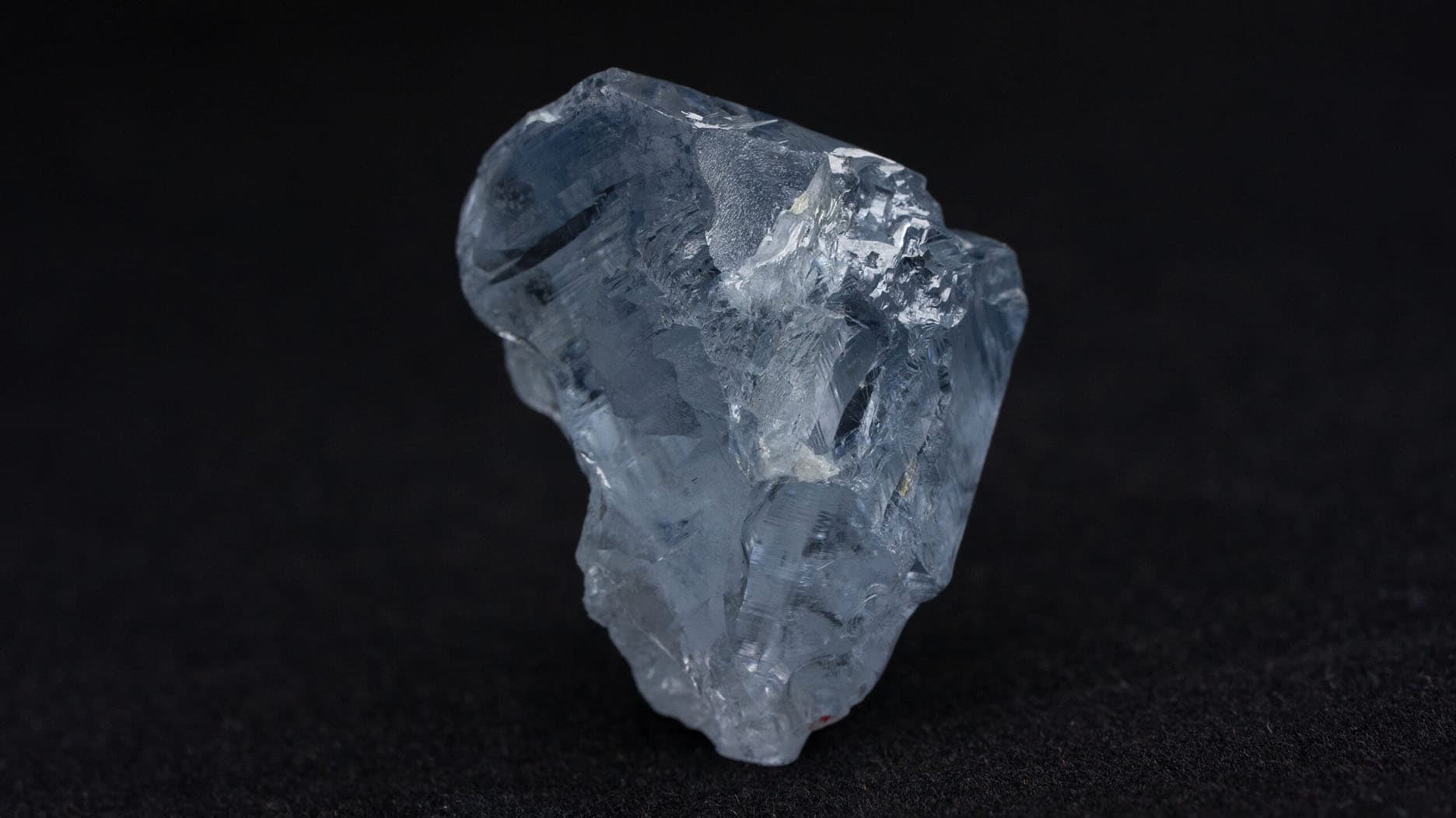
On January 25, 1905, mine superintendent Frederick Wells was working eighteen feet below the surface of the Premier mine in Cullinan, South Africa, when he spotted a flash of reflected light embedded in the wall above him. What he had found weighed 3,106 carats, or roughly 1.33 pounds, a single rough crystal of near-colorless diamond that remains the largest gem-quality diamond ever unearthed. It was named after Thomas Cullinan, the owner of the mine.
For two years the stone sat unsold in London before the Transvaal Colony government acquired it in 1907 and Prime Minister Louis Botha presented it to King Edward VII as a gift. The cutting fell to Joseph Asscher & Co. in Amsterdam. The Cullinan was later cut into nine large stones and about one hundred smaller ones. The largest of those, Cullinan I, also known as the Great Star of Africa, came out at 530.4 carats and holds the title of the largest cut colorless diamond in the world. It is mounted in the head of the Sovereign's Sceptre with Cross. Cullinan II, the Second Star of Africa at 317.4 carats, sits in the Imperial State Crown. Both stones, along with several of their siblings, are on permanent display in the Tower of London as part of the British Crown Jewels.
The Largest Faceted Diamond in the World: The Golden Jubilee
Discovered in 1985 at the very same Premier mine that produced the Cullinan, the stone that would become the Golden Jubilee was initially so unremarkable it was simply called "Unnamed Brown." Its warm, tawny color attracted no particular excitement until master cutter Gabriel Tolkowsky took the 755.50-carat rough and spent years coaxing from it a fire rose cushion cut of 545.67 carats. That figure makes it the largest faceted diamond in the world by carat weight. In 1997, the stone was presented to King Bhumibol Adulyadej of Thailand to mark the Golden Jubilee of his reign, after which it became part of the Thai Crown Jewels. The story of the Golden Jubilee is a reminder that rarity is not always about color or clarity: the largest cut diamond on the planet is brown.
The Most Famous Blue Diamond in the World: The Hope
Few stones have accumulated as much mythology per carat as the 45.52-carat Hope Diamond. Its traceable history begins with French merchant traveler Jean Baptiste Tavernier, who acquired a 112 3/16-carat rough stone, most likely from the Kollur mine in India's Golconda region. Tavernier described its color as "un beau violet," a beautiful violet. Cut down and set as the centerpiece of Louis XIV's ceremonial jewel known as the French Blue, the stone was later reworked again after it disappeared during the French Revolution and resurfaced in the early nineteenth century. By then it had become the Hope Diamond, named after the banking family who purchased it, and it had acquired a reputation for bringing catastrophe to its male owners.
Washington D.C. socialite Evalyn Walsh McLean, who famously wore the stone to her high-society parties, purchased it in 1911 for $180,000, roughly equivalent to about $5.8 million today. Harry Winston acquired it and, in 1958, donated the Hope Diamond to the Smithsonian Institution's National Museum of Natural History in Washington D.C., where it remains on permanent exhibition. A Gemological Institute of America examination confirmed its color as fancy dark grayish-blue, caused by trace concentrations of boron embedded in its crystal structure, ranging from zero to eight parts per million. When an Associated Press reporter was allowed to hold it in 2003, his first thought, he wrote, was simply: "Wow."
The Most Contested Diamond on Earth: The Koh-i-Noor
If provenance is the central ethical question of the gem trade, no diamond has had it raised more persistently than the Koh-i-Noor. The stone, which weighs 105.6 carats in its current form, was originally a rough of approximately 186 carats recovered from the mines of India. It fell into Queen Victoria's hands, who had it recut into a brilliant. Estimates of its worth, were it ever sold, have ranged between $1 billion and $20 billion, which would make it the most valuable gem on the open market. The Koh-i-Noor has a tradition of being worn exclusively by female members of the British royal family. It has been set in the crowns of Queen Alexandra, Queen Mary, and Queen Elizabeth the Queen Mother. It currently sits in the Tower of London, and calls for its repatriation from India, Pakistan, Afghanistan, and Iran continue to this day.
The Most Expensive Diamond Ever Sold at Auction: The Pink Star
In April 2017, Sotheby's Hong Kong sold a 59.6-carat pink diamond for $71 million. The Pink Star is the largest known diamond to receive a Vivid Pink color grade. That combination, maximum size and maximum color saturation in a single stone, made the auction room decisive. A round number that large for a stone that vivid clarified, in the plainest financial terms, what separates colored diamonds from colorless ones. Rarity of color multiplies everything.
The Most Diamonds on a Single Object: The Coca-Cola Handbag
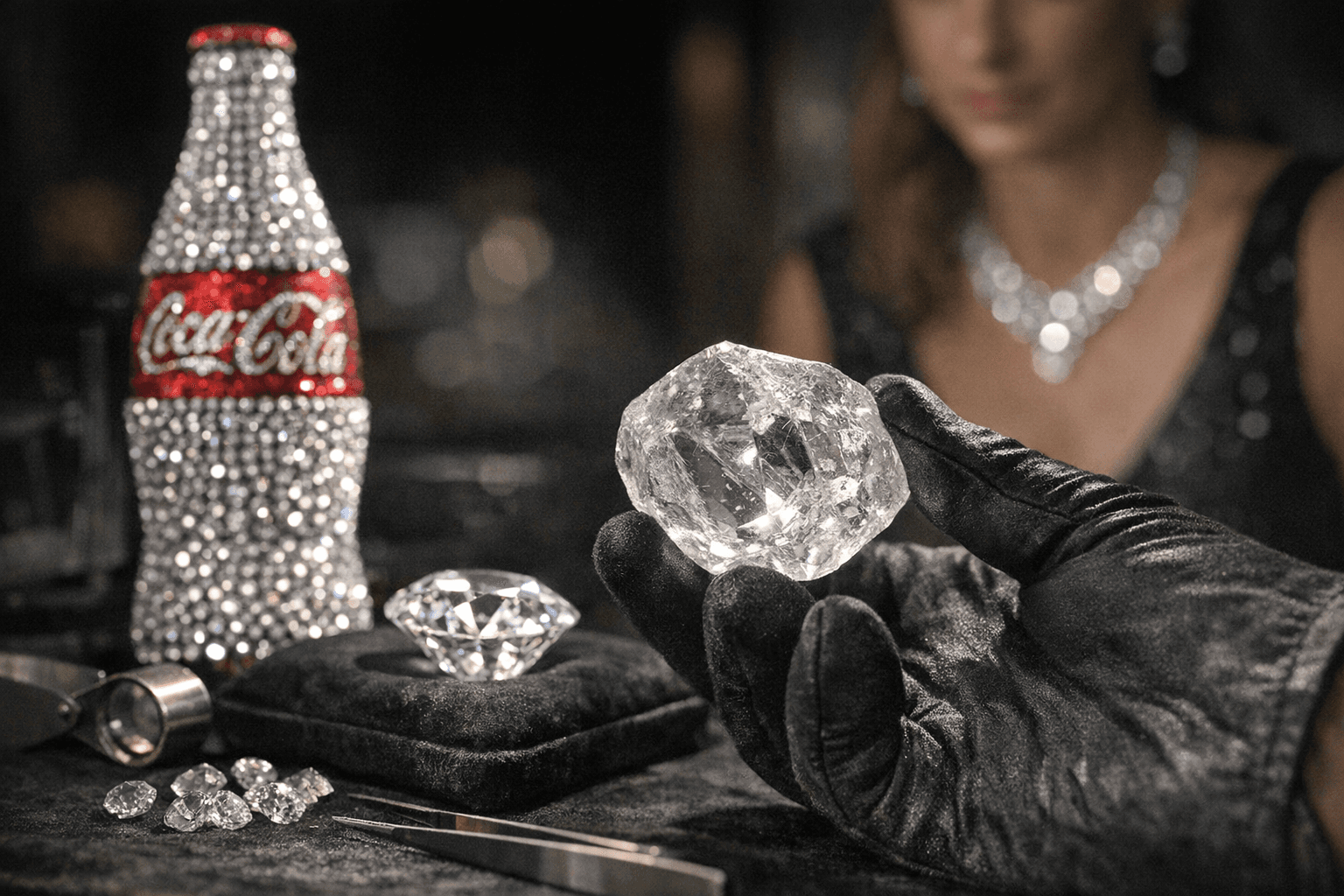
Not every diamond story involves royalty or auction rooms. Beverly Hills designer Kathrine Baumann and Hong Kong manufacturer Aaron Shum Jewelry set 9,888 natural diamonds into a handbag shaped like a Coca-Cola bottle, earning a Guinness World Record for the most diamonds set on a handbag. Of those stones, 8,543 are black diamonds arranged to mimic the dark color of the soda, while 1,345 colorless diamonds define the iconic logo, the clasp, and the borders separating the red enamel label from the rows of black stones. Total diamond weight across the piece is 120 carats. Fifteen craftsmen worked for nearly one hundred days to complete it. The piece was unveiled at the Baselworld trade fair, in the same halls where serious horology and high jewelry are debated with great solemnity. It is probably the only Guinness record in the jewelry world that tastes better in theory than in practice.
Why the Extremes Matter
What these diamonds have in common is not simply size or price but the intensity of the stories attached to them. The Cullinan redrew the map of what a single stone could become. The Hope Diamond crossed continents and centuries before landing in a box mailed to a museum. The Koh-i-Noor carries the unresolved weight of colonial history. The Pink Star demonstrated in real time how a single GIA grade can move $71 million. And Kathrine Baumann's Coca-Cola bag showed that diamonds, for all their ancient gravitas, are also capable of the absurd. April gets the hardest, oldest, most storied birthstone on the list. That has never been an accident.
This article was produced by Prism’s automated news system from verified source data, official records, and press releases, then run through automated quality and moderation checks before publishing. The system is built and supervised by the people who set the standards it runs under. Read our full AI policy.
Did this article answer your question?