The Vermeil Jewels Poised to Be Summer's Best Sellers
Vermeil birthstone jewelry is closing the gap between fashion and fine, offering 18k gold looks at a fraction of the price — and summer 2026's best designs prove the category has grown up.
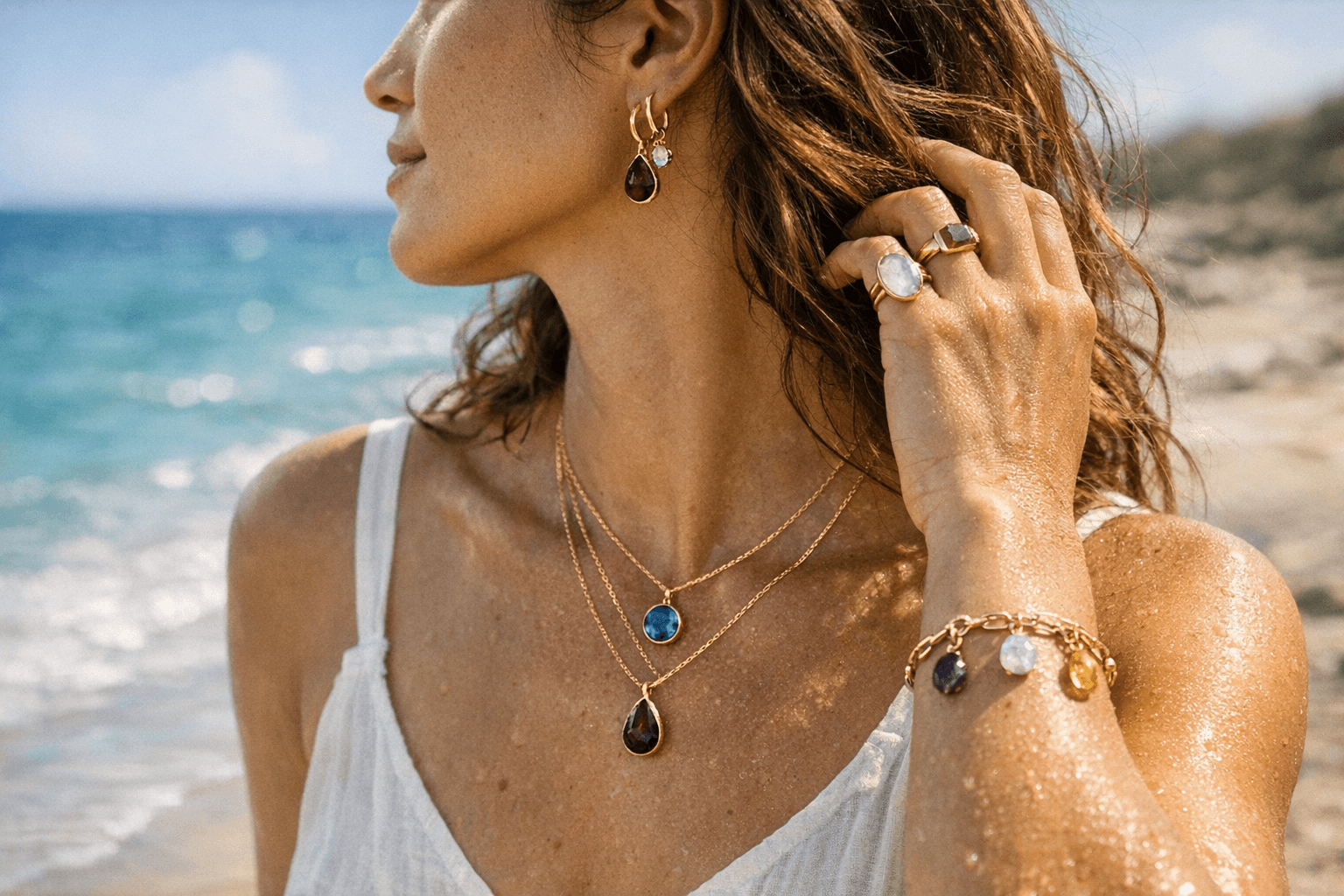
Gold is having a moment, but not everyone wants to pay the spot price to wear it. That tension is exactly where vermeil has stepped in, and heading into summer 2026, it is quietly reshaping how birthstone jewelry gets designed, priced, and worn.
What Vermeil Actually Is (and Why the Distinction Matters)
Vermeil (pronounced ver-MAY) is a legally defined standard in the United States, not a marketing term brands can apply freely. Under the Federal Trade Commission's Jewelry Guides, a piece must meet three specific criteria to carry the name: a sterling silver base, typically stamped 925; a gold layer of at least 10 karats; and a plating thickness of no less than 2.5 microns. That last number is the meaningful one. Standard gold-plated jewelry, which often uses brass or copper cores and paper-thin flash plating, can wear through in months. Vermeil's thicker gold layer, over a noble metal base, is built to last considerably longer, and therein lies its credibility as a bridge category between fashion costume pieces and solid fine jewelry.
Brands pushing into this space in 2026 are not stopping at the FTC minimum. Mejuri, whose Puzzle stacking ring collection debuted in August 2025 in 18-karat yellow gold vermeil, describes its plating as a "thick layer of 18k solid gold" applied over 92% recycled sterling silver, a formulation that prioritizes both longevity and sustainability credentials. That environmental detail matters to a buyer who is thinking not just about cost-per-wear, but about what they are putting on their body and where the materials came from.
Birthstones in Vermeil: The Accessible Personalization Play
Personalized jewelry has been one of the most durable trends in fine accessories for several years, and birthstones sit at the center of that story. What vermeil adds to the equation is accessibility: you can own a piece set with your stone, finished in 18-karat gold, without committing to the price of solid gold construction.
The format that has emerged as the clearest expression of this is the birthstone bar pendant. A slim horizontal bar in vermeil, set with a small colored gemstone representing the wearer's birth month, delivers a delicate, wearable silhouette that works equally well as a standalone piece or layered with other necklaces. Brook & York's Jewel Vermeil Birthstone Bar Necklace follows exactly this logic: a gold bar pendant housing a personalized stone, positioned as both a gift and a self-purchase. It is the kind of piece that photographs well and wears to anything from a linen shirt to a sundress, which explains why it is being flagged as a summer standout.
Mejuri's approach to birthstone vermeil takes stacking as its organizing principle. The Puzzle ring collection, which launched exclusively in 18-karat gold vermeil before expanding to sterling silver in late March 2026, now spans all 12 birth months: garnet for January, amethyst for February, aquamarine for March, lab-grown white sapphire for April, with opal and citrine appearing later in the calendar. The gold vermeil versions sit alongside the new silver styles, giving buyers the choice of a warmer, gold-toned finish at a higher price point, or a cooler silver look at $118 to $128 per ring. A three-ring starter stack in silver runs approximately $30 less than the equivalent gold vermeil configuration, a difference that is meaningful without being dramatic.
The commercial data behind the Puzzle collection's expansion is telling: since the collection launched, 60% of Mejuri's customers have purchased three or more pieces. In a category where single-stone sentiment jewelry often results in a single purchase, that repeat-buy rate signals genuine brand attachment built around the stacking mechanic.
Reading the 2026 Market: Why Vermeil's Moment Is Now
JCK's spring-summer 2026 runway analysis found that the dominant aesthetic direction is a new maximalism rooted in intentionality and scale, quite the departure from the quiet minimalism of recent seasons. For birthstone jewelry in vermeil, that shift translates directly: buyers are not just choosing one piece, they are building collections. Multiple birthstones stacked on a finger, a bar pendant layered with a chain, a pendant echoing a ring stone from another family member's birth month. The category lends itself to accumulation in a way that solid gold, with its higher price-per-piece, often cannot.
Sustainability is a secondary but real driver. Brands using recycled sterling silver as the base metal for vermeil are working within a supply chain that is substantially more traceable than gold mining at scale. When Mejuri notes that its vermeil sits on 92% recycled silver, that detail speaks to a buyer who has come to expect provenance transparency as a baseline, not a premium.
What Buyers Should Know Before They Buy
Vermeil is not solid gold, and the most important service a retailer can provide is honest education about what that means in practice. The 2.5-micron FTC minimum is a floor, not a ceiling, and a brand that exceeds it will offer meaningfully better wear. Ask specifically about plating thickness: a piece at 3 or 4 microns will outlast one at the minimum. Avoid exposing vermeil to chlorine (pools, hot tubs), harsh soaps, and prolonged friction with fabrics or other metals, all of which accelerate wear on the gold surface.
Storage matters too. Keeping vermeil pieces in individual pouches rather than loose in a jewelry box prevents the kind of micro-abrasion that dulls a finish over time. And when the gold layer eventually thins, as it will, replating is a viable option with a local jeweler, typically at a fraction of the original purchase price.
- Ask about plating thickness beyond the 2.5-micron FTC minimum
- Check that the base metal is genuinely sterling silver (925 stamp), not brass or copper
- Remove vermeil jewelry before swimming, exercising, or applying skincare products
- Store pieces separately to prevent surface scratches
- Inquire whether the brand uses recycled silver in its base metal
The Price Calculus
Compared to solid 14-karat gold, a vermeil birthstone piece typically prices at roughly a third to a fifth of the equivalent construction. Mejuri's Sia Birthstone Pendant Necklace in 18-karat gold vermeil is priced at $168. A solid 14-karat version of a comparable birthstone pendant from a fine jewelry brand would generally begin somewhere between $350 and $600, depending on the stone and setting complexity. That gap is precisely where the buying argument lives: the visual impact is nearly identical to the untrained eye, the craftsmanship in a well-made vermeil piece is genuine, and the savings can go toward building out the rest of a stack.
Vermeil has earned the language of fine jewelry because the better makers are building to fine-jewelry standards, starting with the base metal. For birthstone jewelry specifically, where the value is as much emotional as it is material, that construction quality is exactly what justifies the investment. The gold will not last forever. The story behind the stone will.
This article was produced by Prism’s automated news system from verified source data, official records, and press releases, then run through automated quality and moderation checks before publishing. The system is built and supervised by the people who set the standards it runs under. Read our full AI policy.
Did this article answer your question?