Tanzanite, turquoise and zircon offer distinct blue December birthstone looks
December’s blue stones are not interchangeable: tanzanite, turquoise and zircon differ in color, history, wearability and the kind of gift they make.
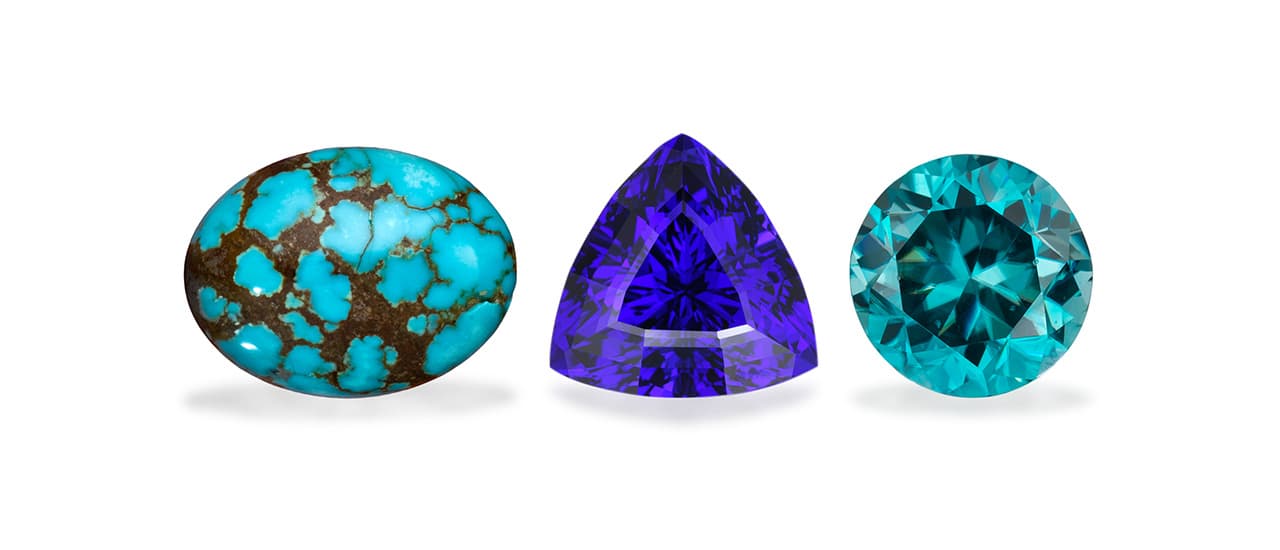
Which December birthstone fits your budget and lifestyle? GIA’s answer is threefold, and the choice matters more than a simple preference for blue. Tanzanite, turquoise and zircon each cast December in a different light: one leans violet and velvety, one is ancient and earthy, and one flashes with diamond-like fire in a startling range of colors.
Why December offers more than one blue
GIA treats birthstones as an accessible, colorful way into gemstone collecting, and December is a perfect example of why some months offer more than one option. Some gemstones are too rare or expensive for broad accessibility, while others simply never become popular enough to stand alone, so the calendar opens up room for alternatives. December’s lineup includes turquoise as the traditional birthstone, zircon as the alternate, and tanzanite as a modern addition, with blue topaz also appearing in December conversations.
That variety gives shoppers a real decision instead of a default. If blue is the goal, the question is not just which stone looks best, but which one makes sense for the way it will be worn, the budget behind it, and the message behind the gift.
Tanzanite: modern, saturated, and best chosen with care
Tanzanite is the youngest of the three, and that newness is part of its appeal. GIA describes it as a transparent blue-to-violet gem whose rapid rise came from vivid color, high clarity and the possibility of large cut stones. In person, its mood is richer and cooler than turquoise, with a blue-to-bluish-purple range that feels luxurious and contemporary.
The catch is size and structure. GIA notes that tanzanite generally needs to be larger than 5 carats to show its deepest saturated violetish blue or bluish violet color, so the most compelling examples are often not tiny accents. It also has a hardness of 6 to 7, which makes protective settings a smart choice for rings. A bezel or other guarded mounting makes practical sense here, because tanzanite is at its best when the stone can be admired without being overexposed to daily knocks.
That makes tanzanite especially strong for a commemorative gift, a statement pendant or a ring meant for occasion wear rather than rough treatment. It also has anniversary significance, since GIA identifies it as a 24th-anniversary gem, adding another layer of meaning to its polished, slightly regal blue.
Turquoise: the traditional December stone with the deepest history
If tanzanite feels modern, turquoise feels ancient, and that is part of its emotional pull. GIA says turquoise has been used in jewelry since the earliest recorded history of civilization, with examples found in ancient Egyptian tombs dating to around 4,000 BC. Its name likely entered Europe through Turkish sources in the 13th century, and its story moves easily from archaeology to ornament.
This is the stone with the most cultural breadth. GIA notes that turquoise served as a ceremonial gem and a medium of exchange for Native American tribes in the Southwestern United States, which helps explain why it still carries such a strong sense of place and identity. It is the traditional December birthstone, and in jewelry it often reads as both personal and symbolic, especially for someone drawn to pieces with a human, historical presence.
Color-wise, turquoise is not a single flat blue. GIA describes it as ranging from intense blue to green, and that spread gives it a more organic character than the cooler precision of tanzanite. It is the right choice when the gift should feel rooted, meaningful and unmistakably December, rather than simply fashionable.
Zircon: the bright, misunderstood contender
Zircon is the stone most likely to surprise a first-time buyer. GIA says it occurs in many colors, including yellow, green, red, reddish brown and blue, and that its rainbow variety gives it a personality unlike either tanzanite or turquoise. If you want a blue that still sparkles with a kind of inner lightning, zircon is the one to examine closely.
Its optical character is also the reason it has long been misunderstood. GIA notes that zircon’s properties are close enough to diamond to have caused centuries of confusion between the two gems, and colorless zircon has sometimes been used as a diamond substitute because of its brilliance and dispersion. That means zircon can deliver a lot of visual drama for shoppers who want light performance as much as color.
As an alternate December birthstone, zircon feels especially appealing for someone who likes the idea of a classic blue but wants a livelier, more unexpected gem. It does not carry the same ancient ceremonial history as turquoise or the same contemporary cachet as tanzanite, but it offers a different kind of value: brilliance, variety and a look that reads far more expensive than its name sometimes suggests.
How to choose among the three
The easiest way to decide is to start with the kind of blue you want to see on the hand, at the ear or at the throat.
- Choose tanzanite if you want a saturated blue-to-violet stone with modern glamour and are comfortable treating a ring with care.
- Choose turquoise if you want the most storied December gem, one with ceremonial weight, historic resonance and a blue that can lean vividly toward green.
- Choose zircon if you want a bright, prismatic blue with exceptional sparkle and a look that feels more luminous than monochrome.
Budget sensitivity is part of the calculus, too. GIA’s explanation for multiple birthstones is revealing: the system exists partly because some gems are too rare or expensive for broad access. Tanzanite’s richest color often depends on larger stones, turquoise has the advantage of being the traditional choice with a long jewelry history, and zircon gives shoppers a vivid blue alternative with a very different optical effect. Put simply, December is one of the few birthstone months where “blue” still gives you room to define your priorities.
The GIA perspective
GIA’s role in all of this matters. Founded in 1931, the Gemological Institute of America is an independent nonprofit built around research, education and laboratory services, and its birthstone guides are meant to do more than decorate a calendar. They help shoppers understand why one blue stone feels delicate and modern, another feels ancient and ceremonial, and another catches the eye with a flash that borders on diamond-like.
That is the real gift of December’s trio: three blue stones, three very different personalities, and one month that lets style, sentiment and practicality meet in the same setting.
This article was produced by Prism’s automated news system from verified source data, official records, and press releases, then run through automated quality and moderation checks before publishing. The system is built and supervised by the people who set the standards it runs under. Read our full AI policy.
Did this article answer your question?