Casey Perez Shapes Loma Pendant From Botanical Forms and Gold
Casey Perez’s Loma pendant turns botanical curves into a buying lesson: organic diamond jewelry works best when light, security, and metal weight are all balanced.
Organic form is becoming a serious diamond-jewelry choice
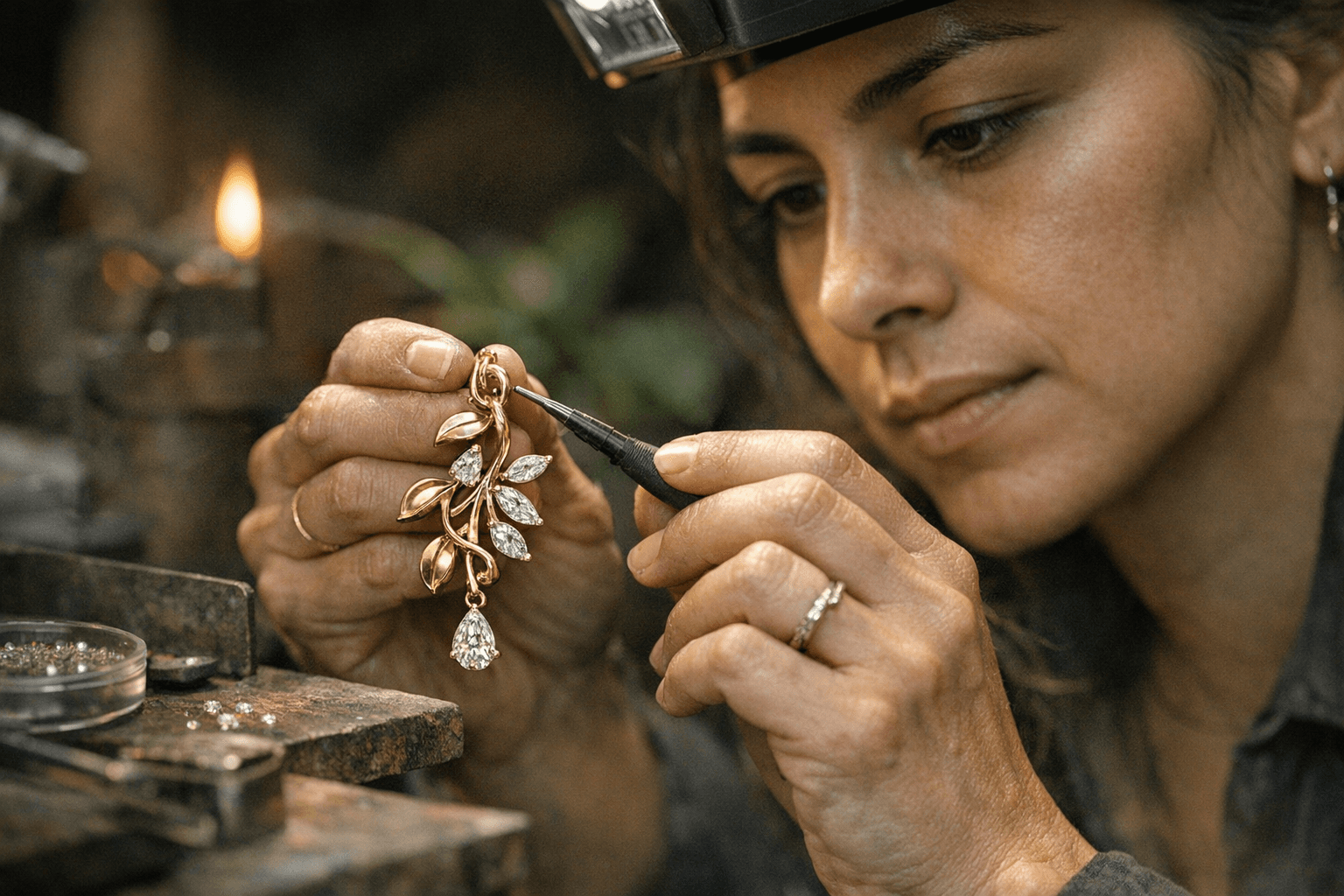
Casey Perez’s Loma pendant reads like a small argument for buying with the eye, not just the checklist. Shaped from a fluted teapot, a vintage scalloped lampshade, and Karl Blossfeldt’s botanical studies, it shows how nature-inspired jewelry can feel deliberate rather than decorative. Perez’s version of luxury is not symmetry for its own sake. It is contour, movement, and the kind of goldwork that catches light as the wearer moves.
That matters because this style is increasingly appealing to clients who want something less literal than a classic bridal solitaire. Perez’s own work, from custom engagement rings to the new Loma pendant, shows how sculptural diamonds and warm gold can offer a softer path than rigid, traditional settings. The result is a piece that feels modern but rooted, especially for buyers who want jewelry that looks personal without losing polish.
Why Loma feels wearable, not precious in a fragile way
Perez describes the Loma pendant as a sculptural gold pendant with soft radial fluting designed to catch the light, and that detail tells you almost everything about how to judge pieces in this category. Organic form should not just look interesting in a case. It has to sit close to the body, move cleanly on the neck, and avoid snagging on knitwear or hair. A pendant with radial lines and a gentle contour can create dimension without building in sharp edges that make daily wear difficult.
The name helps explain the logic. Loma comes from the Spanish word for hill or slope, which suits a form built around gradual rise and fall rather than hard angles. That matters when you are evaluating a sculptural diamond piece for everyday use: ask whether the design feels like it was shaped to be worn, or merely photographed. Perez’s pendant is meant to do both, but the wearability is part of the point.
Gold, natural diamonds, and the value of material honesty
Perez says she is drawn to gold for its warmth, lineage, and centuries of use, and to natural diamonds because they were formed over spans of time far beyond our own. That is a useful frame for buyers because organic jewelry often lives or dies on the credibility of its materials. If a brand leans on nature-inspired language, the finish, the alloy, and the stone quality should support the story.
For readers comparing options, the strongest pieces usually have three things in common:
- A clearly stated metal, not a vague “gold-tone” description.
- A diamond specification that distinguishes natural from lab-grown if that distinction matters to you.
- A form that is matched to the material, so the setting looks engineered rather than merely ornate.
Perez’s preference for natural diamonds and gold is not just aesthetic. It is part of a material language that values permanence, history, and texture. For buyers, that can justify a higher price, but only if the workmanship is equally careful.
What Perez’s background says about craftsmanship and provenance
Casey Perez Jewelry is based in New York City, and the brand says its pieces are handcrafted between her Brooklyn studio and New York City’s jewelry district using traditional techniques. That production story matters because sculptural jewelry can look effortless while actually requiring a high level of bench skill. Soft fluting, uneven contours, and organic profiles demand precise metalworking so the piece still feels refined once it is cast, finished, and polished.
Perez’s path also gives the work context. She is a first-generation Mexican-American artist and goldsmith based in New York, and she discovered metalsmithing while studying at New York University. Her references stretch from modernist architecture and the Bauhaus to Memphis, Swedish minimalism, and nature, which helps explain why her designs balance structure with softness. In other words, the organic look is not a trend veneer. It is part of a broader design vocabulary.
How to evaluate a sculptural diamond piece before you buy
The rise of botanical and organic diamond jewelry is not just about style. It is about whether a piece can hold up as an everyday object. Perez’s Loma pendant is a good test case because it combines visual softness with a gold form that still needs to be durable, comfortable, and secure.
When you are evaluating a piece like this, focus on four things:
- Wearability: Check whether the surface is smooth against the skin and whether the shape will sit flat under clothing. A gently fluted pendant may be comfortable, but deep ridges or protruding forms can catch.
- Stone security: If diamonds are part of the design, look closely at how they are held. Organic silhouettes can hide practical weaknesses if stones are set in shallow bezels or thin prongs.
- Metal weight: Sculptural gold can feel substantial, which is part of the appeal. But weight should support the design, not make the piece awkward or unbalanced.
- Budget implications: Custom-looking work and traditional bench techniques often cost more than simple mass-produced jewelry. The price should reflect the metal content, the labor, and the complexity of the form, not just an aesthetic narrative.
Perez’s own engagement ring offers a useful reference point here. In a 2024 Natural Diamonds interview, she said she selected a reclaimed oval-cut natural diamond for the ring, set on a gold band with waves and ridges that evoke landscape and her Mexican heritage. That design shows how organic form can work in a bridal context without defaulting to the symmetrical classics many buyers expect.
Why this style resonates with modern bridal buyers
Perez’s custom engagement work makes the strongest case for the category. A reclaimed oval-cut natural diamond already signals a shift away from the cookie-cutter engagement ring, but the real story is the band: waves, ridges, and landscape-like movement turn the ring into a personal object rather than a standardized symbol. For clients who want something less traditional, that combination offers emotional weight without visual stiffness.
It also reflects a broader appetite for pieces that feel authored, not assembled. A sculptural diamond ring or pendant can carry references to place, heritage, and natural form at once. Perez’s work proves that the best organic jewelry is not trying to imitate nature literally. It borrows nature’s logic, then translates it into gold, light, and wearability. That is why pieces like Loma feel timely now: they give buyers a route into diamond jewelry that feels intimate, tactile, and harder to mistake for anyone else’s.
This article was produced by Prism’s automated news system from verified source data, official records, and press releases, then run through automated quality and moderation checks before publishing. The system is built and supervised by the people who set the standards it runs under. Read our full AI policy.
Did this article answer your question?