Lab-Grown Diamonds Reshape Engagement Rings as Market Identity Crisis Deepens
Lab-grown diamonds have changed the price, size, and symbolism of engagement rings. The real difference now is provenance, disclosure, and what story you want the ring to tell.
What still separates lab-grown from mined
Before you spend a single dollar on a diamond, decide what you are really buying: a bigger stone for less money, a mined diamond with legacy value, or a lab-grown ring that trades geology for affordability and clarity of origin. The visual difference can be negligible, which is exactly why the market is in an identity crisis.
That tension is not just romantic, it is practical. The Federal Trade Commission updated its Jewelry Guides in July 2018 to address laboratory-created and simulated diamonds, making clear that sellers must disclose origin and avoid language that could make a lab-grown stone sound mined. In other words, the line between “natural” and “created” is now a consumer-protection issue, not just a branding choice.
The shape of the ring may not tell the whole story, but it does reveal where the market has settled. The Knot’s engagement study found round center stones remained the most popular shape, even as lab-grown diamonds moved into the mainstream. The important distinction is no longer how the stone looks across a dinner table. It is how it was made, how it is described, and what kind of value it is expected to hold.
The price gap has become the whole argument
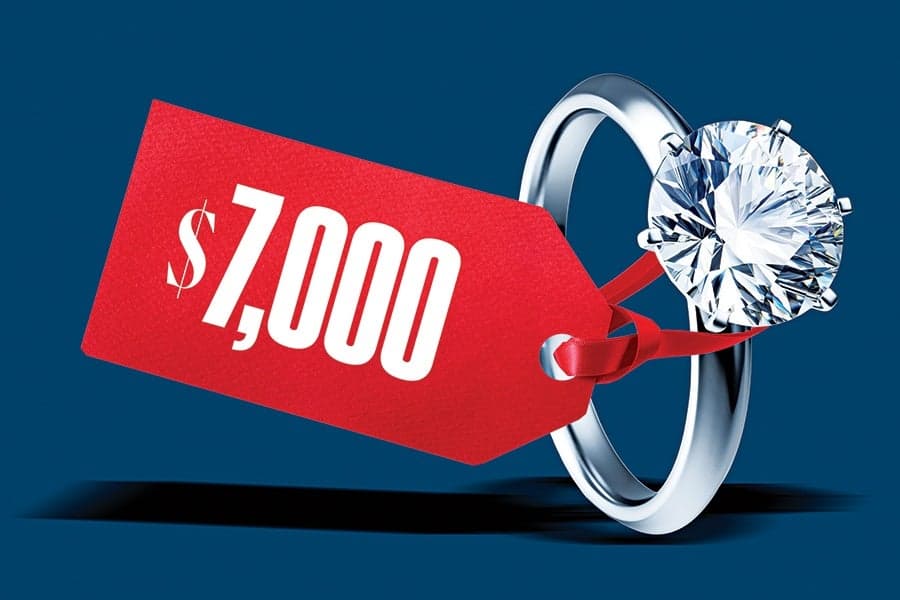
The strongest force behind the lab-grown shift is simple: price. Paul Zimnisky estimated a 1-carat lab-grown diamond at about $845 at retail in early 2025, compared with roughly $3,895 for a similar natural diamond. That gap explains why couples can step up in size without blowing past a budget, and why the average engagement ring now looks different than it did just a few years ago.
The Knot’s 2024 study showed 52% of engagement rings featured a lab-grown center stone, up from 46% in 2023 and 12% in 2019. At the same time, average engagement-ring spending fell to $5,200 from $5,500 in 2023 and $6,000 in 2021, even as the average center stone grew to 1.7 carats from 1.5 carats three years earlier. Bigger stones are becoming the norm, but they are increasingly being achieved through a different supply chain and a lower sticker price.
BriteCo’s data pushes that point further. It found the average lab-grown engagement-ring center stone grew from 1.31 carats in 2019 to 2.45 carats in 2025, and that 85.9% of lab-grown diamonds sold in 2025 were colorless, up sharply from 37.7% in 2020. The market is not just shifting toward lab-grown, it is shifting toward larger, whiter, more commercially uniform stones.
That price compression has also shaken the industry itself. De Beers said lab-grown jewelry prices had fallen 90% at wholesale since Lightbox launched in 2018, and it described that brand’s starting point as transparent pricing of $800 per carat. In May 2025, De Beers said it intended to close Lightbox and focus on natural diamonds, a move that underscored how quickly lab-grown stones moved from novelty to high-volume commodity.
For buyers, this is where resale reality enters the picture. A product whose wholesale value has collapsed so dramatically leaves far less room for a generous second life on the secondary market. The market is telling you that a lab-grown diamond is a purchase for beauty and budget, not a store of value in the old luxury sense.
Disclosure is the line you should not let a seller blur
If a retailer cannot state clearly whether a diamond is lab-grown or mined, walk away. The FTC’s 2018 Jewelry Guides were built to prevent exactly that kind of confusion, and in 2019 the agency sent warning letters to eight companies over diamond ads that lacked adequate disclosures. The issue is not subtle marketing language. It is whether the consumer is being told the truth in plain English.
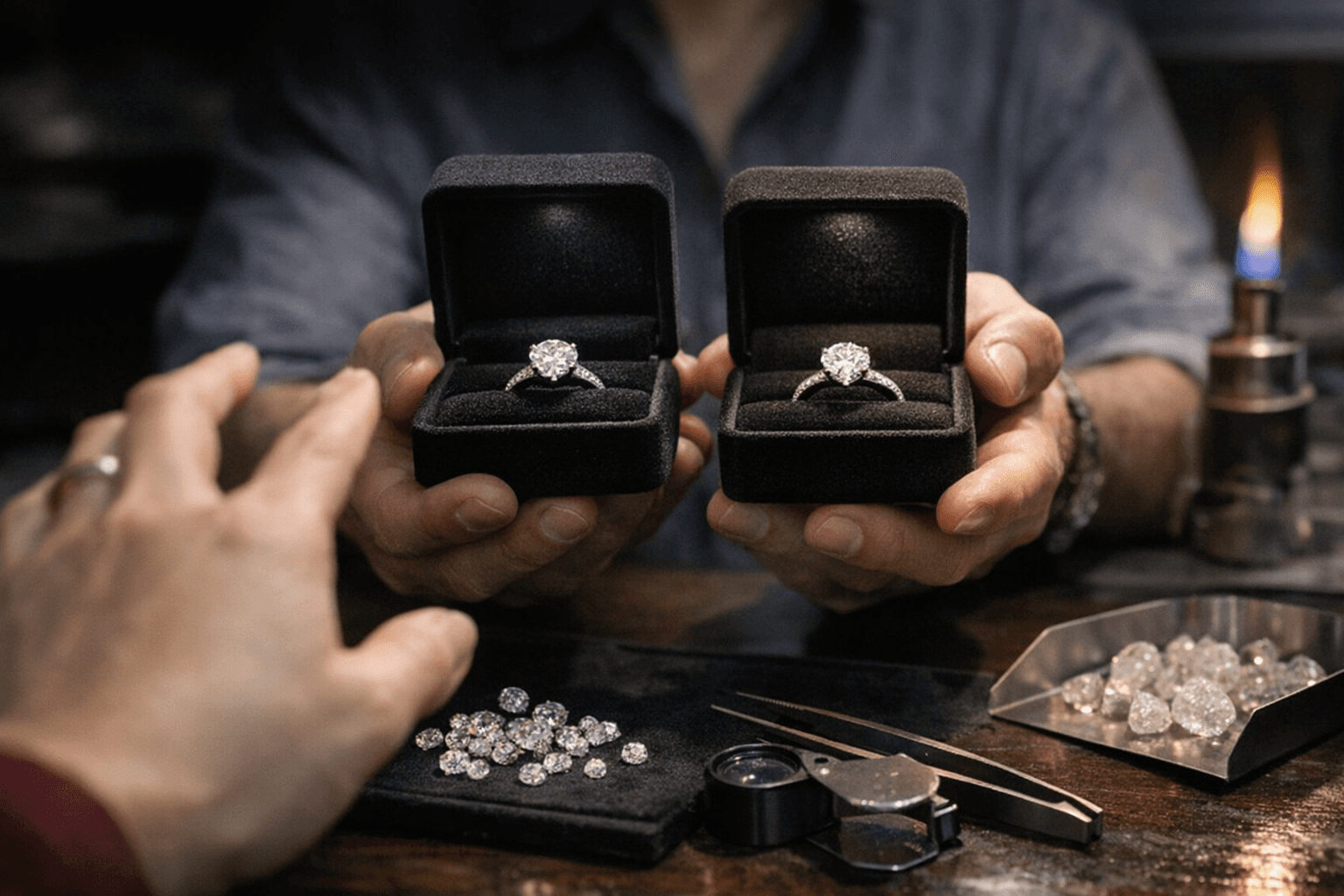
The safest buying practice is to look for language that says laboratory-created, lab-grown, or mined without hedging. Vague phrases are a warning sign, especially if a seller leans on atmosphere instead of specifics. A ring can be beautiful and still be marketed sloppily, and sloppy here matters because origin is part of the product.
This is also where certification and paperwork matter. A buyer should expect a clean, written description of the stone and its origin, not just a sales pitch. If the invoice, tag, or report leaves room for confusion, the seller is not meeting the standard the FTC set out years ago.
What couples are really choosing between
The lab-grown debate is partly a clash between an older romantic story and a newer value proposition. De Beers’ 1947 “A Diamond Is Forever” campaign, created by N.W. Ayer, helped turn diamond engagement rings into a modern cultural norm. That campaign made mined diamonds feel like destiny. Lab-grown diamonds answer with a different pitch: more size, less cost, and a cleaner story about origin for buyers who want it.
That is why the conversation is no longer about sparkle alone. Some couples want the symbolism of rarity, geology, and tradition. Others want a larger stone, a lower invoice, and a ring that does not require them to pay for old scarcity myths. Both choices are valid, but they are not the same choice.
The clearest way to decide is to ask a few blunt questions before you buy:
- Is the diamond lab-grown or mined, and is that stated in writing?
- Does the price reflect the size and origin, or just the label?
- Does resale matter to you, or is the ring meant to be worn and loved without financial expectations?
- Do you want the ring to tell a story about heritage, efficiency, ethics, or all three?
Those questions matter because the market has already changed. Lab-grown diamonds are no longer a fringe alternative. They are reshaping the center of the engagement-ring case, pushing bigger stones into more hands, pressuring natural diamond pricing, and forcing jewelers to be precise about what they are selling. The new luxury question is not whether the stone shines. It is whether the story behind it still holds up.
This article was produced by Prism’s automated news system from verified source data, official records, and press releases, then run through automated quality and moderation checks before publishing. The system is built and supervised by the people who set the standards it runs under. Read our full AI policy.
Did this article answer your question?