Gracie Hunt's Custom Ring Features Emeralds, Bible Verse, and Groom-Led Design
Derek Green had two emeralds, a surname nod, and a Bible verse hidden inside Gracie Hunt's custom cushion-cut diamond ring, co-designed with Dallas jeweler Lyles DeGrazier.
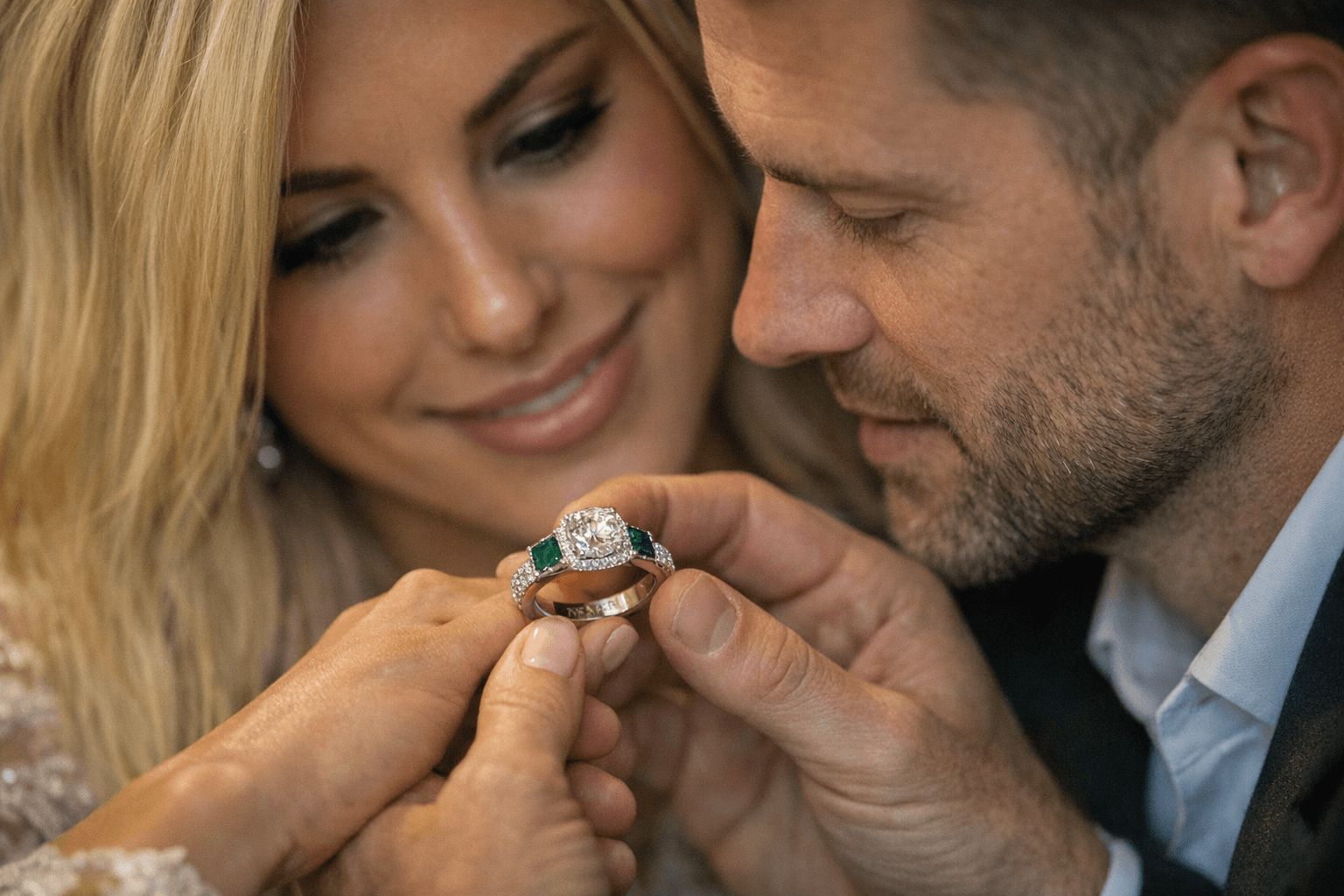
The ring that Derek Green built for Gracie Hunt is less a piece of jewelry than a document of intention. An elongated cushion-cut diamond sits at the center, flanked by two vivid green emeralds and set on a pavé band, but the design choices that make it remarkable live in the details most people will never see: a surname encoded in gemstone color, a scripture verse pressed against the inside of the band, and a generational jeweler connection that links the piece directly to Hunt's own family history.
Green, 26 and the son of former Kansas City Chiefs quarterback Trent Green, proposed to Gracie Hunt, 27, in Mexico on April 5. Three days later, Hunt described the ring's architecture layer by layer, revealing a commission that reads more like a love letter in object form than a standard engagement purchase.
"Derek designed the ring alongside Lyles DeGrazier, which makes it incredibly special to me because so much intention and thought went into every detail," Hunt said. "Lyles' master jeweler, Scott Polk, who also helped design my mother's ring, was part of the process, which made it feel even more meaningful and connected to my family."
That last sentence deserves to be read twice. Scott Polk is a third-generation jeweler and the grandson of Arch Lyles, who opened the Dallas house in 1949. The fact that Polk crafted both Tavia Shackles Hunt's ring and her daughter's is not a coincidence; it is what a genuine jeweler-family relationship looks like across decades. Lyles DeGrazier, located at the World Trade Center in Dallas and fully family-owned, designs, casts, and finishes all pieces in-house, a rarity in an industry where most retail operations outsource production entirely. Gracie Hunt, the daughter of Kansas City Chiefs CEO Clark Hunt and Chiefs Women's Organization director Tavia Shackles Hunt, now wears a ring connected to her mother's by the same craftsman's hands.
The center stone is an elongated cushion cut, a shape that has emerged as one of the defining diamond cuts of the mid-2020s. It carries the soft, romantic geometry of a traditional cushion but pulls longer across the finger, creating the visual weight of an oval without the pointed tips that require extra prong protection. For Hunt's commission, the cushion sits high enough to command attention while the surrounding pavé band keeps the composition grounded.
Then come the emeralds. "Derek included two green emeralds, one on either side of the center stone as a subtle nod to his last name, Green, which I think is such a thoughtful and personal touch," Hunt said. The stones are small by design; their purpose is semantic rather than structural. Placed symmetrically at the diamond's shoulders, they add a shot of saturated, verdant color against the center stone's icy white, but their real function is to encode a name into a piece of jewelry without a single letter of text. It is the kind of heraldic logic that medieval jewelers would have recognized immediately, adapted here for a very modern couple.
The third layer of meaning is invisible to any observer. Inside the band, Green had one of Hunt's favorite Bible verses engraved. "What makes it even more sentimental is that he had one of my favorite Bible verses engraved inside the band," she said, "a constant reminder of the foundation of faith our relationship is built on." Hunt's engagement Instagram caption quoted Romans 8:28: "And we know that in all things God works for the good of those who love him, who have been called according to his purpose." Whether or not that is the specific verse inside the band, it signals the theological register Green was working with when he chose it.
The groom-led custom ring has become one of the most discussed design trends in fine jewelry since August 2025, when Travis Kelce proposed to Taylor Swift with a ring he co-designed with New York jeweler Kindred Lubeck. Swift described the piece publicly, and the resulting visibility elevated groom-led co-design from sweet gesture to cultural shorthand for romantic seriousness. Green's collaboration with Polk and Lyles DeGrazier follows that template but roots it in a regional, multigenerational relationship rather than a celebrity-driven discovery.
For anyone commissioning a custom ring, the Green-Hunt piece offers three specific design moves worth carrying into the conversation with your jeweler.
The first is stone symbolism over stone scale. The two emeralds flanking Hunt's diamond are small, but they carry the entire emotional weight of the ring's concept. Before meeting with a jeweler, consider whether a surname, a birth month, a place, or a meaningful color could translate into an accent stone. The move from "side stones" to "story stones" adds no cost and changes everything about how the piece is experienced over a lifetime.
The second is the generational jeweler relationship. Polk's involvement in two rings across the same family is not accidental; it is the product of a relationship cultivated over time. When beginning a custom commission, ask whether a trusted relative has worked with a particular jeweler across more than one piece. That existing rapport typically produces better creative shorthand, more candid guidance on stone quality, and a jeweler who already understands your family's aesthetic instincts.
The third is the inner band as meaningful real estate. Band engraving remains the most underused space in engagement ring design. Modern engraving technology is precise enough to accommodate a full sentence. Unlike a stone grade or a metal stamp, the inscription belongs entirely to the two people the ring connects; it appears on no grading report, no resale listing, and no appraisal document. Choose something specific enough that it could only ever apply to this relationship.
Hunt and Green met at Arrowhead Stadium in Kansas City in 2017 and spent nearly a decade as friends before beginning their relationship in 2025. The ring Green commissioned with Scott Polk reflects that timeline: a piece built by someone who had eight years to learn exactly what would matter most, and a jeweler who had already proven he could get it right once before.
This article was produced by Prism’s automated news system from verified source data, official records, and press releases, then run through automated quality and moderation checks before publishing. The system is built and supervised by the people who set the standards it runs under. Read our full AI policy.
Did this article answer your question?