Grant-Winning Designer Johnny Nelson on Craft, Diamonds, and Scaling Artisanal Production
Johnny Nelson, a Brooklyn-raised former rapper, just won the inaugural $50,000 David Yurman Gem Awards Grant — and his origin story begins with a 3-finger ring his mom made.
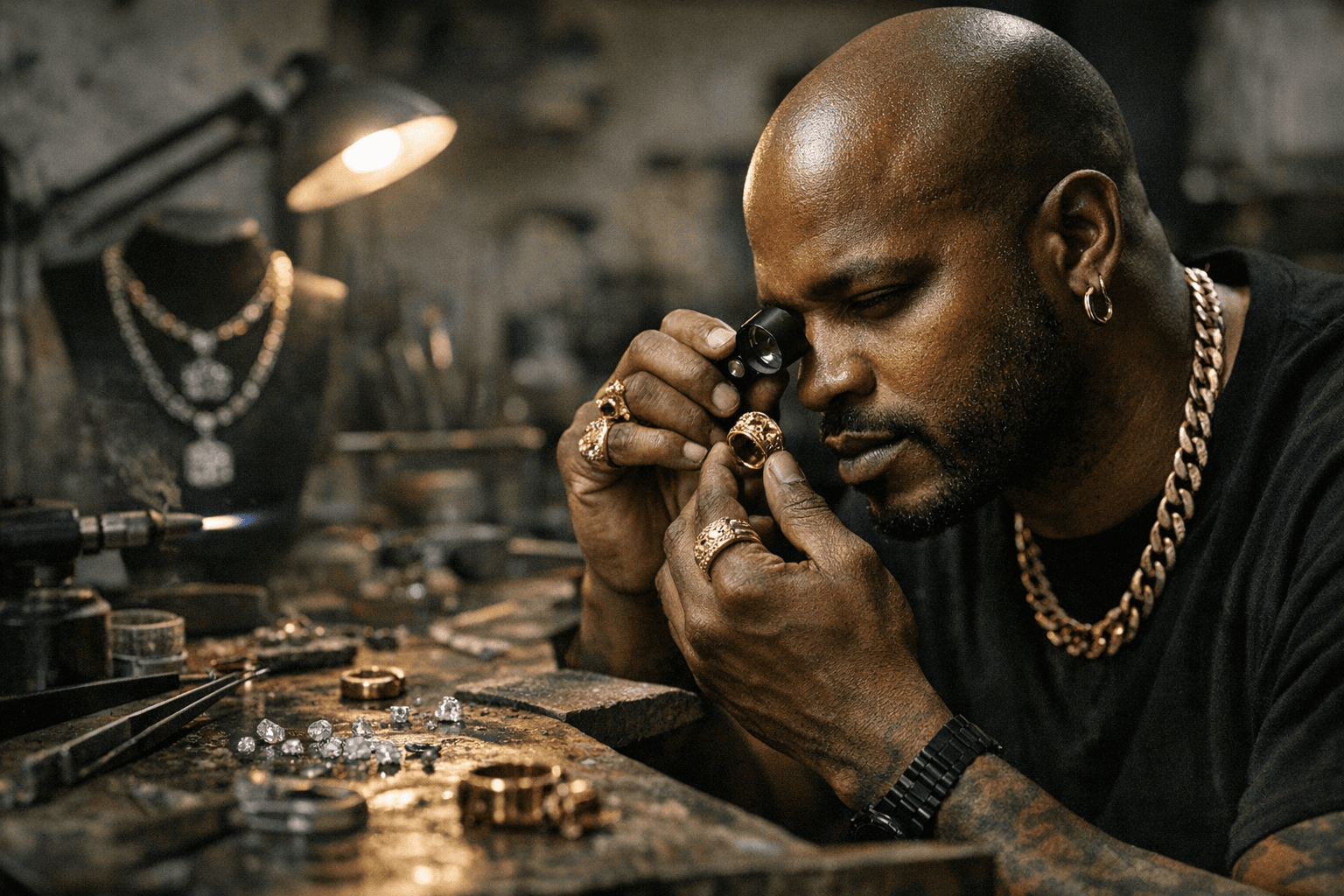
Before Johnny Nelson was a Gem Awards grant recipient, before Beyoncé and Lil Nas X were wearing his work, and before his pieces entered the permanent visual language of New York fine jewelry, he was a rapper on tour who couldn't find anything worth wearing on stage. His solution, in 2014, was characteristically direct: he sketched a three-finger ring, handed the design to his mother, and asked her to bring it to life in stone and wire. She did. He wore it. People asked about it. A jewelry line was born.
That origin story, equal parts pragmatism and instinct, anchors the third episode of National Jeweler's podcast "My Next Question," in which hosts Amanda Gizzi and Michelle Graff sit down with Nelson days after one of the most significant announcements of his career: he is the inaugural winner of the David Yurman Gem Awards Grant, a $50,000 prize accompanied by mentorship meetings with David Yurman executives and consultative sessions with other industry leaders.
A Grant Built for This Moment
The David Yurman Gem Awards Grant is a new addition to the 24th annual Gem Awards, administered by Jewelers of America and the Gem Awards Committee and presented at the ceremony on March 13 in New York City. It was created specifically to recognize an exceptional fine jewelry designer whose star is on the rise, and the inaugural field was formidable: five finalists including Hiba Husayni of ZAHN-Z, Jules Kim of Bijules, Dorian Webb, and Lorraine West, each selected by David and Sybil Yurman and the grant committee following in-person presentations.
Nelson's presentation, by all accounts, stood apart. Gem Awards chair Marion Fasel described it as having "a wonderful combination of sharing his past achievements and a specificity of areas for potential growth he could achieve with additional funding, mentoring and recognition." On the night of the ceremony, Nelson arrived wearing fistfuls of his own jewelry, opened his acceptance with peace and blessings to the room, and described himself as "blessed, honored, and grateful."
From Crown Heights to the Diamond District
Born in London and raised in Brooklyn's Crown Heights neighborhood, Nelson built his early career not in jewelry school but in music, performing as part of the hip-hop crew Ninjasonik. His transition to design wasn't a departure from that world so much as a natural extension of it. He rides his bike to the Diamond District daily; his creative process is rooted in movement, reflection, and deep cultural literacy.
Johnny Nelson Jewelry, which he formally founded in 2017, describes itself with a tagline that feels accurate rather than promotional: "Conversation pieces that catch the eye." Each piece is crafted in New York City, using fine metals and stones, and Nelson draws his conceptual vocabulary from punk, hip-hop, Black history, and spirituality. The work isn't decorative in any passive sense. His signature Gold Rush four-finger ring, which debuted in 2017 and made editors take notice, reimagines the presidential faces of Mount Rushmore in miniature gold. He followed it with the Civil Rights Mount Rushmore ring, depicting Martin Luther King Jr., Malcolm X, Marcus Garvey, and Frederick Douglass, and the 4 Fingers of Def, honoring Biggie, Tupac, ODB, and Eazy-E. The Her Freedom Ring, worn recently by Jill Scott, carries its own weight of meaning.
This is jewelry as portraiture, as historical argument, as wearable essay. That it also reads as impeccably crafted fine jewelry is the point.
What the Grant Makes Possible
The $50,000 prize isn't symbolic money for Nelson; it has a specific destination. His stated plan, discussed at length in the podcast episode, is to use the funds to scale artisanal production, the precise bottleneck that has historically limited independent designers who hand-craft their work in American studios. Scaling without industrializing, growing without outsourcing the craft that defines the brand: this is the challenge Nelson is directly naming, and the grant's structure, combining capital with executive mentorship from one of America's most institutionally significant jewelry houses, is designed to help him solve it.
David Yurman himself built his brand at the intersection of art and craft, beginning with sculpture before moving into jewelry. There is a deliberate coherence to his name being attached to a grant for designers who work in a similar register, making things by hand that carry ideas larger than their physical form.
The Broader Industry Conversation
The podcast episode doesn't stay purely biographical. Gizzi and Graff use the hour to address several of the industry's more pressing current concerns, including engagement ring trends, the evolving everyday diamond market, ongoing developments in the De Beers sale, and a topic that has generated significant conversation in retail circles: store safety. A double murder in Chicago prompted renewed online discussion about security protocols for jewelry retailers, a conversation the hosts engage with directly. These aren't tangential topics. For independent designers like Nelson who are building direct-to-consumer relationships and considering their own retail presence, the climate in which jewelry is bought and sold matters practically, not just commercially.
A Profile That Was Always Coming
Nelson's trajectory had already cleared multiple credibility thresholds before the Gem Awards. His work appeared in the landmark "Ice Cold" exhibition at the American Museum of Natural History in New York. He collaborated with Adidas and, more recently, crafted one-of-a-kind 18-karat gold and diamond Grammy Trophy brooches. His client list includes Colin Kaepernick, Lena Waithe, and Beyoncé. Paper Magazine and i-D had his number years before the grant committee did.
What the David Yurman Gem Awards Grant does is less about discovery and more about institutional recognition meeting a designer at exactly the right inflection point: established enough to use resources wisely, hungry enough to use them urgently. Nelson has always known what he was building. Now the industry's most prestigious annual event has said so, formally, on stage, in front of the room.
The three-finger ring his mother made in 2014 led here. What comes next is the work of scaling something handmade into something lasting, without losing the hand.
This article was produced by Prism’s automated news system from verified source data, official records, and press releases, then run through automated quality and moderation checks before publishing. The system is built and supervised by the people who set the standards it runs under. Read our full AI policy.
Did this article answer your question?