JCK Editors Spotlight Bold Diamond Designs, Fancy-Color Standouts
JCK's five picks point to a trade leaning into sculptural pieces, real color, and high-craft diamonds as lab-grown prices keep sliding.
The retail vote is rewarding risk, not safe sameness
JCK’s editors used the 2026 Jewelers’ Choice Awards to sketch a clear market message: the pieces getting attention are the ones with personality, scale, and visible craft. Victoria Gomelsky has said the brands that keep winning are willing to take risks, and that feels especially true in a year when retailers judged the awards, editors added their own picks, and influencers joined the conversation. The competition ran from September 2, 2025, through November 2, 2025, with retailers voting by February 8, which makes the results less like a glossy popularity contest and more like a snapshot of what actually moved the trade.
That matters because the category mix tells a story buyers will recognize in the store. The Natural Diamond Council says 1.5-carat lab-grown diamond value has fallen 83% over nine years, while rings account for 39% of diamond jewelry demand and earrings for 20%. In that context, JCK’s emphasis on bold silhouettes, natural fancy-color stones, and statement-scale diamonds reads like a rebuttal to anything generic. The market is rewarding pieces that look distinct in a case, photograph well, and justify their price through construction and rarity.
Nelson Jewellery’s praying mantis turns a high-jewelry whim into a serious statement
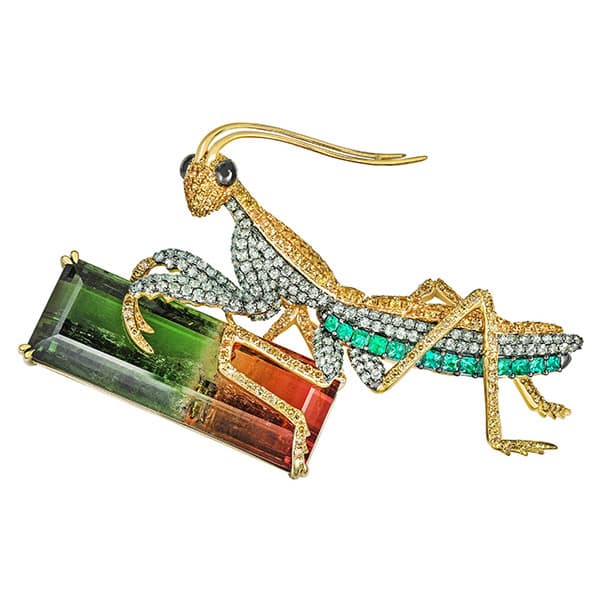
The most theatrical of the editors’ picks was Nelson Jewellery’s praying mantis piece, crowned Best Statement Piece and anchored by a 93.68 ct. tourmaline. It is the sort of object that stops a passerby mid-step, because the appeal is not just the size of the center stone but the decision to build a jewel around an insect form and let the gemstone carry the drama. That combination signals a stronger appetite for figurative design, especially pieces that blur the line between wearable jewel and miniature sculpture.
For retailers, that kind of object serves a very different purpose from a straightforward diamond solitaire or halo ring. It creates a talking point in the case, and it proves that high-end clients are still open to one-of-a-kind craftsmanship when the design feels collected rather than conventional. In a market where many offerings can look interchangeable, a mantis with a nearly 94-carat tourmaline is the opposite of easy inventory.
Trésor’s Desir earrings show that color still sells when the making is precise
Trésor’s Desir earrings bring the same appetite for visual energy down to a more wearable scale. Set in 18k yellow gold, the drops carry 15.23 cts. t.w. of blue, pink, orange, and yellow sapphires, and their $4,950 price places them far below the six-figure jewelry that often dominates awards chatter. That contrast is part of the point: the trade is clearly still making room for colored gemstone jewelry that feels lively and fashion-forward without drifting into intimidation pricing.
The design also helps explain why earrings keep showing up as an important category. They sit close to the face, they move, and they can carry color more boldly than many rings or bracelets because the visual payoff is immediate. In a display case, that kind of piece gives retailers an accessible entry point into statement dressing, especially for buyers who want impact without committing to a larger diamond purchase.
Khepri Jewels’ Cartouche necklace puts fancy-color diamonds back in the luxury conversation
Khepri Jewels’ Cartouche charm fancy color diamond necklace, priced at $286,000, is the clearest signal that natural fancy-color diamonds remain a language of rarity at the top end. JCK framed the piece against a market saturated with look-alike lab-grown offerings, and that contrast is crucial. When a necklace is built around fancy-color diamonds, the value proposition is not only the sparkle, but the provenance, scarcity, and the unmistakable fact that these stones are not easily replicated in bulk.
That is why the piece matters to collectors and to retailers positioning a showcase around true luxury. Fancy-color diamonds still carry a halo of exclusivity that lab-grown stones, however bright or well-cut, cannot fully duplicate in the eyes of many high-end clients. For a fashion-conscious buyer, the Cartouche necklace signals taste that is informed by rarity rather than trend alone, and for the trade it underscores that natural color remains a powerful differentiator.
Vanessa Fernández’s Las Olas ring, and the larger winners’ board, point to a more sculptural diamond market
Vanessa Fernández’s Las Olas ring brings the story back to diamond design itself, with two pear-shape diamonds just over 2 cts. each and a $50,000 price tag. The fluid name suits the look: this is not a stiff, commercial ring built only to disappear into everyday wear, but a design that uses matched pears to create movement and presence. It sits comfortably in the same conversation as the year’s heavier statement winners, because the market is rewarding pieces that read as authored, not merely assembled.
The broader 2026 winners package reinforces that shift. Rahaminov’s Alexandra necklace took Best Statement Piece over $50,000 at $725,000, while Pompos won Best Colored Stone Jewelry over $30,000 with an Australian black opal ring priced at $150,000. That follows a recent run in which Rahaminov took the 2024 grand prize with a Celestial Diamond lariat featuring 40+ carats of white and yellow pear-shape diamonds, and Norman Silverman won the 2025 grand prize with a yellow diamond collar. The trade is clearly leaning toward bold color, strong silhouettes, and high craftsmanship, which means the next wave of standout diamond jewelry is likely to be less cautious, more collectible, and far more visible from across the room.
This article was produced by Prism’s automated news system from verified source data, official records, and press releases, then run through automated quality and moderation checks before publishing. The system is built and supervised by the people who set the standards it runs under. Read our full AI policy.
Did this article answer your question?