MSU awarded $3M to develop AI camera imaging to detect diamond defects
MSU won a $3 million NSF Future Manufacturing grant to build AI and multi-camera imaging that spots defects during lab-grown diamond synthesis.
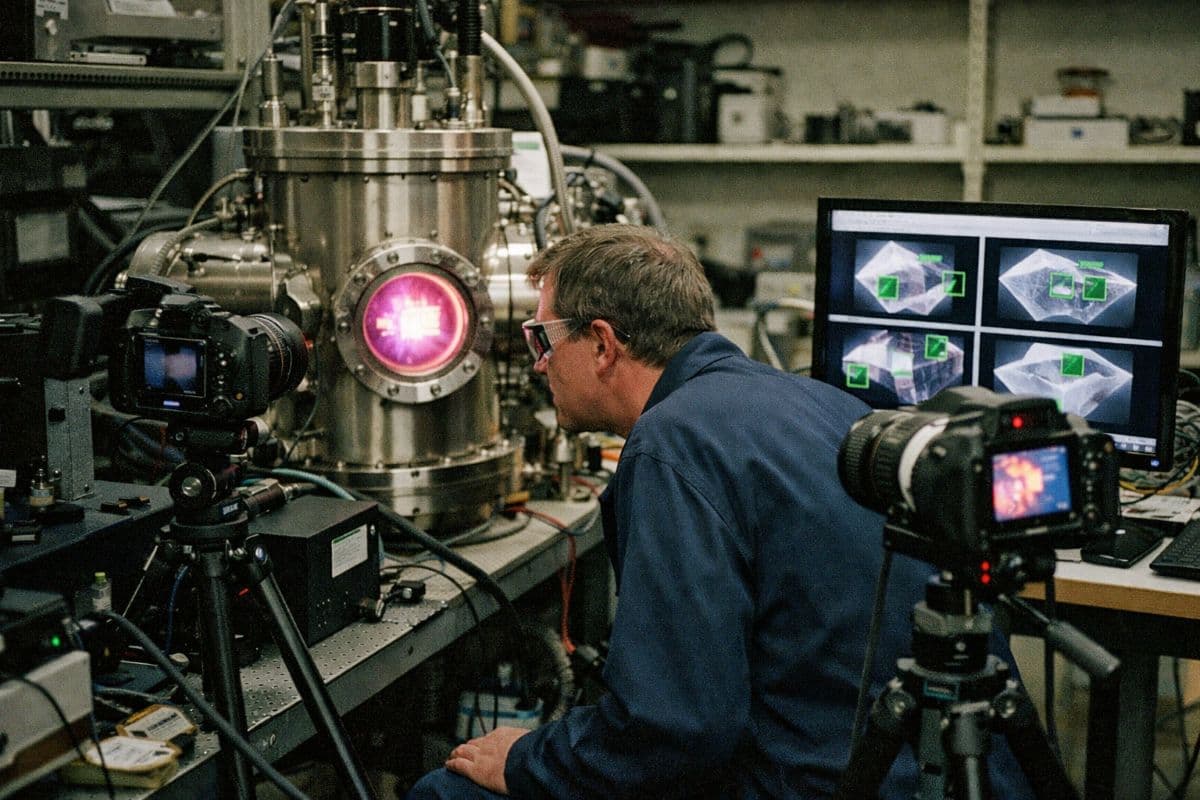
Michigan State University researchers received a $3 million National Science Foundation award from the NSF’s Future Manufacturing program to develop camera-based and artificial-intelligence systems that spot defects during laboratory synthesis of diamond material. The project aims to tighten process control, improve yield and material quality, and move toward automated AI control of growth parameters.
The effort pairs MSU with Fraunhofer USA Center Midwest and Fraunhofer USA Center Mid-Atlantic, with the Mid-Atlantic team in Maryland assigned to analyze imaging data with AI. “What makes it even more frustrating is that this challenging growth process takes a long time, which means that once we are aware that a defect is present, it’s too late to go back and remake the diamond,” said Anthony. “That’s the big challenge: to grow a high-quality diamond material with as few defects as possible by understanding how they form in the first place.”
Technically, the project will fuse three imaging modalities during diamond growth: a digital single-lens reflex camera, a hyperspectral imaging systems camera, and a forward-looking infrared camera. The images from these three cameras are analyzed using AI by the team at Fraunhofer USA Center Mid-Atlantic in Maryland to help the MSU team examine the growth of the diamond material layer by layer to identify if and where any defects appear.
Using layer-by-layer imaging and AI, the team intends to predict the spatial and temporal emergence of defects so processing parameters can be tuned during growth rather than after the fact. “Using this information, we can try to predict where and when the defects are forming so that we can tune the process during the growth and prevent these imperfections from forming,” said Anthony. “In the future, we would like this to become more automated as AI can set and adjust the parameters for growing the diamond material we want.”

The teams are using artificial intelligence to grow high-quality diamond in labs, which could be the key to the future of semiconductor manufacturing and advancing workforce talent in the U.S. The award includes explicit workforce development funding for K-12 summer camp opportunities, training for students at Washtenaw Community College in Ann Arbor, outreach to adults already in the workforce, and education for undergraduate and graduate students at MSU, with the stated goal of increasing the number of people in the semiconductor talent pipeline.
The NSF award was reported on February 23, 2026, and the project’s combination of DSLR, hyperspectral and FLIR imaging with Fraunhofer-led AI analysis sets a concrete path toward reducing wasted growth runs and improving the material quality of lab-grown diamonds used in advanced manufacturing.
Know something we missed? Have a correction or additional information?
Submit a Tip