Beyoncé's 24-Carat Emerald-Cut Engagement Ring: History, Design, and the Story Behind the $5 Million Stone
Beyoncé's 24-carat emerald-cut ring is a $5 million masterclass in scale and restraint, yet its designer's most revealing choice may be the one she makes every day: not wearing it.
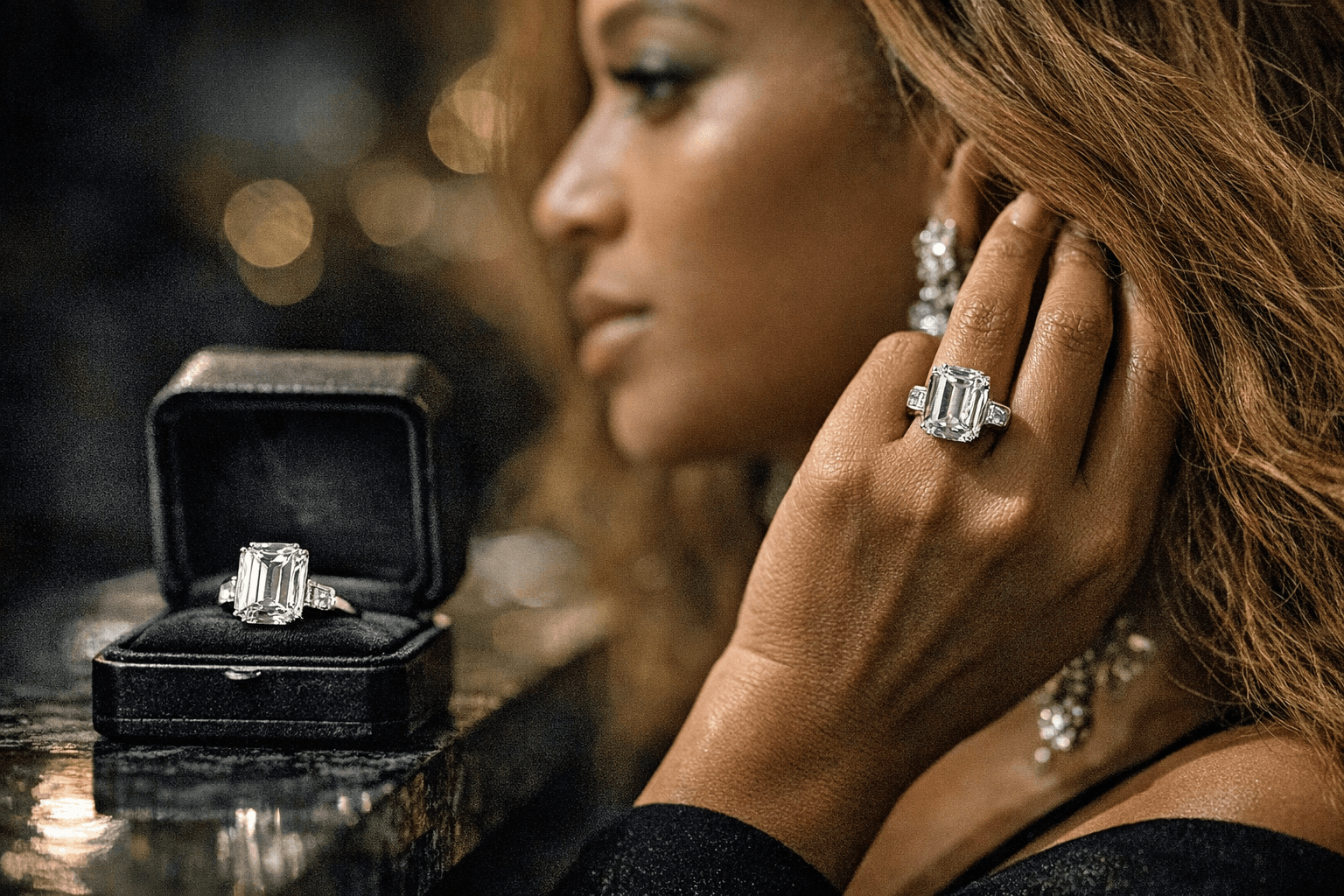
Twenty-four carats sits on a finger very differently than it sounds on paper. It dominates. It tilts. It catches light from across a room, draws eyes before words are exchanged, and makes the hand it occupies feel both powerful and conspicuous in equal measure. Beyoncé's engagement ring features an emerald-cut diamond set on a split-shank pavé band and is estimated to be worth about $5 million. Those three design decisions, the cut, the band architecture, and the total weight, are not accidental flourishes. They are a considered set of choices that define exactly why this ring became a cultural landmark, and why its owner rarely puts it on.
The Design Logic of an Emerald Cut at Scale
The emerald cut is the jeweler's choice for stones with exceptional clarity, and there is a structural reason for that. The emerald cut diamond is renowned for its elegant, elongated form and crisp lines, which enhance the clarity and brilliance of the stone. Unlike the brilliant round, which uses dozens of triangular facets to scatter light into prismatic flash, the emerald cut deploys long, rectangular step facets that create what gemologists describe as a "hall of mirrors" effect: deep, still flashes of reflected light rather than surface sparkle. At 24 carats, those flashes are immense. The stone's elongated footprint also means it covers significantly more finger real estate than a round of equivalent weight, creating the visual impression of something even larger than its carat count would suggest.
The ring's center diamond is set on a platinum band, a rare and precious choice that complements the stone's cool, icy brilliance. The split-shank design divides the band into two parts as it approaches the setting, framing the center stone from below and drawing the eye upward toward the diamond itself. Pavé diamonds line both shanks, adding lateral sparkle that reinforces the stone's presence without competing with it. The net effect is that a ring which already reads enormous in person reads even more dramatically in photographs, the split-shank creating shadow and dimension while the pavé fragments of light anchor the eye on the center stone.
According to reports, Beyoncé's diamond is a Type IIa stone, a rare and precious category that represents only a tiny fraction of all diamonds mined. Type IIa diamonds contain virtually no nitrogen impurities, which means their optical transmission is superior, they absorb less light, and they appear exceptionally white and brilliant even at large sizes. At 24 carats, a Type IIa stone isn't just expensive; it is genuinely rare in a way that makes price secondary.
The Jeweler Behind the Ring
Lorraine Schwartz is an American bespoke high jewelry designer who has created pieces for a host of famous female celebrities including Beyoncé, Jennifer Lopez, and Kim Kardashian. But her relationship with Beyoncé runs deeper than a single commission. The two first collaborated in 2003, when Schwartz designed the earrings Beyoncé wore on her first solo album cover, "Dangerously in Love." Beyoncé has played the role of client and muse throughout Schwartz's career, with Schwartz creating much of her red carpet and editorial jewelry and sharing diamond and gemstone knowledge along the way.
Schwartz has also designed engagement rings for Blake Lively (a light pink oval diamond) and Kim Kardashian (a 15-carat cushion-cut diamond), cementing her reputation for gobstopper-sized engagement rings as a signature. In the 2006 Beyoncé song "Upgrade U" and the 2023 song "My House," Lorraine Schwartz is mentioned by name, a cultural acknowledgment that signals something rarer than any carat count: a jeweler who has become part of an artist's personal mythology.
In 2021, Beyoncé and Schwartz extended their collaboration into philanthropy, announcing The Beyoncé Knowles-Carter x Lorraine Schwartz GIA Scholarship, which sponsors tuition and expenses for two Black students at the Gemological Institute of America. Schwartz described the initiative as "an homage to Beyoncé for the inspiration she's given me throughout my career," a statement that captures what makes this designer-client relationship unusual: it is genuinely reciprocal.
The Ring's Quiet Origin Story
Beyoncé and Jay-Z first started dating sometime between 2000 and 2001, and the couple dated for about seven years before tying the knot in a secret ceremony in New York on April 4, 2008. The wedding was attended by only 40 guests, including Kelly Rowland and Chris Martin. The engagement itself was kept so private that, by most accounts, it was confirmed only after the wedding was already done.
The number four runs through the couple's story with an almost architectural precision. Beyoncé's birthday is September 4th, Jay-Z's is December 4th, and they married on April 4th. The couple chose matching Roman numeral IV tattoos on their ring fingers in lieu of conventional wedding bands. It is a detail that reframes the entire conversation around the $5 million ring: the piece Jay-Z commissioned from Schwartz is the grand gesture, but the tattoo is the daily commitment.
Why the World's Most Famous Engagement Ring Rarely Leaves the Vault
This is where the design conversation turns practical. Beyoncé has long been reported to favor not wearing the showpiece regularly, instead wearing a simple band over her Roman numeral IV tattoo most of the time. For anyone who has held a stone above 10 carats, this decision makes immediate physical sense.
A ring of this scale presents real challenges as an everyday object. The sheer weight of 24 carats shifts the ring's balance, making it prone to rotating on the finger so the stone tilts toward the palm. An emerald cut's flat table and open facet structure also makes it a highly efficient dust and soap trap; the step facets lose their dramatic depth the moment the stone clouds even slightly. Security is a separate concern entirely: a piece valued at $5 million cannot be worn the way one wears a $2,000 ring, without conscious attention to every environment it enters. Schwartz's split-shank pavé setting, while magnificent, also places dozens of small stones in a setting that requires regular professional inspection to ensure prongs haven't loosened.
The practical reality is that rings designed for maximum visual impact are often designed for maximum visual impact specifically: for photographs, for red carpets, for moments when the image is the point. The IV tattoo Beyoncé wears daily is, in many ways, the more radical jewelry choice: permanent, private, and entirely unmerchandisable.
Translating 24 Carats Into a Ring You Can Actually Wear
Understanding what makes Beyoncé's ring so visually commanding is also a blueprint for achieving a similar effect at a fraction of the cost and at a scale that suits daily life.
The emerald cut itself is the single most impactful choice you can replicate. Its elongated footprint reads larger on the finger than equivalent-weight stones in round or cushion cuts, meaning a well-proportioned 2-carat emerald cut can command attention that a round of the same weight cannot. Lab-grown emerald-cut diamonds now offer Type IIa-equivalent optical properties at roughly 80 to 90 percent less than their mined counterparts, making it possible to access the cut's characteristic clarity and depth at significantly higher carat weights for the same budget.
The split-shank pavé band is the second design element worth adopting. The architectural bifurcation of the shank creates visual complexity that frames and elevates any center stone, making a modest diamond appear more considered and custom. A thin pavé split-shank on a 1.5-carat emerald cut will read with considerably more authority than the same stone set in a plain solitaire.
For those who want to maximize a smaller stone's apparent size:
- A step-cut halo, using baguette or emerald-cut accent stones rather than rounds, maintains the geometric vocabulary of the emerald cut and extends the stone's visual footprint without disrupting its clean lines.
- A bezel-set halo offers a more modern alternative; the continuous metal border around the center stone adds perceived size while also providing a security advantage over prong settings.
- Elongated radiant and elongated cushion cuts occupy similar finger territory to the emerald cut and offer more brilliance for buyers who want the scale without the emerald's requirement for near-flawless clarity.
The deeper design lesson in Beyoncé's ring is not really about carats. It is about the deliberate alignment of stone, setting, and scale toward a single visual intention. Jay-Z and Lorraine Schwartz built a ring designed to be unforgettable in a single glance. The IV tattoo was always going to handle the rest.
This article was produced by Prism’s automated news system from verified source data, official records, and press releases, then run through automated quality and moderation checks before publishing. The system is built and supervised by the people who set the standards it runs under. Read our full AI policy.
Did this article answer your question?