How to find the right engagement ring size for a perfect fit
The right fit is won at the knuckle, not the base of the finger. Sizing beads, hinged shanks and the right band width can prevent spinning, pinching and costly resizing.
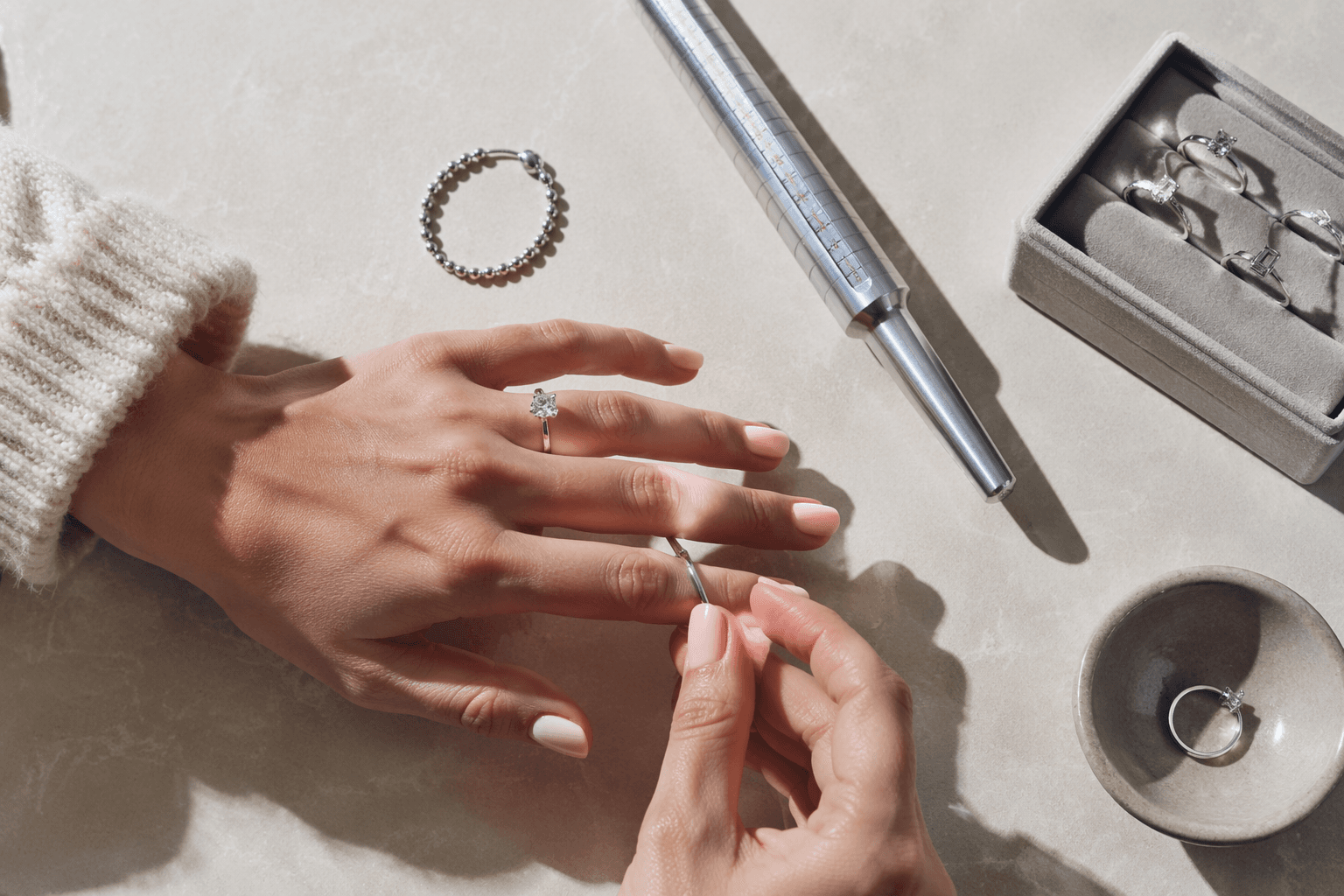
A ring that looks right on a finger-sized sketch can catch at the knuckle, spin at the base, or need an awkward resize before the proposal is over. Paper and string methods miss the difference between where a ring sits and where it has to pass first.
Start with the knuckle, not the base
A properly fitted ring should slide over the knuckle with a little friction, then sit securely without rotating so much that it feels unstable. The Knot’s sizing guidance treats free spinning and knuckle resistance as the same problem: the fit is wrong even if the number looks right on paper.
For rings that turn too easily, jewelers often reach for sizing balls, sometimes called shots, inside the shank. GIA puts the simplest version of that fix at two small beads soldered onto the inside of the band when the finger is 1.5 sizes or more larger than the area where the ring actually rests. One part of the finger may need a larger opening, while another part needs a tighter seat.
Measure the way jewelers do
Paper strips and string loops remain tempting because they are quick, but they are unreliable. String can stretch, paper can be damaged, and humidity or temperature can make paper shrink and curl. More important, those shortcuts ignore the knuckle altogether, which is why an apparently exact measurement can still fail when the ring has to go on for the first time.
Jewelers use finger-sizing gauges marked in whole and half sizes, and that detail matters more than it sounds. GIA’s narrow-finger gauge is meant for narrow rings such as solitaires or bands up to 4 mm wide, which means band width belongs in the sizing conversation from the start. A broader band can change the way a ring feels on the hand and affects both comfort and durability, a point The Knot also makes.
If you are buying a surprise proposal ring, measure an existing ring by its interior diameter in millimeters. Tiffany’s size guide recommends that approach when the wearer is not available for an in-person fitting, and it gives you a practical way to compare a known ring against a size chart without guessing from memory or a borrowed string. That method is especially useful when the goal is to preserve the surprise while still getting close enough to avoid a costly first resize.
The ring itself can complicate the measurement
Sizing is not only about the finger. GIA specifies that if a mounted gemstone’s culet protrudes into the finger hole, a grooved sizing stick or mandrel must be used so the stone is not damaged during measurement.
Some rings resize more easily than others. Most rings can be resized up or down by about a size or two, GIA says, but larger changes may be difficult depending on the style. Rings with pavé or channel settings are harder to alter cleanly, and styles with diamonds running all the way around the band can be especially stubborn.
The fixes jewelers actually use
When the issue is a ring that spins but is otherwise close, sizing beads are the cleanest low-impact fix. When the issue is a knuckle that is significantly larger than the finger’s base, a hinged shank can be the better answer because it opens to pass over the joint and then closes securely once it is on. In The Knot’s description, hinged engagement rings open wider, sometimes completely, to fit over larger knuckles without relying on brute-force sizing alone.
GIA sets a technical threshold: if the finger is 1.5 sizes or more larger than the area where the ring sits, two small interior beads are the simplest anti-turning fix.
Buy with the resize in mind
Ring-size advice belongs early in the conversation, alongside style and metal, because the setting you choose affects how much adjustment is realistic later. GIA favors buying slightly larger rather than too small, since sizing down is easier than adding metal and rebuilding structure.
GIA’s older consumer guidance placed more slender or fine-boned wearers roughly in the 4 1/2 to 5 1/2 range and heavier, larger-boned or taller wearers in the 6 1/2 to 7 1/2 range. Those numbers are only a starting point, not a substitute for measuring.
This article was produced by Prism’s automated news system from verified source data, official records, and press releases, then run through automated quality and moderation checks before publishing. The system is built and supervised by the people who set the standards it runs under. Read our full AI policy.
Know something we missed? Have a correction or additional information?
Submit a Tip