Ancient torcs show everyday jewelry was never just for ceremony
Ancient torcs were not only for display. Their rigid, collar-like form and worn edges show how everyday jewelry could be sculptural, symbolic, and practical at once.
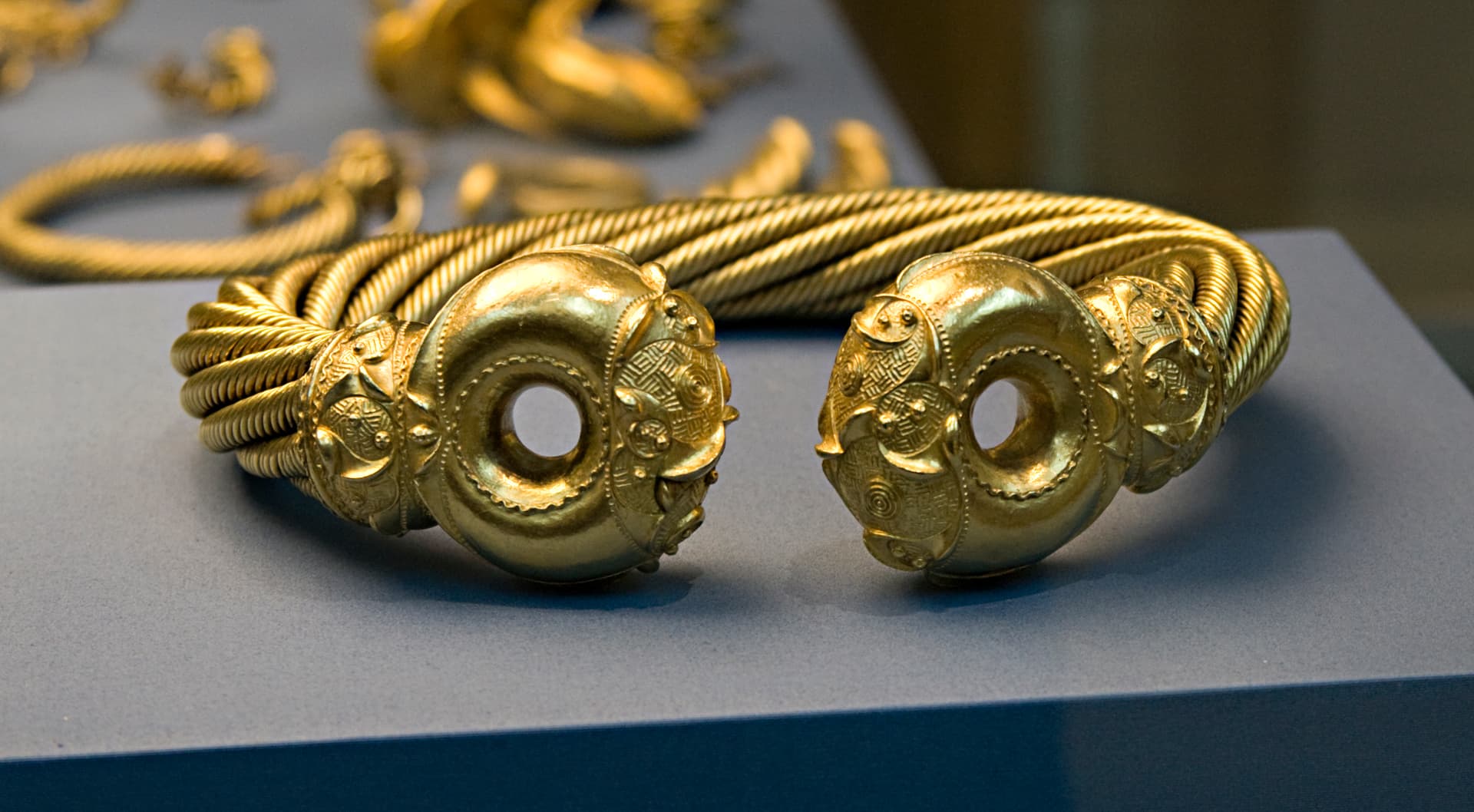
The British Museum distinguishes between decorative torcs likely reserved for special occasions and simpler designs that may have been intended for regular wear. The rigid neck ring still reads clearly in today’s collar necklaces and open chokers.
A neck ring with purpose
A torc is a rigid neck ring, usually made of metal and often open at the front. It sits visibly on the body rather than hanging from it, which gives it a very different logic from a pendant on a chain. The form reads as a piece of architecture for the neck: solid, deliberate, and meant to shape the silhouette as much as decorate it.
The Snettisham Great Torc and what it weighs into the room
The Snettisham Great Torc is the form at its most commanding. Found in Snettisham, UK, it is made of electrum, a gold-silver alloy, and the British Museum dates it to about 150 BC to 50 BC. The museum’s object record places its production in the same range and notes exhibition history in London in 2015 to 2016 and in Edinburgh in 2016.
Google Arts & Culture dates the Great Torc from Snettisham to the first half of the first century BC and gives its material as just over a kilogram of gold alloy. Other catalog records give it a diameter of about 20 cm, a weight of 1 kg, a creation date of 100 to 75 BC, and discovery in 1950. Across those catalog records, it remains a substantial, highly worked object.
Because it is open at the front and rigid in form, the torc behaves less like a dangling ornament and more like an ancient collar. The same visual principle appears in modern pieces built as a clean ring of metal close to the throat.
Everyday jewelry was never a contradiction
Practicality and symbolism were not opposites. A simpler torc could still signal rank, tribe, prosperity, or taste while remaining wearable enough for ordinary use. The same balancing act makes a strong collar necklace work now: it can be the single decisive piece in an outfit and still feel appropriate with a knit, a shirt, or a plain dress.
Torcs are large neck rings usually made of metal. Constant flexing can lead to broken rings, which is why so many surviving examples show wear and tear. Torcs were handled, taken on and off, and lived with. They were physical things that had to survive contact with the body.
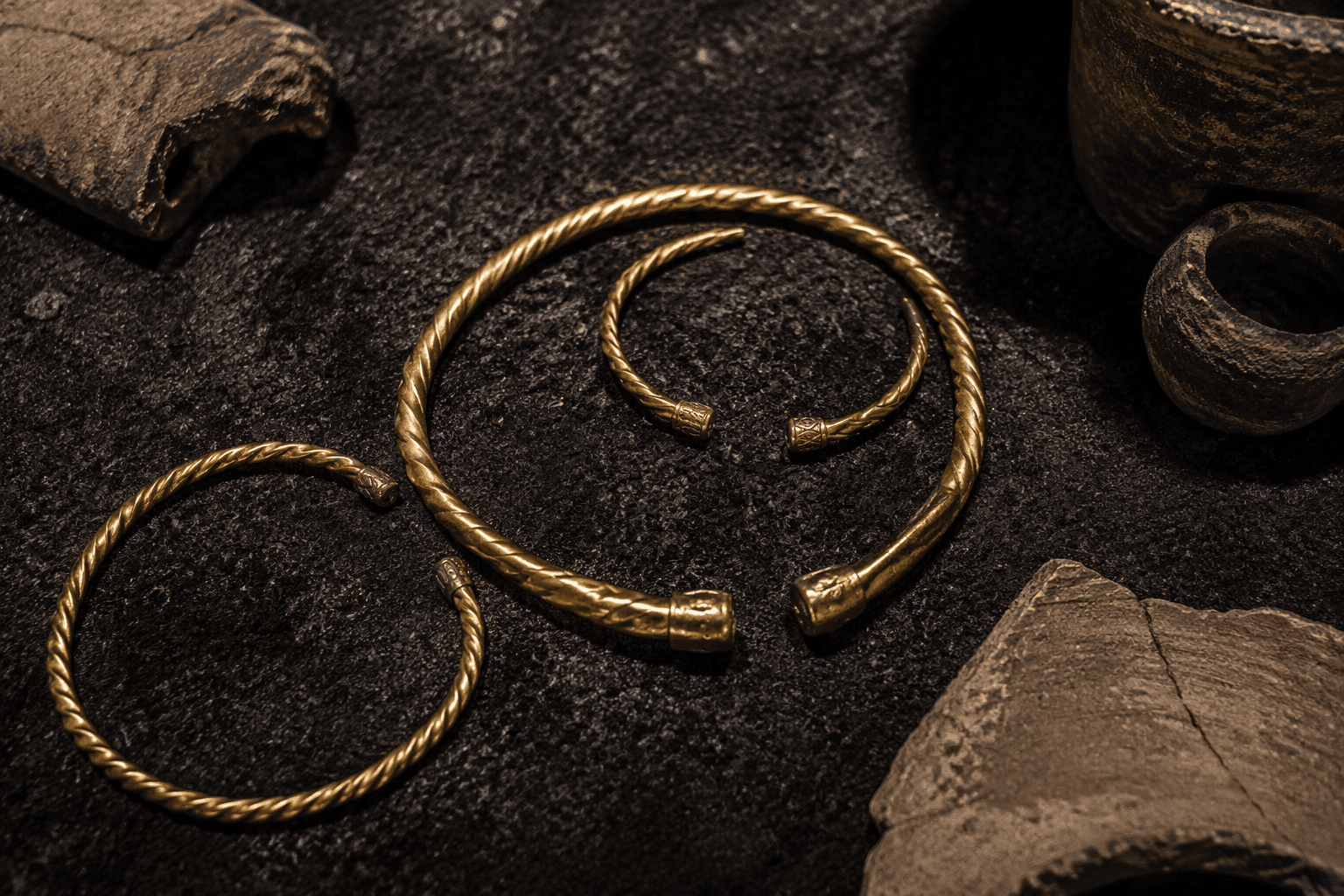
A torc with a simplified profile, a clean opening, and enough rigidity to hold shape anticipates the pieces people reach for now when they want one strong gesture instead of several stacked ones. It is the ancestor of the polished gold collar, the sculptural cuff-necklace, and the kind of open choker that can anchor an entire wardrobe without screaming for attention.
The Iron Age context behind the modern myth
The torc’s association with Celtic identity is powerful, but the historical picture is broader than the popular image suggests. British Museum exhibition material places the Iron Age in Britain between about 800 BC and AD 43, ending with the Roman invasion. The ancient Greeks and Romans called the Iron Age peoples of western Europe “Celts,” a label that flattened a much more varied world.
Farley’s 2016 Society of Jewellery Historians lecture, titled “The Torc in Iron Age Europe,” treated the torc as a symbol tied to the ancient Celts while stressing that Greek and Roman authors turned it into a single trope for a culture that was actually fragmented and complex. A torc is not just shorthand for “Celtic” ornament; it is a specific form that traveled through different communities, with different meanings in different hands.
Why scholars still return to the torc
A Museums Association profile published on June 30, 2016, links Farley to Iron Age collections work and the British Museum’s “Celts: art and identity” exhibition. More recently, Internet Archaeology published “The Pulborough Gold Torc: a 4th to 3rd century BCE artefact of European significance” in 2024. Torcs remain central to archaeological and curatorial discussion as evidence for how people understood status, craftsmanship, and adornment across Europe.
The form is bold, but not inherently theatrical. It can be monumental, as the Snettisham Great Torc is monumental, or pared back enough to live in the everyday wardrobe. The difference lies in weight, opening, finish, and how closely the piece is meant to sit against the neck.
What the torc teaches modern dressing
The best everyday statement jewelry follows the torc’s logic: strong shape, clear closure, and enough restraint to wear more than once a year. A piece like that does not need many companions. It asks for a clean neckline and a simple fabric.
This article was produced by Prism’s automated news system from verified source data, official records, and press releases, then run through automated quality and moderation checks before publishing. The system is built and supervised by the people who set the standards it runs under. Read our full AI policy.
Did this article answer your question?