The Ultimate Guide to Permanent Jewelry: Get Zapped Today
Welded shut, worn forever: permanent jewelry turns the simple act of closing a bracelet into a ritual, and the clasp-free result is redefining how we think about everyday adornment.
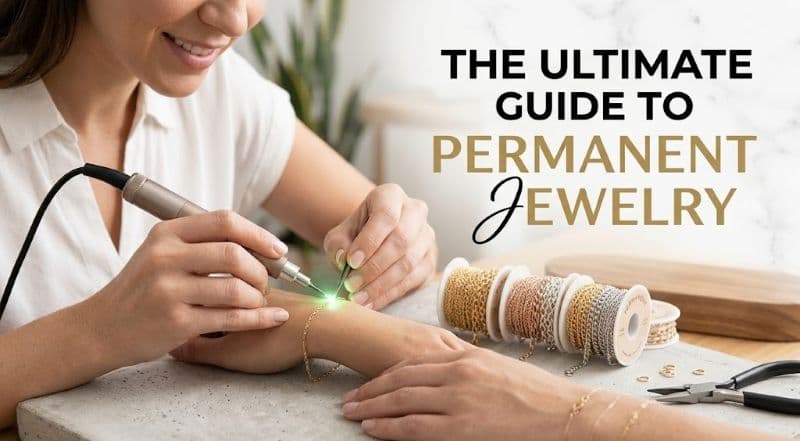
There are no clasps here. No lobster claw, no toggle, no hook hunting along your wrist in the dark. A jeweler uses a specialized arc welding technique to fuse the chain links together, creating a seamless, continuous loop, and the result is clasp-free jewelry designed to be worn continuously, becoming a part of your everyday life. That is the essential premise of permanent jewelry, and it is far more compelling than it sounds.
What Permanent Jewelry Actually Is
Permanent jewelry is a chain, usually a bracelet, anklet, or necklace, that is custom-fitted to your body and welded shut using a small pulse welder instead of a traditional clasp. It is a bracelet designed to stay on through workouts, showers, beach days, and sleep. The category has expanded to include anklets and necklaces with equal enthusiasm, though the wrist remains the most popular canvas. These welded chains are simple, streamlined, and meant to be worn all day, every day, without the inconvenience of fasteners or other closures.
The emotional dimension is just as important as the physical one. It has become the modern evolution of friendship bracelets and couple's gifts, from permanent jewelry for couples celebrating anniversaries to permanent friendship bracelets symbolizing unbreakable bonds. In a category often dominated by trend cycles, this is jewelry with a story baked into the structure itself.
The Welding Process: What to Expect
The actual "getting zapped" experience is both more ceremonial and less dramatic than it sounds. A high-tech micro-welder creates a tiny spark to fuse the metal, and a leather patch is typically placed against the skin for protection. The process is so quick and safe that some studios have clients aged 6 months to 95 years. The jeweler measures the chain directly on your body before welding, so fit is precise rather than approximate. You choose a fine chain bracelet, anklet, necklace, or ring; the jeweller measures it directly on your body and closes it with a tiny spark from a welding machine. There is no clasp.
The weld itself happens at the jump ring, positioned away from the skin, which is why the sensation is nothing more than a subtle warmth. The appointment is brief, but the ritual of it, sitting still while a jeweler permanently closes a piece onto your wrist, gives the whole experience a weight that buying off a shelf never quite matches.
Metals and Chain Types
The permanent jewelry aesthetic aligns with the 'quiet luxury' movement, with simple, high-quality chains that elevate everyday wear without being overpowering. The metals most commonly used are solid gold (yellow and rose), gold vermeil, and sterling silver, each with its own trade-offs for continuous wear.
Solid gold is the gold standard, literally: it resists tarnish, plays well with skin, and ages gracefully. Sterling silver is a more accessible entry point, but it requires more attention. Sterling silver can become tarnished after being exposed to certain chemicals like chlorine or those found in cleaning materials, and salty air, humidity, even the oils in your skin can take the shine off a silver chain over time.
Chain architecture matters as much as the metal. Men often opt for thicker curb or box chains, while women may prefer delicate cable chains or layered stacks, and the style is entirely personal. A fine cable chain reads almost like a drawn line on the skin; a box chain has a satisfying geometric solidity; a curb chain carries just enough visual weight to anchor a stack without overwhelming it.
Why This Trend Has Legs
Permanent jewelry first started gaining popularity in the early 2010s with high-end designers offering welded bracelets in New York and Los Angeles. The trend gained traction through influencers and celebrities who showcased their welded-on pieces as a symbol of love and connection, and by the late 2010s and early 2020s, permanent jewelry had gone mainstream.
The permanent jewelry social media trend has made this practice mainstream, with influencers on TikTok and Instagram showcasing the satisfying welding process and the chic result, driving searches for permanent jewelry near me and permanent jewelry installation. The content writes itself: a close-up of a tiny blue arc of light, a wrist emerging from the jeweler's hands, an uninterrupted line of gold. It is inherently photogenic, which has accelerated its reach far beyond what editorial coverage alone ever could.
The minimalist underpinning of the trend also gives it durability. In contrast to statement jewelry that demands an outfit to support it, a welded chain exists at the intersection of presence and invisibility. It is always on, but it never shouts.
Layering and Styling
Permanent jewelry is not a one-and-done proposition for most wearers. Permanent bracelets are the most searched-for and popular item, ranging from delicate cable chains to bold permanent jewelry layering stacks. Layering two welded bracelets on the same wrist requires some forethought: varying chain widths prevents tangling, and alternating metals, say, yellow gold against sterling silver, creates contrast without chaos.
Mixing chain types is where the real craft lies. A box chain and a fine cable chain worn together create a textural conversation that a matching set never achieves. Anklets follow the same logic, particularly when layered at different lengths for visual movement. Necklaces require the most planning, since welded lengths cannot be adjusted after the fact; knowing your preferred layering formula before you sit in the jeweler's chair is essential.
The Practical Realities: Pros and Cons
The appeal of permanent jewelry is inseparable from its commitment, which is also its primary complication. On the positive side:
- No lost earrings, no clasps that require two hands and good lighting
- Custom fit means the piece sits exactly where you want it, every time
- The sentimental symbolism is structural, not decorative
- Low visual maintenance: clean lines that work with any wardrobe
The considerations are equally real:
- Permanent jewelry can absolutely be removed, but it just requires scissors or a quick snip from a jeweler. It is not reversible in the sense that a clasp is; removal means cutting, and reattachment requires another welding appointment.
- Medical imaging raises a practical flag. MRI machines require removal of all metal jewelry, which means a trip to the jeweler before the scan and another welding session after.
- Airport security is generally uncomplicated with fine-gauge chains, which do not register on standard detectors, but this varies by equipment and country.
- The closest alternative is a fine solid-gold bracelet with a secure clasp that you wear every day and only remove when you genuinely need to, offering the same effortless always-on feel without losing flexibility. That comparison is worth sitting with before committing.
Care for Continuous Wear
Modern-day permanent jewelry does not need much maintenance, despite being on 24/7. With proper care, it can be beautiful years later: clean with Dawn dish soap, warm water, and a soft bristle toothbrush frequently, and dry with a soft cloth. For gold pieces, this routine is typically sufficient. Sterling silver may benefit from occasional polishing with a dedicated silver cloth to counter tarnish from sweat, chlorine, and humidity.
Avoid ultrasonic cleaners, which can stress the welded jump ring over time, and keep harsh chemical exposure, including bleach-based cleaning products, away from any fine chain. If you swim in chlorinated water regularly, gold is meaningfully more resilient than silver.
Insurance and Investment Value
Fine permanent jewelry, particularly solid gold pieces, represents a real material investment that deserves protection. Comprehensive jewelry insurance can provide protection against loss, theft, damage, disappearance and provide repair or replacement of jewelry of same kind and quality, and unlike homeowners insurance, dedicated jewelry insurance may offer broader and more tailored protection. Given that a welded piece cannot be slipped off and stored away, it faces more daily exposure than a piece kept in a jewelry box, which makes coverage a sensible consideration rather than an afterthought.
For Retailers and Buyers Alike
Permanent jewelry occupies a unique commercial space: it is an experience as much as a product. Pop-up welding events at markets, weddings, and boutiques have proven that the appointment itself is part of the draw. For retailers, adding permanent jewelry services requires trained staff and the right micro-welding equipment, but the payoff is a deeply loyal customer whose purchase is, by design, visible every single day.
For the buyer, the question is less "is permanent jewelry worth it?" and more "what do I want this piece to mean?" When the answer is clear, the weld is just the beginning.
This article was produced by Prism’s automated news system from verified source data, official records, and press releases, then run through automated quality and moderation checks before publishing. The system is built and supervised by the people who set the standards it runs under. Read our full AI policy.
Did this article answer your question?